Implements & Attachments
Post Hole Digger Buying Guide: Auger Size and HP
A 3 point post hole digger can set a long fence line in a day, but only if the auger, gearbox and tractor match. Here is the auger size for each post, the hp and hitch you need, and how to dig safely.
IN THIS GUIDE JUMP TO A SECTION +
As an Amazon Associate, TractorFolk earns from qualifying purchases. Links to products on this page may earn us a commission at no cost to you.
Picture 40 fence posts along a property line. By hand, that is a day of prying clay and hauling dirt out of 40 holes. With a 3 point post hole digger on the tractor, each hole takes a few minutes.
Your job shrinks to keeping the auger plumb and the PTO slow.
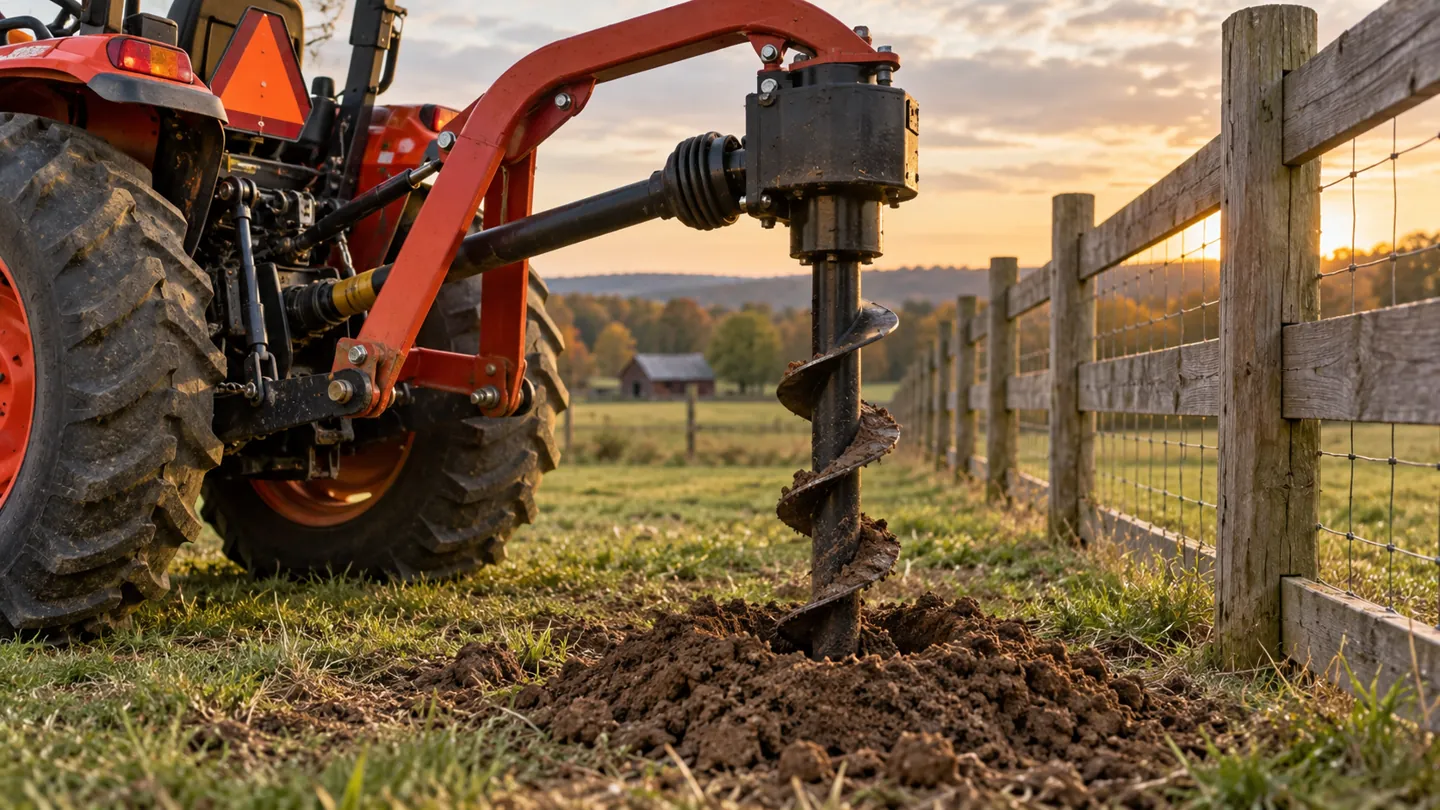
The digger is a PTO driven gearbox, boom and auger that hangs on your 3 point hitch. It digs fast in soft ground and stalls hard in rock. This guide covers the auger size each post needs, which tractors can run one, and how to dig without snapping bolts or getting hurt.
The short version
- A 9 inch auger suits most nominal 4 inch wood line posts. Corner and brace posts usually want 12 inches or more.
- Sub compact tractors need a short, light digger with a 30 inch auger. Kubota’s BX80 sheet lists a 45 inch digging depth for the BX1880, BX2380 and BX2680.
- Most diggers use a shear bolt as the weak link. Use only the bolt the manufacturer specifies, and keep spares.
- Engage the PTO at idle. Keep bystanders at least 20 feet away while the auger turns.
- Steel T posts need no hole. Drive them with a post driver.
How a 3 point post hole digger works
A 3 point digger turns your 540 rpm PTO into slow, high torque rotation at the auger. A driveline runs from the tractor’s PTO stub to a gearbox on the digger’s frame. The gearbox drops the speed and points the power straight down.
The frame hangs from the lower links and top link of your hitch. The boom is the tube that carries the gearbox out over the hole. It usually has several mounting positions, so you can shift the auger toward or away from the tractor.
The gearbox is the part that costs money. Worksaver’s Model 720 lists a 3.18:1 ratio, a 2 inch output shaft, tapered roller bearings and a 5 year gearbox warranty. Its lighter Model 500 and sub compact Model 300 list a 3:1 ratio.
Land Pride backs its PD25 and PD35 gearboxes for 5 years and its small PD10 for 3 years. A 2 inch output shaft is the common size across these brands, which matters when you shop for augers later.
Down pressure: who does the pushing
On a basic digger, the weight of the auger and gearbox does the pushing. You lower the hitch, and the auger point screws itself into the ground. There is no hydraulic force pressing down.
That is why a slow drop matters. A fast drop lets the auger bury itself and pack the flights with dirt before it has cut anything.
Some makers sell a hydraulic down force kit for hard ground. Land Pride lists one as an option on its PD series.
Worksaver says its DFK kits for the Models 500 and 720 are not designed for compact tractors under 40 hp. A kit helps only when your tractor has the weight to hold the digger down, and most sub compacts do not.
What size auger for fence posts
For most wood posts, pick an auger about two to three times the post’s width. That means 9 inches for a nominal 4 inch post. Go to 12 inches for larger posts, or when you want room to plumb the post and tamp around it.
Owners commonly call 9 inch the most common auger sold. They also say a 12 inch hole is easier to plumb and backfill, at the cost of more torque and more fill. The table turns that rule of thumb into numbers.
| Post type | Typical auger | Notes |
|---|---|---|
| Wood line post, nominal 4 inch | 9 inch | The common choice. Use 12 inch for more room to plumb. |
| Wood post, nominal 6 inch, or round 5 to 6 inch | 12 inch | Leaves room to tamp gravel or soil around the post. |
| Corner, gate and brace posts | 12 to 18 inch | These posts run larger and go deeper. Penn State Extension puts them about 25 percent larger in diameter than line posts. |
| Steel T post | No hole | Drive it. See the post driver section below. |
| Deck or small building footing | 9 to 12 inch | Check your local code for footing size and frost depth. |
Depth matters as much as width. Penn State Extension’s fence planning guide lists a typical line post depth of 36 inches. It says corner and gate posts are often set to 48 inches.
The diameters in the table are installer and owner rules of thumb, not an extension standard. Match your fence plan, soil and frost line.
Contact 811 a few days before you dig, even for fence posts. The service is free, and buried lines often run along property edges.
What tractor do you need for a 3 point post hole digger
You need a working 540 rpm rear PTO, a hitch that matches the digger’s category, and enough lift and weight to hold the digger. Start with horsepower.
Land Pride rates its PD10 for 15 to 30 hp, its PD25 for 25 to 55 hp and its PD35 for 30 to 75 hp. Worksaver rates its Model 300 for tractors up to 25 hp. Its Model 500 covers 20 to 35 hp and its Model 720 covers 25 to 65 hp.
Those are tractor hp ranges. Your PTO hp is lower than your engine hp. Our guide to how 540 rpm and PTO horsepower work shows how to read your tractor’s spec sheet.
Hitch category
Match the digger to your hitch. Sub compacts usually have a Category 1 or limited Category 1 hitch, and some tiny ones are Category 0.
Land Pride’s PD10 fits Category I only. Its PD25 and PD35 fit Category I or II.
Worksaver’s Model 300 is built for Cat 0 hitches with 7/8 inch pins or limited Cat 1 hitches. Our 3 point hitch categories guide explains the categories and the bushings that bridge them.
Can a sub compact run one?
Yes, if you pick a small digger and respect the limits. Kubota’s BX80 implement limitations sheet covers the BX1880, BX2380 and BX2680. It lists a post hole digger with a digging depth of 45 inches.
The sheet gives no weight limit for diggers. It does not say how the digging depth is measured.
It does warn against implements that exceed its maximums, and says failures from improper implements are not covered by the warranty. You can read the BX80 implement limitations sheet yourself.
BX owners commonly report two problems. The 3 point lift is limited, and the tractor is light, so it can lose traction when an auger grabs. A short digger with a 30 inch auger solves most of the lift problem.
John Deere’s manual for the 1 series says to check the full range of hitch travel whenever you mount a new implement. It adds that some attachments with short driveshafts need an up stop. Ask your dealer if the driveline binds at full lift.
Plan on ballast too. Worksaver tells buyers to counterbalance the tractor, and our ballast guide shows how much weight a compact needs.
If you are still shopping, see the best sub compact tractors and the tractor sizing guide.
Gearbox ratings, auger lengths and diameters
Auger length sets how deep you can dig. Gearbox rating sets how much torque the digger can pass along without damage.
Compact diggers use 30 inch augers. Heavier diggers use 42 or 48 inch augers, and all of them take extensions.
| Digger | Tractor hp | Auger length | Auger diameters | Hitch |
|---|---|---|---|---|
| Worksaver Model 300 | Up to 25 | 30 inch | 6, 9, 12 inch | Cat 0 or limited Cat 1 |
| Land Pride PD10 | 15 to 30 | 30 inch | 6 to 12 inch | Cat I |
| Worksaver Model 500 | 20 to 35 | 42 inch | 6 to 12 inch | Cat I or II |
| Land Pride PD25 | 25 to 55 | 48 inch | 6 to 24 inch | Cat I or II |
| Worksaver Model 720 | 25 to 65 | 42 inch | 6 to 24 inch | Cat I or II |
| Land Pride PD35 | 30 to 75 | 48 inch | 6 to 24 inch | Cat I or II |
Land Pride’s PD25 and PD35 manual rates the gearboxes at 55 hp and 75 hp and lists augers from 6 to 24 inches. One overseas Kubota listing caps them at 18 inches, so confirm the largest sizes with your dealer. The PD10 figures come from that same listing, since Land Pride’s own pages would not load for us.
Land Pride sells 7 inch and 14 inch auger extensions. Worksaver sells a 12 inch extension for the Models 500 and 720.
Here is some arithmetic worth doing before you buy. A 30 inch auger plus a 14 inch extension is 44 inches of auger. That is just under the BX80 sheet’s 45 inch digging depth.
A BX owner who wants 48 inch corner post holes should ask the dealer how deep that combination will actually reach.
Bobcat sells a Category 1 digger with 6, 9 and 12 inch bits. It lists a 72 inch overall length and a 140 pound operating weight.
We found no verified spec page for Titan or Field Tuff diggers. Read the manual for any digger from those brands before you trust a listing.
Heavier is not better by default. A big digger on a small tractor is hard to lift and hard to hold. A gearbox rated far above your PTO hp does not make your tractor stronger.
Shear bolt vs slip clutch: protecting the driveline
Most 3 point diggers protect themselves with a shear bolt. It is a cheap bolt designed to snap when the auger stops suddenly. Worksaver’s Models 300, 500 and 720 all list a Grade 2 shear bolt.
Land Pride lists a shear bolt on its PD10, PD25 and PD35. Its PD25 and PD35 manual describes the driveline as shear pin or radial pin protected. Bobcat puts the bolt through the input shaft.
Some systems use a slip clutch instead. A slip clutch is a torque limiter that slips under overload and resets itself. It costs more, and trade press notes that most PTO auger systems ship with shear bolts.
An auger catching a root or rock is the main danger to the machine. The auger stops, but the PTO driveline still carries momentum. The bolt breaks so the gearbox does not.
The danger to you is different. A stopped auger beside a turning shaft can still wrap clothing or a limb.
The rules for bolts are simple. Use only the shear bolts the manufacturer supplies or specifies, which is the same warning Ohio State Extension gives. A harder bolt moves the breaking point to your gearbox.
Owners often prefer Grade 2 because it breaks predictably. Buy a box of spares before the first hole.
Digging in rocky, clay and root filled soil
In bad ground, a good auger and a slow hand matter more than horsepower. Soft loam is easy. Hard clay, cobbles and roots stop an auger fast, so plan for short bites and a hand bar.
Auger types and points
Worksaver sells standard duty, heavy duty single flight and heavy duty double flight augers. All use a bolt in fish tail point.
Worksaver describes single flight augers as the choice for lighter soil free of stones and roots. Land Pride sells dirt and rock augers for its PD25 and PD35, with replaceable hardened steel teeth.
Our judgment on bits: the fishtail point is the right default for dirt and clay. It centers the auger and starts the hole cleanly.
Rock augers with replaceable teeth earn their price only where you hit stone on most holes. Replace worn points, because trade press notes that rounded points make penetration harder in hard ground.
What owners report in rock and clay
Owners commonly say rocks around an inch across just come up with the dirt. Rocks near 4 inches bind the auger and shear the bolt. Many report that a 9 inch auger handles packed gravel better than a 12 inch, because it needs less torque.
Clay packs into the flights, and the auger quits cutting. Lift the auger a few inches, let it spin clear, and go back down.
In ground that stays hard, owners often finish with a bar or hand digger. Some give up on the auger and switch to a post driver.
Hydraulic post hole augers on loaders and skid steers
A hydraulic auger runs on your loader’s auxiliary circuit instead of the PTO. Land Pride’s HD25 and HD35 manual lists 5 to 12 gpm for the smaller unit and 10 to 25 gpm for the larger. Both run at 1,500 to 3,000 psi.
Some dealer listings quote up to 3,500 psi, so plan around the manual’s lower figure. Many sub compact loaders cannot supply even the HD25’s flow, so check your tractor’s auxiliary hydraulic rating first.
The big advantage is reverse on demand, which helps with a stuck auger. The big drawback is that your loader needs the flow, and the mount adds weight to the front axle.
A separate article on hydraulic vs PTO diggers is planned. For loader basics, see our guide to front end loaders for compact tractors.
Post hole digger safety: PTO, auger and distance
A turning auger and PTO shaft will wrap loose clothing, strings and hair faster than you can react. The operator sits on the tractor, so nobody at the auger can shut it off. Treat the driveline and auger as a no go zone while they run.
Ohio State University Extension’s fact sheet on tractor mounted diggers sets clear rules. Keep bystanders at least 20 feet from the equipment while it runs.
Engage the PTO with the engine at idle. Do not lift the auger point more than 12 inches off the ground when the PTO is running.
- Never touch the implement, driveline or auger while the PTO is engaged.
- Wait for all moving parts to stop before you step off the tractor.
- Skip loose clothing, and remove strings from sweatshirts and jackets.
- Keep every shield in place, including the cover where the auger meets the gearbox output shaft.
Never use your body to steer or force the auger. If a hole drifts, lift the auger out and reset the tractor.
These rules come from real deaths. A NIOSH hosted investigation of a 2005 Iowa case found a farmer entangled at the unguarded joint between the auger and the gearbox. The tractor was still idling the next morning.
Its recommendations match the list above. Shut down the drive and engine before leaving the seat, keep everyone clear, and keep every guard on.
Read the Ohio State fact sheet on tractor mounted digger safety before your first dig. The Iowa FACE report is short and worth five minutes.
Technique: setting the auger plumb and digging in stages
Dig plumb by leveling the digger, starting slowly and working down in short bites. A crooked first inch becomes a crooked hole. Follow these steps for each post.
- Park on level ground and set the parking brake. Mark the hole with a stake or paint.
- Check the shear bolt, the driveline overlap and every shield.
- Line the auger point up over the mark. Adjust the top link and leveling so the boom stands vertical both ways.
- Drop the engine to idle and engage the PTO slowly. Then raise engine speed a little.
- Lower the hitch gently until the point bites. Let the auger pull itself in a few inches.
- Raise the auger every 12 to 18 inches to clear dirt. Let it spin at the bottom a moment to clean the hole.
- Disengage the PTO before you lift the auger from the hole. Check the depth with a tape.
The 12 to 18 inch lift pattern comes from trade press. Owners describe even shorter bites in clay, and they say speed does not help and only breaks bolts.
Kubota’s BX manual says to bring the throttle to half speed before engaging the PTO, then shift the lever slowly. Either way, the auger does its best work well below full throttle.
Getting a stuck auger out
Shut the tractor off first. Never reach for a wrench with the PTO live.
Owners commonly turn the driveline backward, not the auger, using a long pipe wrench on the shaft or a bar through the U joint. A quarter turn is often enough to break it free.
If the auger is buried deep, disconnect it from the gearbox and dig around it. The lesson owners draw is to dig in small bites and slow the drop. Hydraulic augers reverse on demand, which is why some owners switch.
Post hole digger vs post driver
Use a digger for wood posts that need a hole, and a driver for steel T posts that do not. A T post is built to be pounded in. Digging a hole for one wastes time and loosens the soil that holds it.
A hand held driver is the usual tool. A 24 inch, 12 pound T post driver from MTB is a simple option if you have more than a few posts to set. Skip it if you are only setting wood posts.
Wood posts can be driven too, and that is a judgment call. A driver works in loose ground and leaves undisturbed soil around the post.
A digger lets you backfill and tamp. That is the better bet in rocky or hard ground, where a driven post may split or stop short.
Owners with rocky ground often say a driver beats fighting an auger. There is no official standard that settles the question for wood posts.
Buying a used post hole digger: what to inspect
A used digger is often a good buy, because the wear parts are cheap and the frame is simple. The expensive parts are the gearbox and the boom. Inspect these before you pay.
- Gearbox: Spin the input shaft by hand. Feel for roughness or play, and look for oil weeping at the seals.
- Oil level: Check that the gearbox has oil, and ask what grade it uses.
- Output shaft: Look for wear, rust or a bend where the auger connects.
- Boom and yoke: Look for cracks at welds, a bent boom and worn hitch pin holes.
- Driveline: Check shields, U joints and shaft length against your tractor.
- Auger: Check the point, cutting edges and flights. A worn point is cheap to replace. A bent auger shaft is not.
- Shear bolt: Ask what size and grade the owner used. A bolt that is too strong is a red flag for a stressed gearbox.
- Hitch: Confirm the category fits yours, and ask whether bushings are included.
Also compare the model’s hp range to your PTO hp, and the auger length to your lift. Ask for the manual, or look it up by model number. More implement guides live in our implements section.
Bottom line
A 3 point digger is worth owning if you set more than a handful of wood posts. Pick the auger for your posts, usually 9 or 12 inches. Match the digger to your PTO hp, hitch category and lift.
Sub compacts can run a small digger with a 30 inch auger. Keep spare shear bolts, dig in short bites, and stay well back from the turning auger.
Frequently asked questions
What size auger should I use for a 4×4 fence post?
Most owners use a 9 inch auger for a nominal 4 inch post. A 12 inch auger gives more room to plumb and tamp. In rocky ground, a 9 inch bit needs less torque.
How much horsepower do I need for a 3 point auger?
Follow the maker’s range for your digger. Land Pride rates its PD10 for 15 to 30 hp and its PD35 for 30 to 75 hp.
Worksaver rates its Model 300 for tractors up to 25 hp. Compare against your PTO hp, not just engine hp.
Can a Kubota BX run a post hole digger?
Yes. Kubota’s BX80 sheet lists a 45 inch digging depth for the BX1880, BX2380 and BX2680. Owners report limited lift and light weight, so choose a short digger with a 30 inch auger.
Is a shear bolt or slip clutch better?
Neither wins every time. Shear bolts are cheap and predictable, but you must carry spares. A slip clutch resets itself, but it costs more, and most compact diggers ship with a shear bolt instead.
Do I need down pressure on a 3 point auger?
Not in soft soil. A down force kit helps in hard ground. Worksaver says its kits are not designed for tractors under 40 hp.
What do I do if my auger gets stuck?
Shut the tractor off. Then turn the driveline backward with a long pipe wrench, or dig around the auger and disconnect it from the gearbox. Do not run the PTO to free it.
Do T posts need a hole dug first?
No. Steel T posts are driven into the ground with a driver. A hole would only loosen the soil that holds the post.