Implements & Attachments
3 Point Hitch Categories Explained: Cat 0, Cat 1, Limited Cat 1 and Cat 2
Category 0, 1, 2 and limited Category 1 hitches differ in pin size and link spacing. Here is how to check yours, adapt between them and avoid buying the wrong implement.
IN THIS GUIDE JUMP TO A SECTION +
As an Amazon Associate, TractorFolk earns from qualifying purchases. Links to products on this page may earn us a commission at no cost to you.
You bring home a used box blade and the lower pins are too fat for your lift arms. Or the pins slide in, but the implement is 6 inches too wide for the arms to reach. The 3 point hitch categories exist so you can see that mismatch before you pay for it.
Every 3 point hitch is built to one of a few standard sizes, called categories. The category fixes the pin diameters and the distance between the lower links, and nothing else.
Match the tractor’s category to the implement’s and the two connect. Miss it and you are looking at bushings, adapters or a return trip.
Most sub compact and compact tractors use Category 1. A few garden sized machines use Category 0. John Deere’s sub compacts carry a variation called limited Category 1.
This guide covers all of them. It also covers quick hitches, top link and sway settings, and the buying mistakes that follow from mixing categories.
The short version
- Cat 0, 1, 2 and 3 differ in pin size and lower link spacing. Lower pins run 5/8, 7/8, 1 1/8 and 1 7/16 inch. Spacing runs about 20, 28, 34 and 40 inches.
- Most tractors from about 20 to 45 hp are Category 1. Cat 2 starts around 40 hp.
- Limited Category 1 has the same pins and spacing as Cat 1. It sits lower and may not raise every implement as high.
- Bushings let a smaller implement ride on a bigger hitch. Nothing easy goes the other way.
- Your operator manual lists the category. Confirm it with a tape measure before you buy.
What are 3 point hitch categories, and who sets them?
3 point hitch categories are standard hitch sizes, numbered 0 through 4. They let any maker’s implement connect to any maker’s tractor of the same category.
The dimensions come from an international standard, ISO 730. The American standards body ASABE adopted it as ANSI/ASABE AD730, in place of its older S217 standard.
The current standard covers categories 1N, 1, 2N, 2, 3N, 3, 4N and 4. The N versions are narrow variants that keep a category’s pin sizes on a tighter hitch. Category 0 is a garden tractor size from the older American tables, and most reference charts still list it.
The standard fixes where the hitch points sit and how big the pins are. It says nothing about lift capacity or implement weight.
That second point trips people up. A Category 1 hitch on a 20 hp tractor and one on a 45 hp tractor share the same pins. Their lift capacities are nowhere near the same.
3 point hitch categories chart: pins, spacing and horsepower
The table below gives the pin diameters and lower link spacing for each category. The metric figures are the ones most reference tables trace back to ISO 730. Horsepower ranges overlap because manufacturers draw the lines in different places.
| Category | Top link pin | Lower link pin | Lower link spacing | Typical tractor |
|---|---|---|---|---|
| Cat 0 | 5/8 inch (17 mm) | 5/8 inch (17 mm) | About 20 inches (500 mm) | Up to about 20 hp |
| Limited Cat 1 | 3/4 inch (19 mm) | 7/8 inch (22 mm) | Same as Cat 1 | Deere 1 Series sub compacts |
| Cat 1 | 3/4 inch (19 mm) | 7/8 inch (22 mm) | About 28 inches (718 mm) | About 20 to 45 hp |
| Cat 2 | 1 inch (25 mm) | 1 1/8 inches (29 mm) | About 34 inches (870 mm) | About 40 to 100 hp |
| Cat 3 | 1 1/4 inches (32 mm) | 1 7/16 inches (37 mm) | About 40 inches (1010 mm) | About 80 to 225 hp |
You will see other spacing numbers in print. Older charts list Cat 1 at 26 inches, Cat 2 at 32 and Cat 3 at 38. Some dealer tables split the difference at 27.
Part of the gap is where the tape goes. The sources that quote 26 inches describe it as the space an implement takes up between the lower pins, not a center to center figure. Most tables do not say which they mean.
Pin sizes do not have that problem. If the pins match, a Cat 1 tractor’s arms will spread or close enough to take a Cat 1 implement. That is the check that matters.
The standard text itself is a paid document, so these figures come from reference tables built on it. For how much tractor your land actually needs, see what size tractor you need by acreage and job.
What is a limited Category 1 hitch?
A limited Category 1 hitch uses standard Category 1 pins and link dimensions. Cat 1 implements connect to it normally. The word limited refers to lift height, not pin size.
John Deere’s operator manual for the 1023E and 1025R (OMTR135770) says the hitch is classified as a limited Category 1 hitch. The specification table lists 758 pounds of lift at 24 inches behind the arms. At the lift link ends it lists 1,177 pounds.
The manual labels the hitch but does not explain the word. Deere dealer literature does: the hitch sits lower to the ground than a full size Category 1 hitch. It may not lift as high or open as wide.
Owners quoting Deere’s product description add one more line. The low profile can keep some implements from reaching the minimum lift height in the Category 1 standard.
Deere now sells these tractors as the 1E 23 and 1R 25. The hitch specification is the same.
What limited means in practice
The pins still match. Your Cat 1 implement will connect, and owners generally report that most of them work fine.
The problems show up in two places. The first is transport. Owners report that a limited hitch may not raise an implement high enough to clear a trailer ramp.
The second is implements with tall mounting points. An implement with a tall top link mast can stay on the ground at full travel. That is the case the label warns about.
Some implements are made for limited hitches. Deere’s Frontier BB20L box blade and RB20L rear blade are listed for Category 0 and limited Category 1 hitches. If you own a 1 Series, look at those first, and read our box blade buying guide for sizing.
Why many sub compacts use it
The hitch has to fit a short, low frame on small tires. The lift arms have less height to work with. A limited hitch keeps the standard Cat 1 pins and spacing without a taller tractor.
Kubota BX is listed as plain Category 1
Kubota’s BX spec sheet lists the BX2380 hitch as SAE Category 1. Lift is 680 pounds at 24 inches behind the lift points. Kubota does not use the word limited.
Some owners say older BX hitches behave like a limited design. One older owner report says Cat 1 implements with pins spaced past about 32 inches will not dock. That is a single report, not a pattern.
Treat it as a reason to measure, not as a rule. The Kubota BX2380 spec sheet shows the official figures. For Deere owners, our John Deere 1 Series guide covers the tractor itself.
Cat 0 vs Cat 1: can you adapt between them?
You can adapt a Cat 0 implement to a Cat 1 tractor far more easily than the reverse. Even then, only if your measurements work. Cat 0 pins are 5/8 inch and Cat 1 lower pins are 7/8 inch.
Sleeve bushings can take up that difference. Bushings do not fix width.
The lower links on a Cat 0 hitch sit about 20 inches apart against about 28 on Cat 1. Dealer tables also list a shorter top link mast for Cat 0, about 12 inches. So the top link meets the implement at a different angle.
So a Cat 0 implement on a Cat 1 tractor has pins that are too small and too close. Owners fix this several ways.
Some use stepped pins that are Cat 1 at the threaded end and Cat 0 at the implement end. Some Cat 1 implements can be converted by fitting Cat 0 pins facing inward.
Going the other way is harder
Owners report that a Cat 1 implement can be bushed down to Cat 0 pin size. The 28 inch width usually cannot close to 20. A drawbar is a clear case where bushings do nothing.
There is also the strength problem. A Cat 0 implement is built for a small, light tractor. Put it behind a bigger one and owners commonly report bent top links, sheared lift pins and early wear.
Cat 1 vs Cat 2: the mismatch that costs the most
A Cat 1 tractor cannot run a Cat 2 implement. Cat 2 pins are a quarter inch bigger and the lower links sit about 6 inches farther apart.
Cat 2 implements are also built heavier, because the tractors that pull them are. A compact tractor with 7/8 inch ball ends cannot grip a 1 1/8 inch pin.
The reverse works. A Cat 2 tractor can run a Cat 1 implement with bushings, and many owners do.
The risk is power, not fit. A 60 hp tractor can bend a light Cat 1 implement with one bad hookup.
Check the specs for your model before you shop. Some larger compacts ship with Cat 2 hitches and offer Cat 1 bushings for lighter tools.
Quick hitches and the bushings they need
A quick hitch lets you hook up without lining up three pins by hand. Nearly every Cat 1 implement needs bushings to use one. The implement keeps its normal pins, and the bushings slip over them so the hooks can grab.
The reason is a separate standard. Quick hitch couplers are built to ASAE S278, which sets its own pin dimensions for implements meant to be grabbed by hooks. Those dimensions are larger than plain Cat 1 pins.
John Deere’s iMatch Quick Hitch is the clearest example. Deere’s sales manual says it guarantees a fit for Category 1 implements that meet the S278.6 standard. It also says all implements require a set of bushings to fit and work properly.
One bushing set comes in the kit. Deere lists the upper bushing at about 0.76 inch inside and 1.25 inches outside. The lower is about 0.88 inch inside and 1.44 inches outside.
Those outside diameters happen to match the Cat 3 pin sizes in the chart. That is why owners say the hooks are “Cat 3 sized.” The practical point is simpler: order a bushing set per implement.
Read the Deere iMatch sales page for the exact dimensions. Deere dealer literature says the iMatch fits Category 1 and limited Category 1 hitches.
Owners report that a few implements ship with pins already sized for quick hitch hooks. Those need no bushings, but they are the exception.
Universal quick hitches
Aftermarket quick hitches work the same way. One option is the SpeeCo Category 1 quick hitch. Your implements will need quick hitch bushings, so budget for a set per implement.
Owners often report that cheap quick hitches have sloppy geometry. If one rattles, check that the hook size matches the bushing before blaming the implement.
Also confirm the quick hitch category. One owner report describes buying a Cat 2 iMatch and finding that Cat 1 implements would not fit.
Who should skip one
If you swap implements once a season, a quick hitch may not be worth the cost. If you swap a mower and a blade every weekend, it pays for itself fast. Either way, the hitch adds steel and moves the implement farther back, which costs some lift capacity.
Top link length and sway settings by category
No manufacturer we found publishes a fixed top link length per category. Sway settings are set by the implement, not the category. What changes between categories is the top link pin size: 5/8 inch for Cat 0, 3/4 inch for Cat 1 and 1 inch for Cat 2.
Top link
Kubota’s BX manual says the right top link length depends on the implement. You set it by lengthening or shortening the link until the implement sits at the angle you want.
The direction is simple geometry. Shortening the top link pulls the implement’s mast toward the tractor, so the implement rotates on its lower pins. The front edge drops and the rear rises, and lengthening does the opposite.
On a box blade, a shorter link makes the front cutting edge bite harder. A longer link lets the rear edge drag for a smooth finish. Your implement manual will give its own starting setting, so read it before you spin the turnbuckle.
Kubota also says to shorten the top link fully and fix it in the holder when not in use. Deere’s 1 Series manual makes the same point with its storage hook for the center link.
Never pull a load from the top link, because the tractor can flip over backward. Tow from the drawbar.
A standard top link is a simple turnbuckle, and many owners keep a spare. The SpeeCo 3/4 inch forged top link is a common replacement for a bent original. Match the pin size to your category and confirm the length range for your tractor.
A hydraulic top link changes implement angle from the seat. The VEVOR hydraulic top link is a Cat 1 option, and it needs a double acting rear remote. If your tractor has no remote, skip it.
Sway links and check chains
Kubota says to set the check chains for about 2 to 2.4 inches (5 to 6 cm) of side play. They should be tight enough to stop excessive swing when the implement is raised. Loose chains let an implement swing into a tire.
Deere’s 1 Series uses sway links with a turnbuckle and a locking ring. Lower the implement to the ground, park safely, remove the ring, turn the turnbuckle and refit the ring.
Deere also tells owners to check the full range of hitch travel each time a new attachment is mounted. Some attachments with short driveshafts need an up stop, and the manual says to see your dealer for one.
One more setting: the right lift link levels the implement side to side. Kubota warns not to extend it past the groove on the threaded rod.
How to check your tractor’s category
The fastest way to check your tractor’s category is the operator manual, which lists it in the specifications. Kubota BX manuals say SAE Category 1. Deere’s 1023E and 1025R manual says limited Category 1.
- Open the operator manual and find the 3 point hitch line in the specifications.
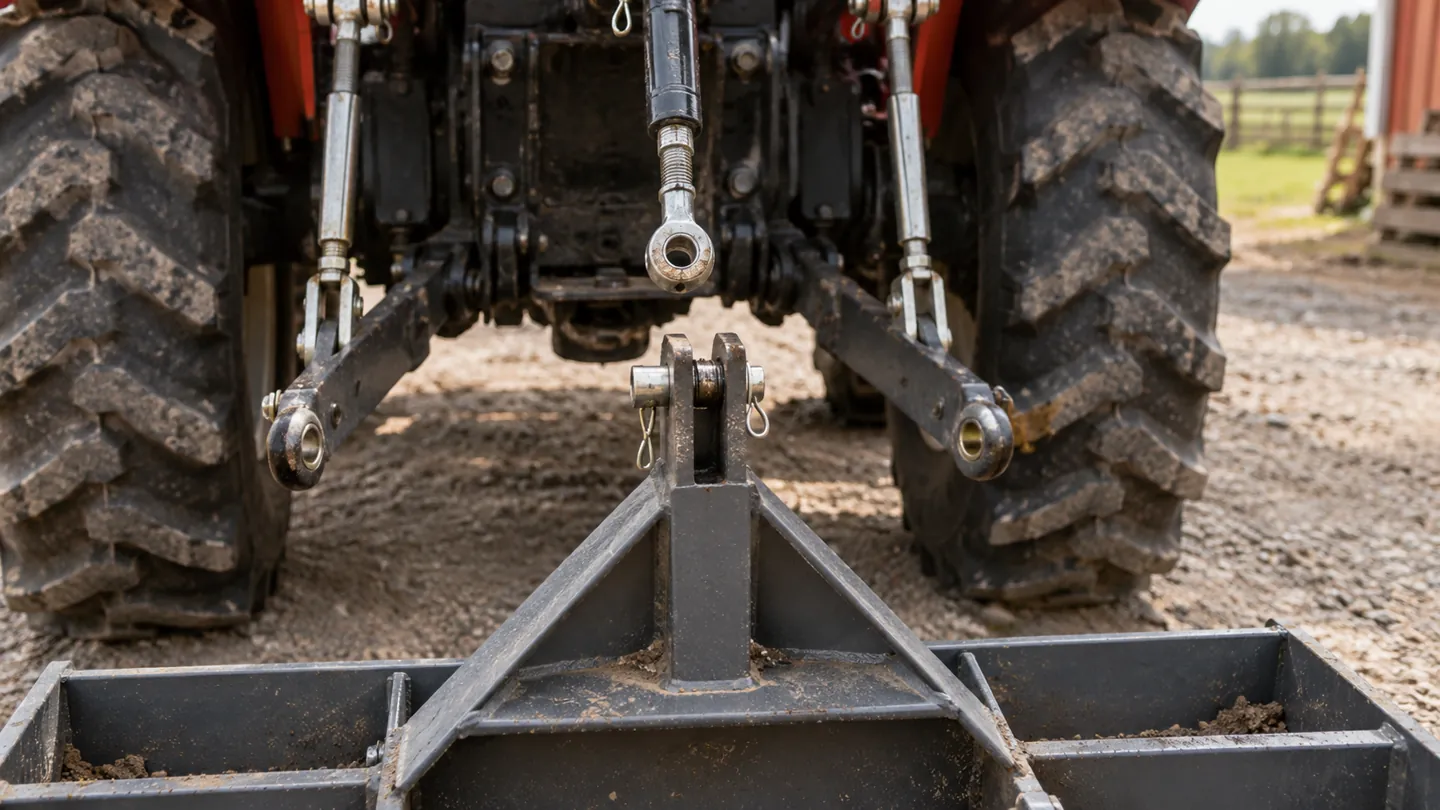
- Measure the hole in the ball ends on the lower lift arms. A 7/8 inch hole means Cat 1. A 1 1/8 inch hole means Cat 2.
- Measure between the two lower arm ends with the arms at their normal spread. About 28 inches is Cat 1, and about 20 is Cat 0.
- Check the top link pin. A 3/4 inch pin means Cat 1, and 1 inch means Cat 2.
- Raise the arms to full height and measure from the ground to the ball ends. Compare that to the implement’s mast height and the clearance you need.
If the tractor has no manual, the pins and spacing from the chart will tell you. A used older tractor may have worn or swapped ball ends, so measure rather than assume. Our vintage tractor section covers the older machines where this comes up most.
Mistakes when buying implements across categories
The biggest mistake is assuming a Cat 1 label means the implement will fit and work. Category covers pins and spacing only. It says nothing about weight, lift height or whether your tractor can carry the load.
- Buying by category alone. Check lift at 24 inches behind the arms. That is 680 pounds on a Kubota BX2380 and 758 on a Deere 1025R, and a full size Cat 1 tool can simply be too heavy.
- Ignoring limited Cat 1. On a Deere 1 Series, check mast height and lift height. Look for implements made for limited hitches when you can.
- Buying a Cat 2 implement for a Cat 1 tractor. The pins and width will not fit, and the weight would be too much if they did.
- Forgetting bushings. A quick hitch needs sleeves for each implement. Count them before you buy.
- Bushing a light implement onto a big tractor. Owners report bent top links and lift pins when a light tool meets too much power.
- Skipping the PTO check. Rotary cutters need the right driveshaft length and the right PTO speed. See our PTO guide and the rotary cutter buying guide.
- Forgetting balance. A heavy rear implement can unload the front end. Read how much ballast your tractor needs.
A receiver hitch for the 3 point arms
Some owners add a receiver hitch for towing a cart. The YINTATECH 3 point 2 inch receiver hitch is a Cat 1 option.
It suits light loads around the yard, and the arms let you raise the tongue to hook up. Skip it if you already use the drawbar. Never tow a heavy load from a raised hitch.
Bottom line
Match your tractor’s hitch category to the implement before anything else, then check lift capacity and mast height. Of all the 3 point hitch categories, Cat 1 is the one most sub compact and compact owners need. Deere 1 Series owners should watch for the limited label.
Bushings solve pin size, not width or strength. When in doubt, measure.
Still choosing a tractor? Start with the best sub compact tractors.
Frequently asked questions
What is the difference between Cat 1 and Cat 2?
Cat 2 has larger pins, 1 inch top and 1 1/8 inch lower. Its lower links sit about 6 inches farther apart. It is built for tractors above roughly 40 hp, and a Cat 1 tractor cannot run a Cat 2 implement.
Can I use a Cat 1 implement on a Cat 2 tractor?
Yes, with bushings or a bushing style quick hitch. Many owners do. Take care with power, because a larger tractor can bend a light implement.
Is a limited Cat 1 hitch a problem?
For most owners it is not. The pins and spacing match Cat 1.
The difference is lift height. It matters on trailer ramps and with tall mounting masts.
Do I need bushings for a quick hitch?
Almost always. Deere says every implement needs a bushing set for its iMatch hitch. Universal quick hitches use the same hook sizes, and only a few implements come with quick hitch sized pins.
What size is a Cat 0 hitch?
Cat 0 uses 5/8 inch pins top and bottom, with lower links about 20 inches apart. It fits garden tractors and the smallest sub compacts, up to about 20 hp.
Where is the hitch category listed?
It is in the specifications section of your operator manual. Kubota lists SAE Category 1 for the BX series. Deere lists limited Category 1 for the 1023E and 1025R.