Implements & Attachments
Tractor PTO Explained: 540 RPM, Live and Independent
A plain guide to the tractor PTO: what 540 rpm means, how live and independent PTOs differ, which shaft fits, and how to engage it safely, drawn from the Kubota BX and John Deere 1 Series manuals.
IN THIS GUIDE JUMP TO A SECTION +
As an Amazon Associate, TractorFolk earns from qualifying purchases. Links to products on this page may earn us a commission at no cost to you.
The number to remember is 540. A tractor PTO at 540 rpm turns its shaft about nine times a second. Your engine has to run at one set speed to get there.
On a John Deere 1025R that speed is 3200 rpm, right at the top of the tach.
That one number decides which implements fit and how hard the engine works. It also decides how fast a mistake turns dangerous.
PTO stands for power take off. It is the splined stub at the back of the tractor. Many small tractors carry a second one under the belly.
It sends engine power through a driveline to a mower, tiller, post hole digger or chipper.
The short version
- Small tractors use a 1 3/8 inch, 6 spline rear shaft turning 540 rpm. Larger tractors add a 1000 rpm shaft with 21 or 20 splines.
- Never run a 540 implement on a 1000 shaft, or the reverse. A spline adapter changes the fit, not the speed.
- For mowing you want a live or independent PTO. A transmission PTO stops when you press the clutch and needs an overrunning clutch.
- Engage at reduced engine speed: half throttle on a Kubota BX, 1500 rpm or less on a Deere 1 Series. Then bring the engine up to the 540 mark.
- Use the shear bolt grade your implement manual names. Rhino allows Grade 2 only; Bush Hog uses a metric 8.8 bolt on some cutters.
- Keep the master shield and the spinning driveline guard on. OSHA’s farm equipment rule requires both on any tractor an employee runs.
What is a tractor PTO and how does power flow?
A PTO on a tractor is an engine driven shaft that powers an implement. It lets a mower or tiller borrow engine power without wheels or hydraulics.
Power runs from the crankshaft through a PTO clutch. Reduction gears then set the shaft speed, and the power leaves through the splined stub.
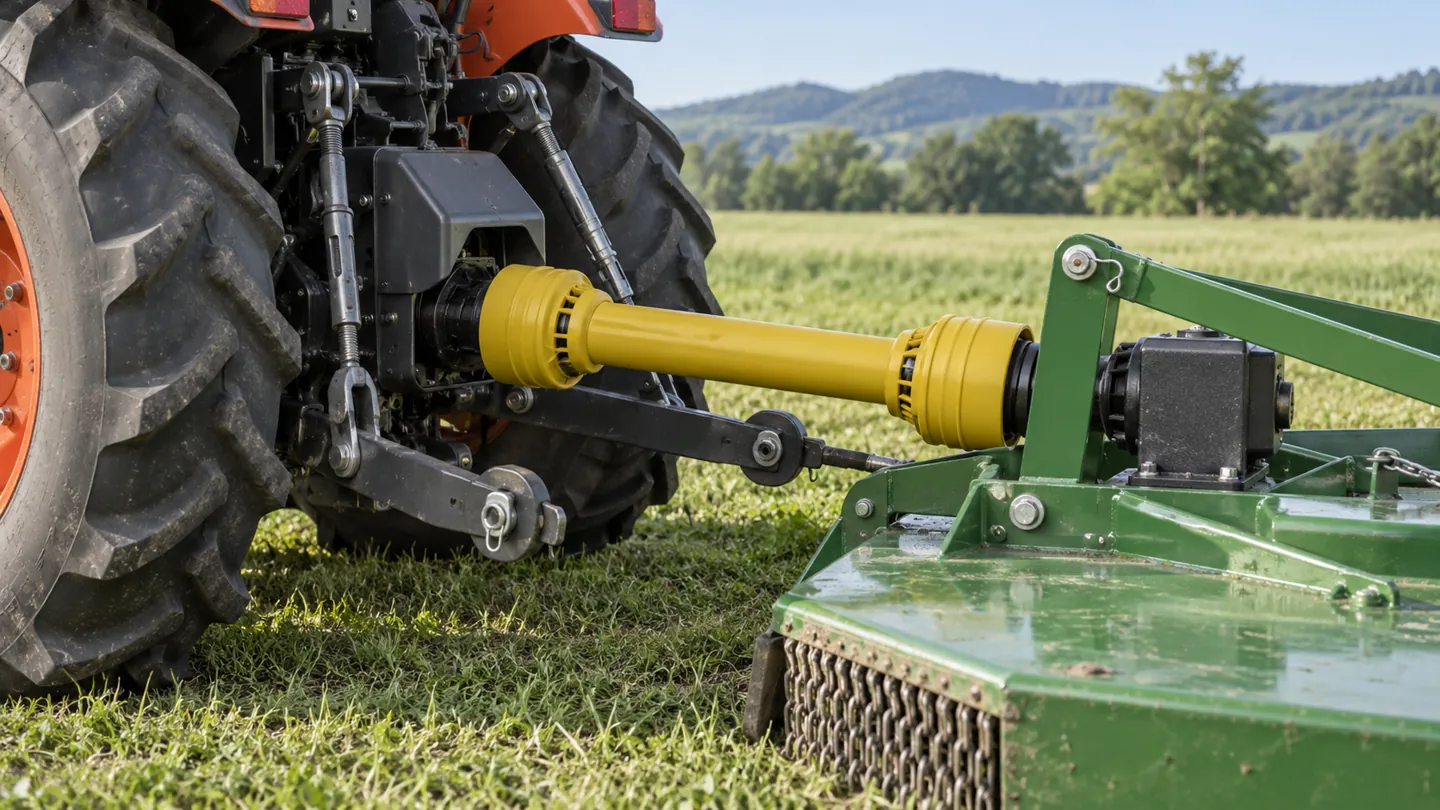
From the stub, a telescoping driveline carries it to the implement’s gearbox. The gearbox turns blades, tines, an auger or a chipper drum.
Shaft speed is locked to engine speed. Slow the engine and the PTO slows in step. That is why the tachometer matters when you mow.
The driveline has three jobs. Its sliding tubes change length as the implement rises and falls. A universal joint at each end lets it bend, and a guard tube rides on bearings around the whole thing so it does not spin with the shaft.
540 vs 1000 rpm PTO, economy PTO and the engine rpm you need
A 540 rpm PTO is standard on small and mid size tractors. A 1000 rpm PTO belongs to larger tractors and heavy implements such as big balers and wide cutters.
At 540 rpm the shaft makes about 9 turns a second. At 1000 rpm it makes about 16.6. The 1000 stub has a different spline count, so a 540 driveline will not slide on by accident.
Ohio State’s extension fact sheet says never to hook 540 equipment to a 1000 rpm PTO, or the reverse. A 540 gearbox spun at 1000 is run far past its design.
What engine rpm gives you 540?
The engine speed that produces 540 at the shaft is set by the tractor’s gearing. It differs by model. Your operator’s manual or the tachometer face gives it, and a dealer can look it up by serial number.
Deere’s 1023E and 1025R manual states it plainly. At 3200 engine rpm the rear PTO turns 540 and the mid PTO turns 2100. The manual says not to run either above the 3200 mark.
Kubota’s BX manual does not print a number. It says to run PTO 540 “within the yellow range” on the tachometer. On a BX you read the colored band, not a figure.
Larger tractors reach 540 at much lower engine speeds. A Deere 5085E makes 540 at its 2400 rpm rated engine speed. Do not borrow a number from another brand or size class.
Run well below the mark and you get a slow blade and a ragged cut. Run above it and you overspeed the implement and waste fuel. Find your mark and hold it.
What is economy PTO (540E and 1000E)?
Economy PTO is an extra gear ratio that reaches rated shaft speed at a lower engine speed. Deere’s spec sheet for the 5085E lists standard 540 at 2400 engine rpm. The 540E setting gives 540 at 1716 engine rpm.
The trade is power. An engine turning 1716 rpm cannot make what it makes at 2400. Economy mode will not deliver the full PTO horsepower rating.
It suits light loads like finish mowing or raking, not a heavy cutter in thick brush.
On Deere’s sheet, 540/540E comes bundled with the transmission choice. It is a factory option, not something you add later. It is a utility tractor feature; the Kubota BX and Deere 1 Series manuals list a single 540 speed.
Live PTO vs independent PTO vs transmission PTO
The three types differ in what the clutch pedal does to the shaft. A transmission PTO stops with the tractor.
A live PTO stops only when you push the pedal all the way down. An independent PTO ignores the pedal entirely.
| PTO type | How it is driven | When you press the clutch | Best for |
|---|---|---|---|
| Transmission PTO | Through the transmission, after the main clutch | Shaft stops as soon as you press | Older tractors, simple jobs; needs an overrunning clutch for mowing |
| Live PTO | Two stage clutch pedal | Half travel stops the wheels, full travel also stops the PTO | Mowing with a gear tractor, stopping or shifting with the blades running |
| Independent PTO | Its own clutch, worked by a lever or switch | Nothing, it runs until you switch it off | Stationary work, mowing, any job where you want separate control |
Most current compacts are independent. Kubota’s BX manual says the PTO clutch lever “gives the PTO independent control.” Kubota’s brochure calls it a live independent PTO with a hydraulic clutch.
Deere’s 1 Series uses a rocker switch for the clutch. A separate lever picks mid, rear or both.
Brand wording blurs the line, so go by the control. A separate lever or switch that works with your foot off the pedal means independent. A clutch pedal with two distinct stages means live.
Why it matters for mowing and stopping
With a live or independent PTO you can stop, back up or shift while the blades keep turning. You never spool a heavy cutter up from zero each time. That spares the clutch and the driveline.
A transmission PTO has a hidden problem. When you press the clutch, the spinning cutter keeps driving the shaft backward into the transmission. It can push the tractor along.
Bush Hog’s and Rhino’s cutter manuals say an overrunning clutch “must be used” when the transmission and PTO share one master clutch. An overrunning clutch is a one way coupler. The tractor can drive the implement, but the implement cannot drive the tractor.
The Ford 8N, 9N and 2N are the classic cases. That is why dedicated couplers are sold for them.
Even with an independent PTO, a rotary cutter coasts a long time after you switch off. Owners regularly describe a long wait, longer than they expect. Stay in the seat until it stops.
Rear PTO vs mid PTO
A rear PTO drives implements on the 3 point hitch or drawbar at 540 rpm. A mid PTO sits under the tractor and drives a belly mower or front snowblower. It turns much faster on a different spline, so the two never interchange.
Mid PTO speed is brand and model specific. Kubota’s BX manual lists 2500 rpm on a 10 tooth involute spline. Deere’s 1 Series manual lists 2100 rpm, and Deere’s 2038R sheet lists 2000 rpm.
That is why a mid mount deck is built for one tractor family. Buy the deck made for your model. Do not try to adapt another brand’s.
Both brands use a selector lever with three positions: mid only, rear only, or both together. Deere’s manual adds that the mid PTO only runs with the operator in the seat. The rear PTO has a separate off seat procedure for stationary work.
Not every compact has a mid PTO. On many models it is optional or absent, so check the spec sheet before you buy a belly mower.
PTO shaft sizes, spline counts and adapters
Small tractor rear PTOs use a 1 3/8 inch, 6 spline shaft for 540 rpm. The 1000 rpm shafts have more splines: 21 on a 1 3/8 inch shaft, or 20 on a 1 3/4 inch shaft.
Deere’s 1 Series manual prints the standard sizes as PTO types 1 through 4. The table below uses those dimensions.
| PTO type | Shaft diameter | Splines | Speed | Typically found on |
|---|---|---|---|---|
| Type 1 | 35 mm (1 3/8 inch) | 6 | 540 rpm | Sub compact, compact and most utility tractors |
| Type 2 | 35 mm (1 3/8 inch) | 21 | 1000 rpm | Utility tractors with a 540/1000 option |
| Type 3 | 45 mm (1 3/4 inch) | 20 | 1000 rpm | Larger tractors and heavy implements |
| Type 4 | 57.5 mm (2 1/4 inch) | 22 | 1000 rpm | High horsepower row crop tractors |
The diameters and spline counts come from Deere’s manual, which follows the ISO 500 standard. The speed column follows common use. The manual does not pair each type with a speed, so confirm the speed on your tractor’s decal.
If yours looks unusual, count the splines and measure across the tips with calipers. Do not measure the guard or the round neck behind the splines.
PTO adapters and extensions
A spline adapter lets one shaft size fit a driveline made for another. An extender adds length. Neither changes shaft speed.
So a 6 to 21 spline adapter puts a 1000 rpm implement on a 540 tractor and drives it at 540. The implement runs too slow to work. Run the other way, a 540 implement on a 1000 shaft can be wrecked.
Use adapters to fix fit, never to bridge two speeds.
Deere’s manual adds two rules. Never install an adapter that lets a 1000 rpm shaft drive a 540 implement above 540. Never install one that leaves any part unguarded.
The master shield has to overlap the stub and the adapter. If it cannot, the adapter does not belong there.
An extender earns its place when the implement’s driveline will not clear the hitch. Check the horsepower rating on the listing first. One common quick release unit lists 75 hp as its maximum.
The PA09 PTO extender for a 1 3/8 inch 6 spline shaft fits the standard small tractor stub. Skip it if your implement already clears the hitch.
Any extension moves the joint away from the tractor and can cut driveline overlap. Ohio State’s fact sheet says at least 5 1/2 inches of sliding shaft should stay in its housing. Recheck that after adding one.
Driveline protection: shear bolt, slip clutch and overrunning clutch
Three devices protect a driveline, and each does a different job. A shear bolt breaks on a sudden jam. A slip clutch slips under sustained overload, and an overrunning clutch keeps a coasting implement from driving the tractor.
Shear bolt
A shear bolt is a deliberately weak bolt in the driveline yoke. It snaps when the blade hits a stump, which spares the gearbox. It is the cheapest protection, and you carry spares.
The grade is set by the implement maker, not by a rule of thumb. Rhino’s RH series manual says “Install Grade 2 (only) shear bolt.” It warns that a stronger bolt will cause driveline failure and void the warranty.
Bush Hog’s BH200 manual takes a different path. It specifies an 8 x 50 mm Grade 8.8 metric bolt on earlier BH215 and BH216 cutters.
So read your manual before you buy a bag of bolts. A stronger bolt than specified does not protect better. It passes the shock straight to the gearbox.
If your manual calls for Grade 2, Grade 2 shear bolts, 1/2 inch by 3 1/2 inch, in a 12 pack are a common fit. Match the length too, since Rhino lists a 3 inch bolt. Skip them if your manual lists a metric or higher grade bolt.
Slip clutch
A slip clutch uses spring loaded friction discs. They slip when torque spikes and grip again when the load eases. It resets itself, so it suits heavy brush where a shear bolt would break every few minutes.
It needs care. A clutch that sits all winter can rust and seize. A seized or over tightened clutch does not slip, so the next hard hit lands on the gearbox.
Bush Hog’s manual gives the reset routine. Loosen the spring nuts about a third of a turn. Engage the PTO at idle for 2 to 3 seconds so the discs slip, then retighten to the original spring length.
Do it at the start of each season. Penn State’s safety guidance also warns against over tightening a slip clutch.
If your cutter came with a shear bolt and you want a slip clutch, the VEVOR 1 3/8 inch PTO slip clutch is one alternative. Match it to the implement’s input shaft and horsepower. It will not fix a driveline that is the wrong length.
Overrunning clutch
You need one when your tractor has a transmission PTO and you run a mower or cutter. Some gear tractors build the function in, so check your manual before adding a unit. Skip it entirely on a live or independent PTO.
For a Ford 8N, 9N or 2N, the C670F overrunning PTO coupler is the usual answer. Buyer feedback on this listing is thin, so confirm fit before ordering. Our Ford 8N buyer’s guide covers the tractor side.
For other tractors with a transmission PTO, a 1 3/8 inch 6 spline overrunning clutch is the generic option. It adds a few inches to the stub. Recheck driveline length and master shield overlap after fitting it.
Check what your implement came with before buying anything. Our rotary cutter buying guide walks through shear bolt and slip clutch drivelines by model.
PTO horsepower vs engine horsepower
PTO horsepower is always lower than engine horsepower. The clutch, gears and accessories eat some of it on the way to the shaft. It is the number implement makers mean when they list a minimum.
The operator’s manuals show the gap on sub compacts. Deere lists the 1025R at 23.9 hp gross and 17.2 PTO hp, about 72 percent. The 1023E is 21.5 gross and 14.9 PTO hp, about 69 percent.
Kubota’s BX manual lists the BX2380 at 23.0 hp gross under SAE J1995 and 17.7 PTO hp. That is about 77 percent. Kubota’s brochure quotes 21.6 engine hp for the same tractor, which would put the PTO at about 82 percent.
That spread is the lesson. Gross, net and “engine hp” are measured differently. Two tractors with the same hood number can differ at the shaft, so compare PTO horsepower to PTO horsepower.
Hydrostatic drives tend to leave a little less at the shaft than gear drives. One spec listing for the Kubota L2501 shows 20.5 PTO hp with gears and 19 with the hydrostatic.
If an implement lists a minimum PTO horsepower, compare it to your PTO figure at rated engine speed. Our guide to tractor sizing by acreage and job shows how much shaft power common jobs need.
PTO safety: guards, shields and entanglement facts
A spinning tractor PTO is a hazard you cannot outrun. At 540 rpm it turns nine times a second. Penn State’s extension fact sheet notes that a half second reaction time is far too slow, since wrapping starts before you can react.
The same source says many entanglements happen at half or a quarter of operating speed. An idling PTO is not a safe PTO. More injuries involve the implement driveline than the bare stub.
The guard system has three parts. The master shield on the tractor covers the stub from above and both sides.
The driveline guard covers the shaft, with bell shaped ends over each U joint. The implement shield covers the input end.
Never cut or modify the bells. The U joints under them are the parts that snag a sleeve or a bootlace.
Test the driveline guard with the engine off. Spin it by hand; it should turn freely on its bearings and stop when you hold it. A guard that spins with the shaft is no better than none.
Many older tractors have no master shield. It was damaged, pulled off to hook up a wide driveline, or lost when the tractor changed hands. Find a replacement before you run anything.
What OSHA requires
OSHA’s agriculture standard, 29 CFR 1928.57, covers guarding on farm field equipment. It binds employers whose employees run it. Paragraph (b)(1) says all PTO shafts, rear, mid or side mounted, must be guarded by a master shield or other guarding.
It requires a master shield on the rear PTO of every tractor. The shield must be strong enough that a 250 pound operator can use it as a step without bending it.
PTO driven equipment must guard its own driveline. Both tractor and implement must carry signs saying the shields stay in place.
Paragraph (a)(6) requires employers to train every operator at hire and yearly after that. The first rule in that training is to keep all guards in place when the machine is running. A one person farm is not covered, but the rule describes the standard every operator should hold.
- Shut off the engine and disengage the PTO before you clean, adjust, service or unclog anything. Both Kubota’s and Deere’s manuals say it the same way.
- Wear close fitting clothes and tie back long hair. Loose coveralls, boot laces and sweatshirt strings are common catch points.
- Walk around a running PTO. Never step over it, and keep children well clear.
- Walk around the tractor before and after each workday. Confirm every shield is in place and the guard tube spins free.
- Never swap a driveline between implements. Use the one made for that machine, cut to length for your tractor.
Penn State adds a warning that surprises people. If no hitch ties the tractor to the implement, the tractor can pull the driveline apart. A separated shaft swings wildly, so if a shaft ever splits, disengage and stop at once.
If your tractor lost its shield, a universal fit is an option. The complete universal PTO shield is one choice, though buyer feedback is thin. Ask a dealer about a factory master shield first, and confirm it clears your driveline.
For the full guidance, read Penn State Extension’s PTO safety page.
How to engage the PTO correctly
Engage the PTO at reduced engine speed, then raise the throttle to the 540 mark. Both manuals we checked say so. Both also say their own steps come first.
Kubota’s BX manual says to pull the throttle back from full to half speed when engaging, then open it to full. It says to move the PTO clutch lever slowly and never hold it half way.
Deere’s 1 Series manual says to set the engine to 1500 rpm or less and engage the switch. Then you bring the hand throttle up.
- Check that every guard is in place and nobody is near the implement.
- Set the park brake and put the range lever in neutral. Deere’s manual requires both before the PTO will engage.
- Lower the implement to its working position if its manual says to. A cutter engaged in the air can swing the driveline through a steep angle.
- Reduce engine speed to the figure your manual gives. Go just above low idle if a heavy cutter stalls the engine there.
- Select mid, rear or both with the selector lever. Then engage the PTO clutch lever or switch in one smooth motion. On a live PTO, let the clutch pedal all the way up.
- Bring the engine up to the 540 mark and start work.
- To stop, throttle down to low idle and disengage the PTO. Wait for the implement to stop spinning before you leave the seat.
Both tractors have interlocks worth knowing. Kubota’s BX will not start with the PTO lever engaged. The engine stops if you leave the seat with it on.
Deere’s 1 Series will start with the switch on but makes you cycle it off and on. It also shuts the PTO off if the engine overheats.
Stationary work is the exception to the seat rule. Kubota’s BX manual gives a procedure for a chipper or pump. Select rear PTO only, set the park brake, block the wheels, tilt the seat forward, then engage.
Deere’s off seat rear PTO mode needs the switch held for 2 seconds before you get off.
Common PTO mistakes
- Engaging at full throttle, which jolts the clutch pack and driveline. Owners with hydraulic PTO clutches commonly report harsh engagement at high rpm.
- Engaging at too low an idle with a heavy cutter, which stalls the engine. Nudge the throttle up a little, not a lot.
- Mowing at the wrong rpm: too slow for a clean cut, or past the 3200 mark that Deere’s manual forbids.
- Removing the master shield to hook up an implement and never putting it back.
- Lifting a cutter high or turning sharply with the PTO engaged. Deere’s manual says to detach the driveline if you need more height than the guards allow.
- Over tightening a slip clutch, or fitting a stronger shear bolt than the manual lists.
- Getting off the tractor before the implement has stopped.
If the PTO will not engage, slips under load or stalls the engine, the clutch or an interlock may be at fault. A dealer can check that by serial number. If the tractor itself will not run, our diesel tractor won’t start diagnosis covers the basics.
Bottom line
A tractor PTO is a simple idea that rewards careful matching. Know your shaft speed and spline count. Run the engine at the 540 mark, and choose live or independent if you mow.
Protect the driveline with the bolt grade or clutch your implement maker names. Keep every shield on, engage at reduced throttle, and let the implement stop before you step off.
For the hitch side of the job, see our 3 point hitch categories guide. For a common PTO job, read about Harley rakes for tractors. For one worked example of a tractor with mid and rear PTOs, see our Kubota BX maintenance guide.
Frequently asked questions
Can I run a 540 rpm implement on a 1000 rpm PTO?
No. Ohio State’s fact sheet says never to hook 540 rpm equipment to a 1000 rpm PTO, or the reverse. If your tractor has a reversible or switchable shaft, set it to the speed on the implement’s decal first.
Does a PTO use a lot of fuel?
Fuel use follows the load, not the shaft. The engine burns what the implement draws. A heavy cutter in brush uses far more than a light blower.
Economy PTO lowers engine rpm on light work, on utility tractors that offer it. Deere’s 5085E gets 540 at 1716 engine rpm in economy mode instead of 2400.
Can I run a PTO with the tractor stopped?
Yes, on a tractor with an independent PTO. Chippers, pumps and generators are the usual jobs.
Follow your manual’s stationary procedure. Kubota’s BX and Deere’s 1 Series both require the park brake and neutral. Each has its own way to keep the rear PTO running after you leave the seat.
How do I know if my PTO is live or independent?
Look at the control. A separate PTO lever or switch that works with your foot off the clutch pedal means independent. A clutch pedal with two distinct stages, a shallow one for the wheels and a deeper one for the PTO, means live.
Why does my mower keep spinning after I turn off the PTO?
A heavy deck or cutter stores momentum and coasts to a stop on its own. Owners report that a big cutter coasts a long time without a PTO brake. Stay in the seat until the blades stop.
Do I need a driveline guard if my tractor has a master shield?
Yes. The master shield covers only the stub, and the driveline guard covers the shaft to the implement.
OSHA’s rule requires both. Penn State’s data shows more injuries come from the driveline than from the stub, so neither replaces the other.
Can I shorten a PTO driveline myself?
Yes, and the tractor manuals explain how. Deere’s method is to attach the implement and push the driveline to its shortest length. Then raise the implement to its highest working position and shorten the tubes and guards if the shaft bottoms out.
Kubota’s method is the same idea. Mark the guard tubes at the shortest working position and cut the guards and sliding tubes by equal amounts. Then deburr and grease.
Cut both halves equally and keep the 5 1/2 inch minimum overlap.