Implements & Attachments
Rock Rake for Tractors: Sizes, Tine Spacing and How to Use One
A rock rake windrows surface stones on dry, loose ground. Here is what size fits your tractor, which tine spacing to pick and how to use one.
IN THIS GUIDE JUMP TO A SECTION +
Picture a pasture you tilled last week. Fist sized stones lie across it like potatoes in a freshly dug row, and a rock rake is the tool that gathers them.
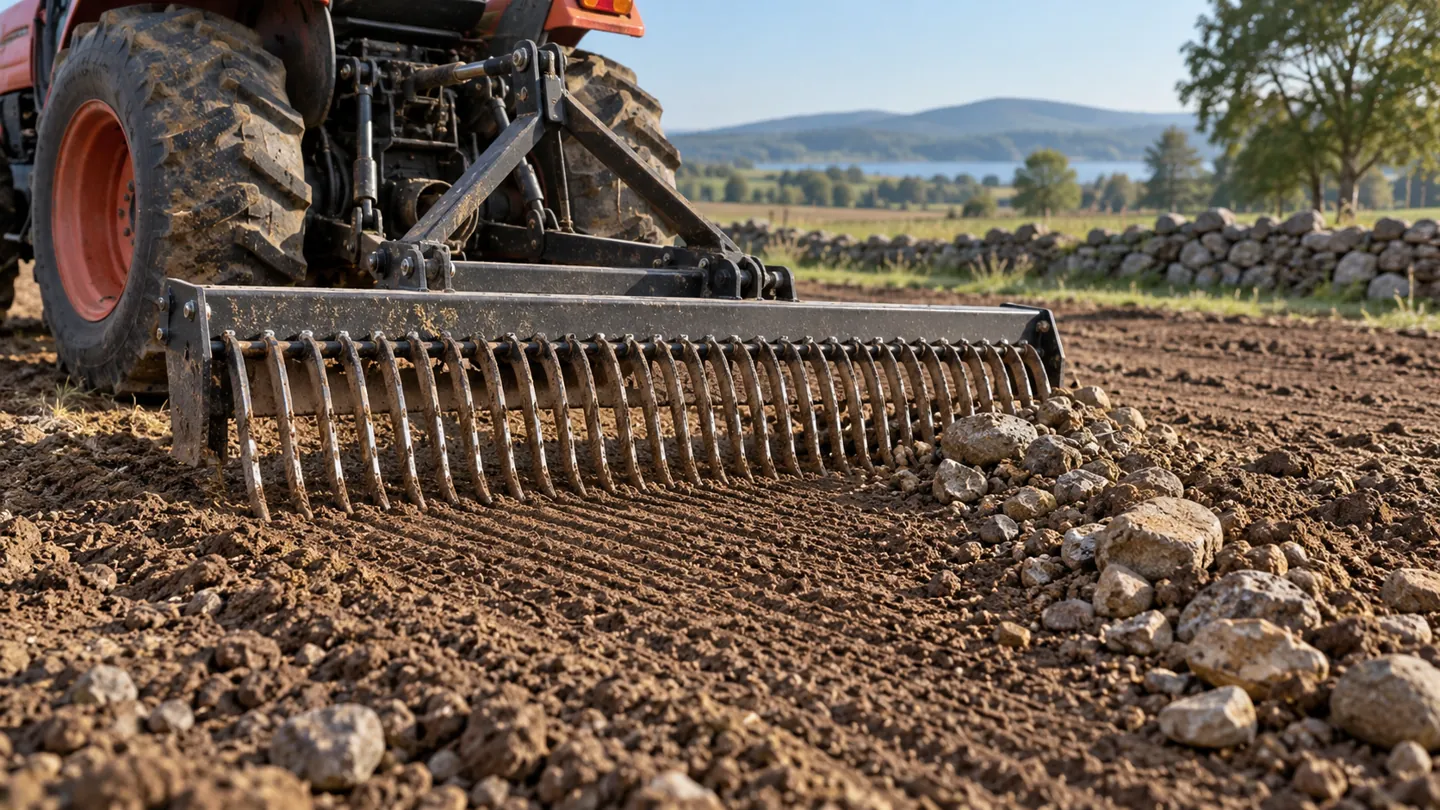
One pass with the rake, swung to a 30 or 45 degree angle, leaves a ragged line of those stones along one edge. The soil behind the tractor is fairly clean.
That line is called a windrow, and making it is the whole job. The rake sweeps surface stones to one side so you pick them up once, in a row. It works on loose, dry, bare ground, not on buried boulders or wet sod.
This guide covers how the tool works and how it differs from a rock bucket, a landscape rake and a Harley rake. It also covers what size fits your tractor and which tine spacing to buy. Then it shows how to windrow without dragging your topsoil along.
The short version
- A 3 point stone rake windrows surface stones. It does not lift them, and it does not dig buried ones.
- Common rakes run 5 to 8 feet wide and weigh about 170 to 420 pounds. Maker ratings run from about 15 hp up to 60 hp.
- Tine spacing is the key choice. 2 inch centers hold fist sized stones and let fines through. 1 inch spacing catches smaller stones but fills with dirt.
- Work dry, loose, bare ground at 2 to 5 mph. Angle the rake, build a windrow, clear it often, then pick the stones up by loader or by hand.
- Kubota’s sub compact implement sheet lists no rake at all. Check weight with your dealer before you buy.
What a rock rake is and how it works
A rock rake is a row of spring steel tines bolted to a frame and dragged over the ground. Stones ride along the tines while loose soil falls through the gaps. Angle the frame and the stones travel toward the trailing end and pile into a windrow.
Most makers do not draw a hard line between a rock rake and a landscape rake. Land Pride’s operator manual lists the jobs for its LR16 and LR26 rakes as spreading rock, moving debris, seed preparation and reshaping soil. Everything Attachments says its landscape rake is also known as a root rake or rock rake.
So read the tine spacing, tine size and tractor rating, not the name on the frame. Those three numbers decide what the rake will and will not pick up.
3 point versions
The 3 point rake is the common choice for compact and sub compact tractors. It hangs from the lower links and the top link. It needs no hydraulics and no PTO.
You angle it by pulling a hitch pin and swinging the frame to a new hole. Land Pride gives seven holes, up to 45 degrees either way in 15 degree steps. Hydraulic angling is an accessory.
Blue Diamond’s holes go to 30 degrees, and the frame also turns 180 degrees for pushing material in reverse.
A plain 3 point rake has no down pressure. It floats over hard spots instead of digging in.
That is why owners add gauge wheels for a consistent depth. Bite comes from the tractor’s own weight.
That rear weight pulls the front end light. Land Pride’s manual warns that lightweight tractors with rear implements may need front weight to keep steering.
Blue Diamond’s manual wants at least 20 percent of the combined weight on the front wheels. The tractor ballast guide walks through those numbers.
Loader mounted rakes
Loader mounted rakes are sold as root rakes or rock grapples. In the skid steer world they become hydraulic rakes with a collecting bucket. All of them ride on a loader carrier and lift with the loader.
Blue Diamond’s severe duty root rake uses a universal skid steer mount. Its 5/8 inch solid steel tines sit on 5 1/4 inch spacing. Blue Diamond lists it for host machines of 6,000 pounds and up.
Werk-Brau’s RockHound is a powered version. It needs at least 13 gpm of hydraulic flow and picks up stones from 3/4 inch to about 8 inches. The stones drop into a bucket that opens from the top to dump.
Both are skid steer and track loader tools. A compact tractor loader needs a matching carrier and enough lift capacity. The front end loader guide covers what yours can carry.
Tow behind versions
A true tow behind rake is a farm scale machine. Degelman’s RR1500 is a PTO driven spiral drum, 14 feet wide, that windrows stones across a field in one pass. It folds to 7 1/2 feet for the road.
Degelman lists it at 3,640 pounds with a 75 hp minimum tractor. That makes it a custom hire or large farm tool, not a compact tractor purchase. It shows what the tool becomes when the field is 80 acres instead of 3.
Retailers also list small wheeled tow behind rakes for ATVs and garden tractors. We found no manufacturer spec sheet for any of them. Treat the figures as unverified and ask the seller for one.
Rock rake vs rock bucket vs landscape rake vs Harley rake
Use a rake to gather stones into a line and a loader bucket or grapple to lift them. Use a landscape rake to level and spread, and a Harley rake to rebuild a whole surface. The decision rule: visible stones go to a rake, buried stones go to a loader, and a stony seedbed goes to a power rake.
| Tool | Best job | Weak spot |
|---|---|---|
| Stone rake (3 point) | Windrowing surface stones on dry, loose soil | Does not lift, skips big stones |
| Rock bucket or grapple (loader) | Lifting, hauling and sifting stones | Needs loader lift, slow on large areas |
| Landscape rake | Leveling, spreading gravel, seedbeds | Same hardware, same limits |
| Harley (power) rake | Rebuilding a surface with a PTO driven drum | Heavier, costs more, needs more hp |
The Harley rake is the powered cousin. A PTO driven drum churns the soil and throws stones to one side. It clears stones and preps a seedbed in one job.
The Harley rake guide covers the tradeoffs, which come down to weight, hp and price.
A box blade pushes stones and levels, but it carries soil rather than letting it fall through. If grading is your real goal, start with the box blade buying guide. Loader tools are compared in the tractor grapple comparison.
One owner pattern repeats across every thread we read. A rake clears small and medium surface stones well. Owners with very rocky ground say a loader mounted tool finishes faster.
So plan on a rake for the first sweep. Use a loader, a rock bucket or your hands for the pickup. Nobody reports a rake finishing the job alone.
Sizes and tractor fit for a 3 point rock rake
Most 3 point rakes run 5 to 8 feet wide and weigh 170 to 420 pounds. Maker ratings run from about 15 hp to 60 hp. The table uses manufacturer figures from spec sheets and manuals read for this article.
| Model | Width | Weight | Tractor rating | Hitch |
|---|---|---|---|---|
| Kioti LR2060 | 60 in | 168 lb | Up to 30 hp | Limited Cat 1 and Cat 1 |
| Kioti LR2072 | 72 in | 186 lb | Up to 30 hp | Limited Cat 1 and Cat 1 |
| Kioti LR2572 | 72 in | 264 lb | 20 to 45 hp | Cat 1 |
| Kioti LR2584 | 84 in | 288 lb | 20 to 45 hp | Cat 1 |
| Land Pride LR1660 | 60 in | 241 lb | 20 to 40 hp | Cat 1 |
| Land Pride LR1672 | 72 in | 270 lb | 20 to 40 hp | Cat 1 |
| Land Pride LR1684 | 84 in | 291 lb | 20 to 40 hp | Cat 1 |
| Land Pride LR2684 | 84 in | 330 lb | 25 to 60 hp | Cat 1 |
| Land Pride LR2696 | 96 in | 348 lb | 25 to 60 hp | Cat 1 |
| Blue Diamond, 4 ft | 48 in | 158 lb | 15 to 45 hp | Cat 1 |
| Blue Diamond, 6 ft | 72 in | 229 lb | 25 to 45 hp | Cat 1 |
| Blue Diamond, 8 ft | 96 in | 285 lb | 35 to 45 hp | Cat 1 |
| Everything Attachments, 5 ft | 60 in | 344 lb | Listed 35 to 80 hp | Cat 1 and 2 |
| Everything Attachments, 6 ft | 72 in | 368 lb | Same | Cat 1 and 2 |
| Everything Attachments, 8 ft | 96 in | 419 lb | Same | Cat 1 and 2 |
All weights are the makers’ approximate figures. Land Pride’s come from its spec sheet dated July 2025 and Kioti’s from its online spec table. Blue Diamond’s come from its 2021 manual.
Everything Attachments gives the 7 foot rake as 395 pounds.
The Everything Attachments hp figure needs a caveat. The 35 to 80 hp range appears only in the product title.
The description says the rake suits sub compact Cat 1 tractors up through Cat 2 utility models. Call before ordering one for a 25 hp tractor.
Both Land Pride and Blue Diamond say a tractor above the rated hp can bend or break the rake. Land Pride adds that a tractor too small can be pushed around by the implement. Stay inside the window at both ends.
Sub compact tractors and the weight limit
On a sub compact, weight and hitch lift decide the purchase, and the makers’ limit sheets rarely mention rakes. Kubota’s BX80 implement limitations sheet covers mowers, tillers, harrows, blades, box blades and more for the BX1880, BX2380 and BX2680. No rake appears anywhere on it.
The closest listed tools are the rear blade, capped at 60 inches and 248 pounds, and the box blade, capped at 60 inches and 375 pounds. A 60 inch rake at 168 to 241 pounds sits inside both caps.
That suggests a reasonable fit. It is our inference, not Kubota’s rule, so ask your dealer before you buy.
Kubota also warns that tractor failures caused by improper implements are not covered by warranty. Other makers publish their own limit sheets, so find yours before shopping. If you are still choosing the tractor, the tractor sizing guide matches tools to acreage.
Hitch category
Nearly every rake in the table is Cat 1. Kioti’s two lightest models also fit limited Cat 1, and Everything Attachments fits Cat 1 and Cat 2.
Land Pride, Kioti and Blue Diamond all say their rakes work with a quick hitch. Check your tractor’s category before you order. If the terms are new, the 3 point hitch categories guide explains Cat 0, limited Cat 1, Cat 1 and Cat 2.
Tine spacing, tine material and replaceable tines
Tine spacing sets the smallest stone the rake keeps and the amount of soil it drags. Two inch centers are the common choice for stone work. One inch spacing suits finish grading.
Land Pride’s LR rakes use 2 inch centers on 5/16 by 1 inch high carbon spring steel teeth. Blue Diamond’s landscape rake runs 6 tines per foot, which is the same 2 inch pitch.
Kioti’s LR rakes use the same 5/16 by 1 inch tine on 1 inch spacing. Dealer listings for Woods rakes show 1 inch spacing as well. Woods’ own pages did not load for us, so take that as unconfirmed.
A tighter pitch catches smaller stones. It also fills with dirt, clods and grass, so the rake stops sifting and starts scraping like a blade.
Owners who build their own rakes report the same tradeoff. Two inch spacing suits brush and larger stones but lets small ones through. Close spacing makes the rake pick up everything and pack with soil.
Some owners pull every other tine so fines pass through on rocky work. That is an owner report, not a maker instruction. It works because the tines are separate parts that bolt in place.
Replaceable tines
Buy a rake with individually replaceable tines, because tines are the part that bends and breaks. Land Pride lists individual replaceable teeth as standard, and its warranty treats rake teeth as wear items.
Everything Attachments sets each tine in its own laser cut hole, held by a carriage bolt. It sells replacement tine sets. Blue Diamond’s parts list carries the tine, the bolt kit and the hold down plate as separate items.
Blue Diamond’s manual shows the swap. Remove the 3/8 by 1 1/4 inch retaining bolt and slide the tine out from under its hold down plate. Fit the new tine and tighten the bolt.
Each plate covers six tines, so you may need to loosen one plate to free a single tine. Land Pride suggests a coat of oil on the bare teeth before long storage to slow rust.
How to use the rake: angle, ground speed and windrows
Hitch the rake, level it, angle it and set the pitch. Then work at 2 to 5 mph with the tines just biting the surface. Pull stones into a windrow and clear that line before it gets deep.
- Walk the area first. Blue Diamond’s manual says to inspect for stones, branches, buried utility lines, pipes and sprinkler heads. Land Pride says to flag hidden hazards.
- Hitch the rake. Level it side to side with the lower link adjustment, which both makers call tilt. Level it front to back with the top link.
- Check clearance to the tires at full angle and full lift. Land Pride says to move or remove the drawbar if the frame touches it.
- Set the angle. Both manuals say angling the rake sends oversized material to the left or right. Start at 30 degrees and go to 45 on Land Pride’s frame if stones roll off too slowly.
- Set the pitch with the top link. Lengthening it tips the teeth in and makes the rake more aggressive. Shortening it makes the rake ride lighter.
- Start with the tines just touching the ground. Drive straight so stones roll toward the trailing end.
- Overlap each pass so it leaves stones on the same side as the last one.
- Stop, clear the windrow, then begin again in the same direction.
Ground speed
Blue Diamond’s manual says the tractor must be able to pull the rake at 2 to 5 mph. That is the only hard figure any maker gives.
Land Pride says to pick a gear and rpm that suit the conditions. It caps transport at 20 mph with the rake raised.
Work at the slow end of that range. If the tines flex over stones and spring back instead of plowing soil, speed up a little. If the windrow turns to dirt, slow down and shorten the top link.
Owner patterns that help
Owners repeatedly say dry, loose, bare soil gives the best results. Stubble or matted grass ruins the rake’s usefulness. An aggressive pitch pulls soil up with the stones.
Once a windrow gets big, the rake starts dragging dirt too. Clear the row and go again.
Two more tips come up often enough to pass on, both as owner reports. Larger stones can bounce over spring tines, so some owners make two opposing passes to build one windrow.
Others prefer a rear blade at 45 degrees on level ground. They extend the top link so the blade rides over the stones.
What to do with the rocks afterward
Pick the windrow up with a loader bucket, a rock bucket, a grapple or your hands. Then haul the stones to a pile, a wall line or a low spot that needs fill. A rake only moves stones sideways, so plan the cleanup before you rake.
A loader rock bucket or a clamping grapple saves a lot of bending and lets soil sift back out. Fist sized stones also make good fill for a muddy gate path or a soft spot along a fence. That removes a haul.
Anything you will not reuse needs a spot that stays out of your hay ground and your mower’s path. A pile at the field edge is the traditional answer. Old stone walls show how long people have been doing this.
Look at cost share before a big clearing job. The University of Maine Cooperative Extension notes that NRCS programs provide cost share funds for clearing, rock removal, mulching and irrigation. It says to contact your county NRCS office, and availability varies by year and county.
Stones come back. Owners in cold climates report a fresh crop each spring, and the physics backs them up. A 2003 Physics Today article describes how soil expanding as water freezes heaves stones toward the surface over winter.
Treat the first clearing as the big job. Plan a lighter sweep each spring after the ground dries.
Brands and build quality
The best built rakes use individually replaceable tines, a supported tine bar and a published hp range. You can check all of that on the maker’s pages. The makers named below are the ones whose literature we could read.
Land Pride’s literature lists high carbon spring steel teeth, individual replaceable teeth and a 3 1/2 inch pivot tube. A support channel backs the teeth. Its warranty is one year parts and labor on the unit, with teeth treated as wear items.
Kioti’s spec table lists 5/16 by 1 inch tines and five angle positions each way in 15 degree steps. It also lists optional gauge wheels and quick hitch compatibility across the LR line. Blue Diamond’s manual lists a 4 by 4 inch angle iron mainframe and a 3/8 inch A frame.
Everything Attachments says its rake uses A572 Grade 50 laser cut steel with Hardox 450 in high stress areas. It adds imported tines on carriage bolts and a slotted floating hitch.
Woods and Titan also sell rakes. Their own spec pages did not load for us, and retailer weights for Titan conflict. Confirm those figures with the seller.
Ask any seller five questions. What is the tine spacing? How thick are the tines?
Can you replace one tine alone? What hitch category and hp range does it fit? Are gauge wheels an option?
A seller who cannot answer those is selling a frame, not a rake.
Mistakes and what this rake cannot do
The biggest mistake is expecting the rake to clear everything. It cannot lift stones or pull buried boulders. It works poorly on wet or sod bound ground.
- Raking untilled sod. Owners report rakes clogging with grass on disked pasture. A rake only works when stones sit loose on the surface.
- Raking wet ground. Wet soil packs between the tines and rides along with the stones. Wait for it to dry.
- Ignoring large stones. Big stones bounce over spring tines. Lift those out with a loader first.
- Too much pitch. A long top link digs soil up with the stones. Shorten it until the tines skim.
- Wrong size tractor. Too big bends the rake, too small gets pushed around. Both makers say so.
- Letting the windrow grow. A deep row makes the rake drag dirt. Clear it often.
- Skipping the walk through. A buried pipe or sprinkler head costs more than the rake.
Do not buy a rake expecting it to remove every stone. If your ground is unproven, owners suggest borrowing or renting one for a weekend first. Mechanical clearing also tears up grass, so budget for reseeding.
Bottom line
A 3 point rake is a modest, hardworking tool for gathering surface stones on dry, loose ground. Pick 2 inch tine spacing for stone work and confirm individually replaceable tines. Check the weight and hp range against your tractor’s limits.
Pair it with a loader, a rock bucket or your own hands for the pickup. Skip it if your problem is buried rock or wet, sod bound ground.
Frequently asked questions
Can a rake pick up rocks?
No. A 3 point rake pushes stones sideways into a line. You still lift them out by loader, rock bucket or hand, though a loader mounted root rake can carry material because the loader lifts it.
What size stones does a stone rake for a tractor handle?
Fist sized stones and up on 2 inch spacing, down to gravel on 1 inch spacing. No maker of a 3 point rake we found gives a maximum stone size. Larger stones roll over the tines, so expect to remove those separately.
Is a rock rake the same as a landscape rake?
Often yes. Everything Attachments uses both names for one product, and Land Pride lists spreading rock as a use for its landscape rakes. The real differences are tine spacing, tine thickness and tractor rating.
What size tractor do I need for a 3 point rake?
Blue Diamond rates its 4 foot rake from 15 hp, and Kioti’s lightest rakes go up to 30 hp. Land Pride rates its LR16 line at 20 to 40 hp and its LR26 line at 25 to 60 hp. Check your hitch category and implement limits first.
Should I rent a rake before buying?
If your ground is unproven, yes. Owners say rakes act differently on bare dry soil than on sod. Test on a corner of your land first.
Will it damage my pasture?
It can tear up grass if you set it aggressively. Keep the pitch gentle and use gauge wheels where the ground is uneven. Plan to reseed bare patches afterward.
Do I need gauge wheels?
Not for a first sweep on flat tilled ground. Land Pride and Blue Diamond both say gauge wheels keep the depth consistent over uneven ground. Add them if your field rolls or you plan to grade with the rake later.