Implements & Attachments
Receiver Hitch for a Compact Tractor: Drawbar vs 3 Point Towing
Which hitch to use for which towing job on a compact tractor, why a high hitch point causes rear overturns, and where to find your hitch load limit.
IN THIS GUIDE JUMP TO A SECTION +
As an Amazon Associate, TractorFolk earns from qualifying purchases. Links to products on this page may earn us a commission at no cost to you.
Pull anything with real weight from the drawbar. Use a 3 point receiver hitch only for light, slow moves on level ground. The limit that matters most is the hitch load printed in your own operator’s manual, not the rating stamped on the receiver hitch, because the tractor is always the weakest link.
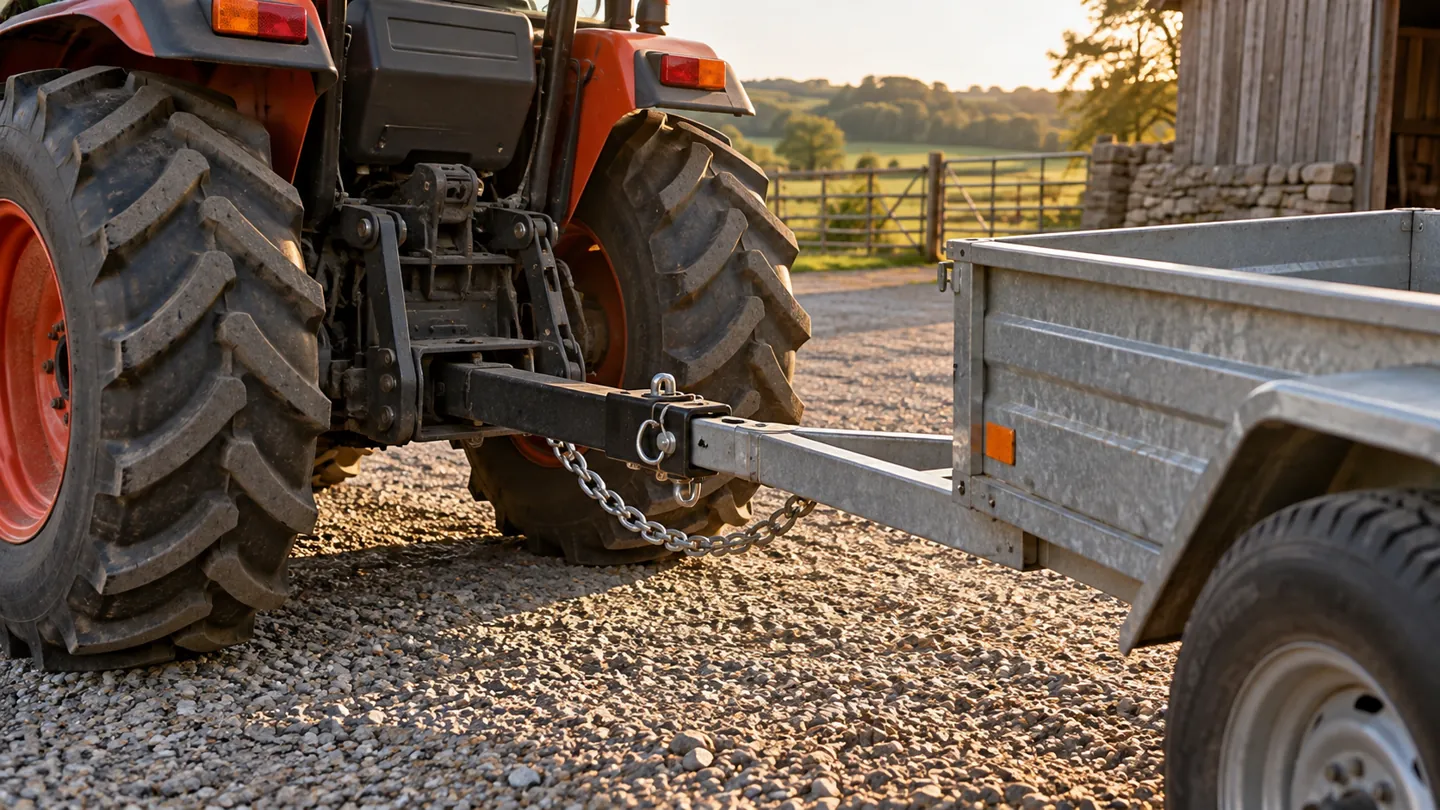
A receiver is the square tube that takes a ball mount, a pintle or a clevis. A 2 inch tube lets a compact tractor share hardware with a pickup. The catch is where that tube sits on the tractor and what holds it down.
The short version
- Tow real loads from the drawbar or rear hitch plate, at the height the maker built it.
- A 3 point receiver is for shunting a light, balanced trailer at walking speed on flat ground.
- Never pull from the top link, the rear axle or any point above the drawbar. That is how tractors flip backward.
- Deere’s 1023E and 1025R manual lists drawbar hitch loads of 2,017 and 2,165 lb. Kubota’s BX manual lists a 550 lb maximum hitch load and 1,765 lb of trailer load.
- Match the ball, coupler, mount and receiver ratings, then let the lowest one, or the tractor, set your limit.
Your options for towing with a compact tractor
You have five common ways to tow with a compact. They are the factory drawbar, a 3 point receiver, a clamp on drawbar, a 3 point drawbar and a ballast box receiver. They differ in one thing that matters: where the pull point sits.
| Option | Where it attaches | Best use | Main concern |
|---|---|---|---|
| Factory drawbar or rear hitch plate | Rear of the tractor, low, built for pulling | Wagons, trailers, spreaders, anything heavy | Some sub compacts ship with a short or fixed one, or none |
| 3 point receiver | Lower links, with the top link or a bracket | Light trailers moved slowly on flat ground | Higher pull point, and nothing holds the tongue down |
| Clamp on drawbar | Clamps across the lower links | Tractors with no usable drawbar | Still hangs from the lift arms; the rating is the accessory maker’s, not the tractor’s |
| 3 point drawbar | Lower links, a flat bar with a pin hole | Pulling on tractors without a drawbar | Sits above true drawbar height |
| Receiver on a ballast box | Back of a weighted box on the 3 point | Light towing plus rear counterweight | Weight helps stability but not pull height |
The last four all hang from the 3 point lift arms. That makes them convenient. It also gives them the same weakness, covered below.
Drawbar vs 3 point receiver: what each is for
A drawbar is made to pull and a 3 point hitch is made to lift. That is the whole difference.
The drawbar sits low and close to the axle line. A hard pull then drives the tractor forward instead of lifting its nose. Penn State Extension puts it simply: the drawbar is designed for and located to pull loads.
The 3 point hitch carries implements that ride on or in the ground, like a box blade. A receiver on it turns that lift system into a towing point. That works for short jobs.
Think of moving an empty utility trailer across the yard or lining up a small cart in the barn. For a loaded trailer, a manure spreader or any hill, use the drawbar.
Why the 3 point is not a towing hitch by design
Two things work against a trailer tongue on a 3 point. The pull point is higher than the drawbar. The arms are held up by hydraulic pressure rather than a solid pin.
Nothing holds those arms down except the weight on them.
Neither the Deere nor the Kubota manual mentions a receiver on the lift arms at all. The closest official word comes from a CDC report on tractor deaths in New York. It says a two or three point hitch should never be used as a single point hitch instead of the drawbar.
A 3 point receiver is exactly that: a single point hitch on the lift arms.
Owners commonly report that a dump trailer or a light tongue can lift the receiver once tongue weight goes negative. Many run a chain from the receiver down to the drawbar to limit that travel. That is an owner workaround, not a maker’s approval.
Why towing from a raised 3 point is risky
A high pull point can drag a tractor over backward, and it happens fast. Penn State Extension says a rear overturn can occur in about 1.5 seconds. That leaves no time to react.
The physics is simple. A pull from behind and above the rear axle makes a lever. That lever tries to rotate the tractor around the rear tires.
The higher the hitch point, the longer the lever. A longer lever needs less force to lift the front end.
The CDC report puts it another way. Once a load is hitched high, it takes less power to lift the tractor’s front than to move the load.
Purdue’s tractor safety lesson calls hitching a heavy load above the drawbar one of the primary causes of rear overturns. University of Arkansas extension says it plainly. Hitch only to the drawbar, or to the 3 point hitch with appropriate implements, and keep the drawbar as low as possible.
The CDC counted 16 rear rollovers in New York over five years caused by improper hitching. You can read the CDC report on improper hitching deaths yourself.
What the manuals say
Both makers we checked say the same thing. Kubota’s BX1880, BX2380 and BX2680 manual warns against pulling from the top link, the rear axle or any point above the hitch. It says the tractor can tip over rearward and cause injury or death.
The John Deere 1023E and 1025R manual says to hitch towed loads only to the rear hitch plate to avoid rearward upset. It also warns that driving forward out of a ditch or up a steep slope could tip the tractor backward. You can read both: the Deere operator’s manual OMTR135770 and the Kubota BX operator’s manual.
Slopes add to the risk. A load that digs in uphill adds to the lever. Back up a steep grade instead of driving forward, as the Kubota manual advises.
Drawbar load and tongue weight limits: where to find them
Your limits live in the operator’s manual. Look in the specifications chapter and in any section on implement or hitch limits. They are not stamped on the receiver, and a 2 inch tube can carry more than your tractor should.
John Deere 1023E and 1025R
The Deere specifications page called Coupling Devices lists Maximum Drawbar Hitch Loads. The figures are 915 kg (2,017 lb) for the 1023E and 982 kg (2,165 lb) for the 1025R. The Operate Rear Hitch section says not to exceed the maximum static vertical load on the hitch plate and points to that table.
Deere’s dealer spec sheets label the same line Drawbar maximum vertical load. So Deere treats the figure as a static vertical load on the hitch plate.
The table itself does not say vertical or pull. Confirm the meaning with your dealer before you rely on it.
Either way, treat it as a ceiling for the hitch hardware. It is not a tongue weight to aim for on a tractor that weighs well under a ton.
The same manual calls the 3 point hitch a limited Category 1 hitch. Lift is 758 lb at 24 inches behind the arms and 1,177 lb at the lift link ends. Those are lift figures for implements, not towing ratings.
Our guide to 3 point hitch categories explains limited Category 1.
Deere also prints a formula for the maximum permissible download on a trailer hitch. It uses tire load capacity, rear axle rating, wheelbase and rear overhang.
It adds that at least 20 percent of the tractor’s unladen mass must stay on the front axle. For most owners, that rule is the practical tongue weight limit.
Kubota BX1880, BX2380 and BX2680
Kubota’s implement limitation table lists a maximum hitch load of 250 kg (550 lb). Trailer loading weight is 800 kg (1,765 lb) without the trailer’s own weight. Total weight with the trailer is 1,100 kg (2,425 lb).
The manual defines the 550 lb figure only as the maximum loading weight for hitching. It does not call it tongue weight, so do not guess what it means for ball weight. Ask your dealer, and stay well under it.
A footnote adds to cut speed and trailer loads on slippery ground or slopes when using front wheel drive.
If your manual gives no tongue weight
Many manuals give only a total towed weight and a drawbar load. If yours does, stay under that load and keep the trailer light. Use the trailer maker’s guidance for how much of its weight belongs on the hitch.
Too little tongue weight lets a trailer sway and lets the tongue lift. Too much overloads the rear and lightens the steering axle. Deere’s 20 percent front axle rule is the clearest number for that second problem.
Receiver sizes, pin and ball ratings, and matching ball to coupler
Two inch is the common receiver size on tractor hitches. It takes the same ball mounts as most pickups, but the tube is only one link in the chain. The ball mount, the pin, the ball and the coupler each carry their own rating, and the weakest one is your limit.
Automotive hitches follow the SAE J684 standard. It covers couplings, hitches and safety chains for trailers up to 10,000 lb gross vehicle weight rating. The class numbers on retail hitches come from that standard.
Hitch makers’ catalogs put class I and II hitches at a 1 1/4 inch opening and class III at 2 inches. Their class weight ratings vary by brand, so read the label on yours rather than a generic chart. We could not read the full standard, so we give no class rating numbers here.
Your tractor’s manual caps you anyway. That number is almost always lower than the hitch class.
- Read the size stamped on top of the ball. The sizes you will commonly see are 1 7/8, 2 and 2 5/16 inches.
- Read the size stamped on the trailer coupler. It must match the ball exactly, or the latch will not grip.
- Find the rating on each part: ball, ball mount, receiver and coupler. Use the lowest.
- Compare that number with your tractor’s hitch load figure. Use the smaller of the two.
- Fit a pin that matches the receiver hole, with a clip or a locking pin. Latch the coupler and pin it.
A trailer rated for more than your tractor can still be too much. The tractor’s limit comes first.
Trailer brakes and towing heavy trailers on the road
Trailer brakes matter because a tractor’s brakes are built to stop the tractor, and a heavy trailer pushes it. Deere’s 1 Series manual sets clear limits. Without trailer brakes, do not go faster than 20 mph or tow more than 1.5 times the tractor’s weight.
With trailer brakes, do not go faster than 25 mph or tow more than 4.5 times the machine weight. University of Florida extension material gives the same figures. If the load is too heavy, add ballast, lighten the load or get a heavier tractor.
Deere also says to learn how the tractor and trailer decelerate together before you go on a road. Stopping distance grows with speed, weight and grade.
State rules differ. They can cover trailer brakes, lights, safety chains, slow moving vehicle signs and speed. Check with your state agency before you tow on a public road.
Kubota’s manual says to lock a 3 point implement in the raised position on the road. It also says to use a safety chain when towing other equipment. Deere says to hitch the load to the hitch plate and run the chain only as a backup.
Those two agree. The chain catches the trailer if the hitch fails, and it never pulls.
Which tractors have a factory drawbar and which need an add on
Most compact and utility tractors come with some rear towing point, but sub compacts vary. Check yours before you buy hardware. The John Deere 1023E and 1025R have a rear hitch plate with one fixed mounting position for towing.
Deere’s 2026 sub compacts are the 1E 23, 1M 25 and 1R 25. We found no towing data for those yet, so check the current manual.
Kubota’s BX manual shows a hitch and a holder plate in its 3 point and drawbar layout. It also names the front hitch or drawbar for towing the tractor itself. Our Kubota BX guide and John Deere 1 series guide cover those models in detail.
We could not confirm drawbar details for Kioti, Mahindra, LS, Massey Ferguson or other sub compacts. Look in the manual index for drawbar or hitch.
If a model has none, ask the dealer about a factory drawbar before you buy an add on. The factory part sits where the engineers wanted the pull point.
Towing is easier with a bigger tractor. See our guide to what size tractor you need for sizing by acreage and job.
Buying a 3 point receiver hitch
You only need one if your tractor lacks a usable drawbar or you want a ball mount for light yard moves. Pick one that fits your hitch category. For most compacts that is Category 1, and Deere’s limited Category 1 takes the same pins.
The YINTATECH 3 point 2 inch receiver hitch is our top pick for a Category 1 tractor. The YZONA 3 point 2 inch receiver hitch is a reasonable alternative. Check the current price and the stated rating, and confirm the pin sizes against your lower links.
If you also run a front end loader, you need weight on the rear. The YINTATECH receiver with suitcase weight brackets combines a receiver and suitcase weight mounts.
Suitcase weight hangers are not all the same. Confirm which weight brand and size the bracket takes before you buy weights.
Rear weight helps a loader, as our front end loader guide and ballast guide explain. A ballast receiver does not lower the pull point. It adds weight behind the axle, but it is still a 3 point mount with the same limits.
Common mistakes with tractor hitches
These errors cause most hitch trouble, and every one is avoidable.
- Towing from the top link. The top link is not a pull point. Kubota says the tractor can tip over rearward, and the CDC report lists a top link hitch among its fatal cases.
- Chaining to the rear axle. Same lever, same result. Both manuals and the CDC report forbid it.
- Trusting the receiver rating over the tractor rating. A rated 2 inch tube does not change your manual’s limit.
- Trusting an over rated ball. A big rating on the ball does not help if the coupler, mount or tractor is rated lower.
- No safety pin or clip. A hitch pin without a clip can walk out on rough ground. Arkansas extension says to always use a safety hitch pin at the drawbar.
- Too much tongue weight. It lightens the front axle and strains the hitch.
- Too little tongue weight. The tongue can lift off a 3 point with nothing to hold it down.
- Towing a heavy trailer on slopes. Back up a steep grade, go slowly downhill and stay off steep ground with a trailer behind you.
Bottom line
Use the drawbar or rear hitch plate for loads. Keep a 3 point receiver for light, slow moves on flat ground. Read your manual for the hitch load, and never exceed it because your ball and tube are rated higher.
Frequently asked questions
Can I tow a trailer with a 3 point hitch?
You can for light, slow moves, but the manuals we read say to hitch to the drawbar or rear hitch plate. The CDC says a 3 point hitch should never replace the drawbar as a single point hitch. Use it only on level ground with a light trailer and positive tongue weight.
Is a 3 point drawbar the same as a factory drawbar?
No. A 3 point drawbar hangs from the lower links and sits higher than a factory drawbar. Treat it as a convenience for light work and not a replacement.
What size receiver does a compact tractor hitch use?
Two inch is the common size and fits most ball mounts. The size does not tell you the rating, so read the label. Your tractor’s limit is the cap either way.
How much tongue weight can my tractor handle?
Your manual sets the limit, and most sub compact manuals do not print a tongue weight by that name. Deere’s 1 Series manual gives a download formula and a 20 percent front axle rule. Kubota’s BX manual gives a 550 lb maximum hitch load without defining it further, so ask your dealer.
Do I need trailer brakes behind a compact tractor?
Often yes. Deere’s manual limits towing to 1.5 times the tractor weight without trailer brakes and 4.5 times with them. Check your state’s rules on top of that.
Why does a high hitch flip a tractor backward?
The pull acts as a lever around the rear axle. The higher the hitch point, the less force it takes to lift the front end. A rear overturn can happen in about a second and a half.
Should I chain the receiver to the drawbar?
Owners commonly do this to limit how far the receiver can lift. It is a workaround and not a maker’s approval. Deere’s manual says a safety chain is a backup and not a towing connection.