Implements & Attachments
Front End Loaders for Compact Tractors: Buying and Adding One
Should you buy a tractor with a loader or add one later, and what does it cost? How to read loader specs, match one to your tractor, ballast it and avoid the common mistakes.
IN THIS GUIDE JUMP TO A SECTION +
As an Amazon Associate, TractorFolk earns from qualifying purchases. Links to products on this page may earn us a commission at no cost to you.
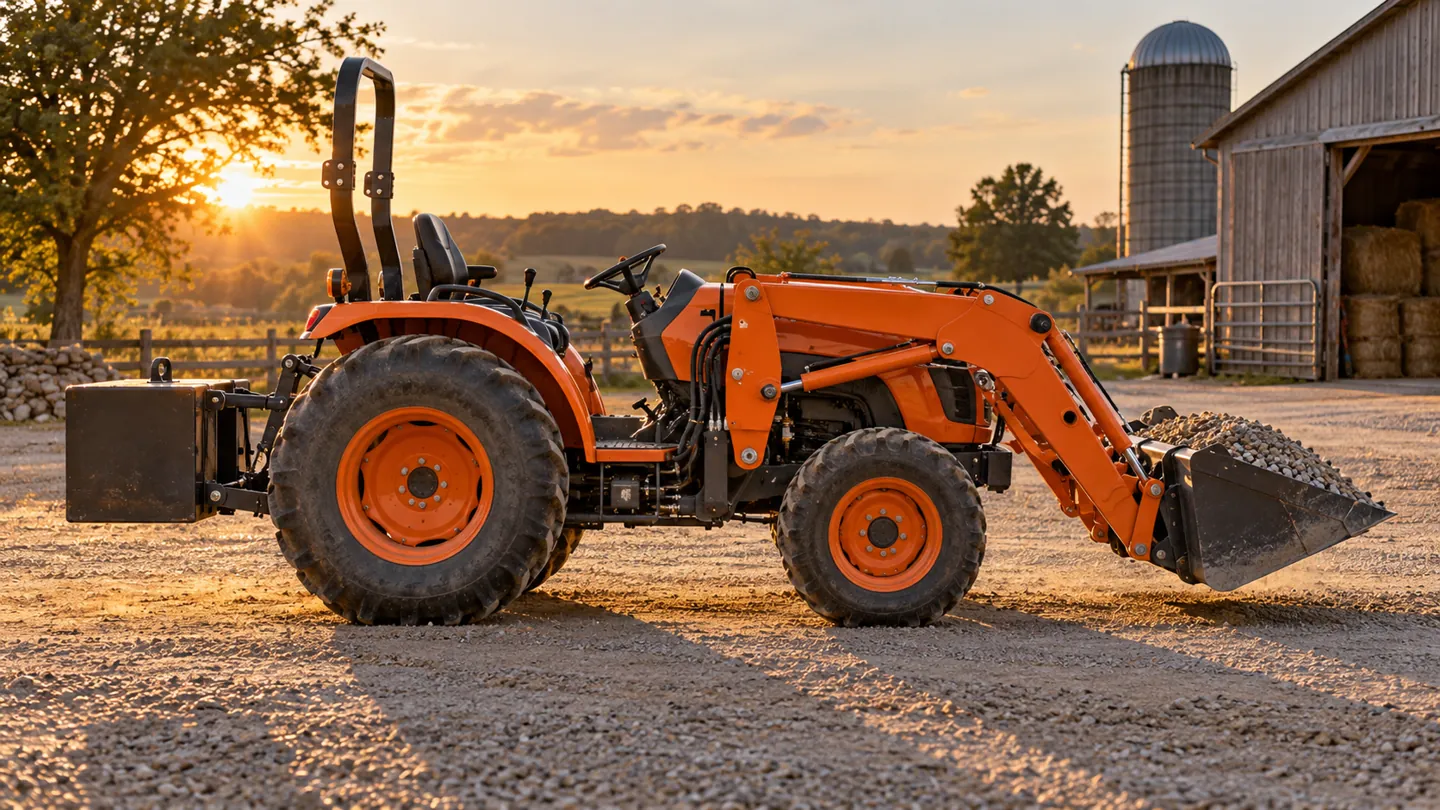
Buy the tractor with the loader on it if you can. A front end loader added later almost always costs more than the same loader bought with the tractor. The subframe, valve, hoses and shop labor get priced one piece at a time.
Owners who have done it both ways report a gap of a thousand dollars or more. On an older tractor with no kit, the gap can be much wider.
Dealer listings we found in October 2026 put a new factory loader alone at roughly $3,400 to $6,000. One Kubota dealer listed a new LA344 for the BX series at $3,400. New Deere 120R listings ran from about $3,800 to $6,000 depending on what was bundled.
Those are asking prices, not list prices. Get an itemized quote with and without the loader before you sign. An aftermarket loader can still make sense on an older tractor, if you know what the mounting really involves.
The short version
- Factory loaders match your tractor’s frame, hydraulics and warranty. Aftermarket loaders cost less up front but usually need mounting work.
- Compare lift ratings only at the same measuring point. The pin number is about a third bigger than the number 500 mm forward.
- A quick coupler costs lift. Kubota rates the LA340 at 739 pounds at the pin, and the LA340S with the coupler at 613 pounds.
- Plan on rear ballast from day one. Kubota lists about 420 pounds of 3 point counterweight for the BX23S loader.
- Add a tooth bar or cutting edge first, then hooks, then forks.
Factory loader vs aftermarket loader
A factory loader is built and rated for your exact tractor. An aftermarket loader is a general design adapted to fit it. That difference shows up in fit, hydraulics, warranty and resale, and price is the only place aftermarket usually wins.
Fit and hydraulics
Factory loaders bolt to holes the tractor maker already put in the frame. The valve, hoses and control lever are sized around the tractor’s pump.
Take the Kubota BX2380. Its detailed specifications list the LA344S with a loader valve, a grille guard and a 48 inch bucket. The loader comes off and goes back on without tools.
Aftermarket loaders often need new brackets or modified mounts. Owners consistently report that factory subframes bolt up cleanly, while aftermarket ones can call for drilling or fabrication. If you are not set up for that, budget for a shop to do it.
Warranty
Expect your dealer to care. Kubota’s implement limitations sheet for the BX series says the tractor was tested with approved implements. Failures caused by improper implements are not covered by the warranty, which the BX2380 sheet lists as 24 months or 1,500 hours.
Owners tell mixed stories. Some report a dealer refusing a claim because an aftermarket loader was on the tractor. Others say a claim was only at risk when the loader caused the failure.
Ask your dealer in writing how they would treat an aftermarket loader before you buy one.
Resale
A tractor with its matching factory loader is simple for a buyer to understand. The loader carries a model number a buyer can look up. A loader with unusual mounts makes some buyers cautious.
We found no resale data, so treat this as a judgment call. If you may sell within a few years, that alone can settle the question.
How to read front end loader specs
Loader specs measure four things: lift, digging force, height and speed. The trap is that two loaders can look different on paper only because they were measured at different points. The numbers below come from Kubota’s BX23S operator’s manual and Deere’s 120R loader page.
Lift capacity: at the pin vs 500 mm forward
Lift capacity at the pin is measured right at the pivot where the bucket attaches. Lift capacity at 500 mm forward is measured about 20 inches out, near where a real load sits. The second number is always lower, and it is the more honest one.
| Loader and tractor | Lift at the pin, full height | Lift 500 mm forward, full height | Max height to pin |
|---|---|---|---|
| Kubota LA340 on BX23S (pin on bucket) | 739 pounds | 509 pounds | 71 inches |
| Kubota LA340S on BX23S (quick coupler) | 613 pounds | 423 pounds | 71 inches |
| John Deere 120R on 2025R | 803 pounds | 553 pounds | 72 inches |
| John Deere 120R on 1025R | not published | 517 pounds | 72 inches |
Read the table two ways. Across brands, the pin number and the 500 mm number differ by about 30 percent. So you never compare a pin figure from one brand with a 500 mm figure from another.
Within Kubota’s own table, the quick coupler version lifts 126 pounds less at the pin and 86 pounds less at 500 mm. The coupler adds weight and pushes the bucket forward. That is the price of swapping tools in a minute.
Deere also publishes lift at 59 inches of height, which is closer to pickup bed height. The 120R on a 2025R lifts 957 pounds at the pin and 688 pounds at 500 mm there.
Third party spec sites give 739 and 509 pounds for the LA344 on the BX2380, the same as the LA340. Kubota’s BX2380 sheet does not print them, so confirm with your dealer.
Breakout force
Breakout force is how hard the loader can pull a bucket free of packed ground. It matters for digging and for scooping from a hard pile.
Kubota lists the LA340 at 1,407 pounds at the pin and 987 pounds at 500 mm. Deere lists the 120R on a 2025R at 1,963 pounds at the pivot and 1,335 pounds at 500 mm.
Breakout only helps if your tractor can keep its rear tires on the ground. A bucket that lifts the rear instead of digging means you need more ballast, not more loader.
Max height and cycle time
Max lift height is how high the pivot pin rises. On a sub compact, 71 to 72 inches is typical. The number you actually use is clearance with the bucket dumped, and Deere lists 51.3 inches for the 120R, so a tall pickup bed gets tight.
Cycle time is how long the loader takes to raise, lower, dump and roll back. Both makers publish it. The LA340 raises in 3.3 seconds and lowers in 2.5, while the 120R raises in 3.7 and lowers in 2.6.
Those times follow hydraulic flow. The BX2380’s sheet lists a 5.2 gpm implement pump plus a 1.0 gpm steering pump, 6.2 gpm total. You cannot change the tractor’s pump, so ask for a demo before you buy.
Matching a loader to your tractor
The loader has to fit the tractor’s frame, its hydraulic system and its control setup. Fit is not only about horsepower. A strong front end loader on a light tractor lifts the rear tires and works the front axle hard.
Mounting frame
The mounting frame, or subframe, bolts to the tractor and carries the loader uprights. It spreads the load into the tractor’s frame and axle housings.
Do not hang a loader from parts that were never meant to carry one. Use the frame the loader maker specifies for your exact model and serial number range. Brackets change between years.
Hydraulic flow and valve type
The loader needs oil from your tractor’s pump and a valve to direct it. If the tractor has no loader valve or aux block, the kit must include one. Some tractors already have a front remote valve, which makes a retrofit much easier.
The loader runs on the same fluid as the transmission and 3 point, so use what your manual names. Our tractor hydraulic fluid guide explains what to use.
Two lever or joystick
Many factory loaders come with a single joystick that lifts and curls from one handle. Some older and aftermarket loaders use two levers, one for lift and one for bucket curl. Owners who switch to a joystick almost always call it a big improvement, because you can lift and curl in one motion.
If you may ever run a grapple or a hydraulic snow blade, ask for a joystick with a third function button now. Kubota offers a third function valve as a BX2380 loader option, and adding it at purchase is cheaper than later. Our tractor grapple guide covers third function valves, diverters and kit costs in detail.
Quick attach systems and buckets
A quick attach system lets you swap buckets and tools without pins and a hammer. The style on your loader decides which attachments you can buy. Order the loader with a coupler if you will ever own more than a bucket.
Two styles cover most compact tractors. The skid steer style, called SSQA, has the biggest pool of new and used attachments. The Euro or Global style is common on larger tractor loaders, and adapters exist in both directions.
Kubota calls its sub compact version a 2 lever quick coupler. On the BX2380, the LA344S comes with it and a 48 inch bucket. The plain LA344 comes with a 48 inch pin on bucket that lifts more but is slow to swap.
Check the bucket width against your tractor. A bucket should cover the tire track so the tires do not run over the pile. Most sub compacts do well with 48 to 54 inch buckets, and a wider bucket means more weight forward of the pin.
Adding a loader to a tractor that never had one
You can add a loader to most tractors with an approved kit, but the loader is the cheap part. You also need a subframe, uprights, a control valve, hoses and a return line to the tank. Buy them as a complete kit if you can.
Owners who have pieced one together put it plainly. Buying the parts separately costs more than a complete kit. An aftermarket loader on a used tractor can come close to doubling what you paid for the tractor.
What a retrofit takes
- Confirm that your tractor has an approved loader kit. Get the part numbers for your serial number from the dealer.
- Price the full kit: subframe, uprights, valve, hoses, control lever, bucket and quick coupler.
- Check the hydraulics. Some tractors need an aux block, and most need a return line to the transmission or tank.
- Add rear ballast before the first bucket of dirt.
- Get a dealer quote for assembly, because shop time can be a big part of the total.
Retrofitting makes sense in three cases.
- A complete used loader with its valve and subframe is on offer at a fair price.
- Your tractor already has the loader valve ports or a front remote.
- You can fabricate or modify mounts yourself.
If none of that applies, selling the tractor and buying one with a loader is often the better move. Our tractor sizing guide and list of sub compact tractors worth buying can help you pick a replacement.
Essential front end loader accessories and which to add first
Add a tooth bar or a cutting edge first, then bucket hooks, then forks. That order follows how often most owners use each one, and the first two cost the least.
1. Tooth bar
A clamp on tooth bar turns a smooth bucket into a digging tool. It bites into hard soil and gravel that a flat edge slides over.
The clamp on tooth bar for sub compact buckets fits cutting edges 1/2 inch or less. It comes in several widths, so measure your bucket inside the side plates and match it.
Skip a tooth bar if you mostly move loose mulch, feed or snow.
2. Bolt on cutting edge
A cutting edge is a replaceable steel strip along the bucket lip. It protects the bucket and lets you scrape clean.
A bolt on cutting edge suits a worn bucket. Check that the width and bolt holes match yours. A tooth bar and a thick edge may not fit together.
3. Hooks for lifting
A grab hook with a backer plate lets you lift logs, stones and chains the right way. Without one, owners tend to wrap chains around the bucket teeth or the lip. That bends buckets and drops loads.
A Grade 70 bolt on grab hook is the basic fix, and it needs no welder. The hook’s rating is not the limit. The load hangs forward of the pin, where the loader lifts less.
4. Pallet forks
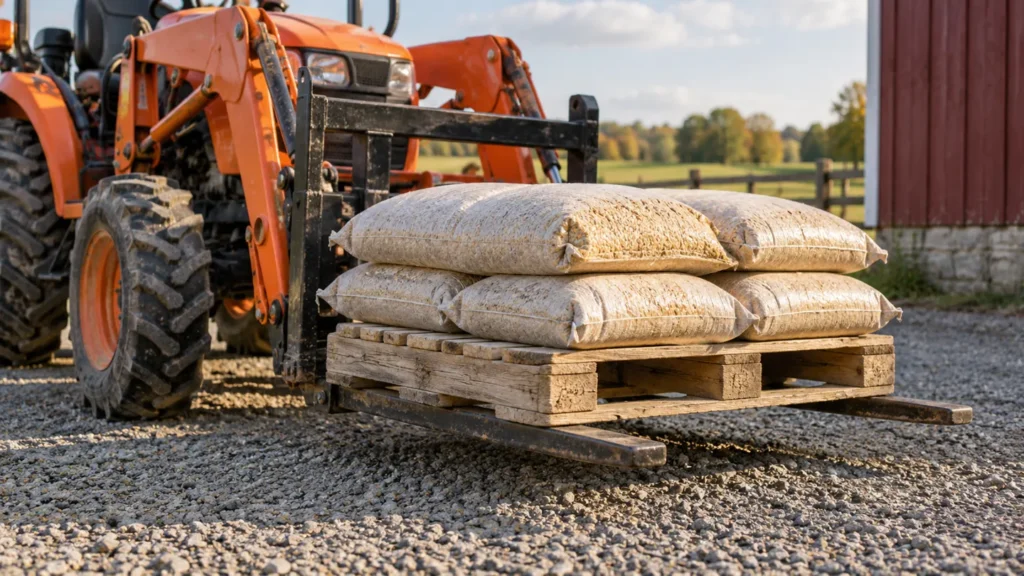
Forks move pallets, fence rolls, feed bags and lumber. They also lift stumps and logs better than a bucket.
Clamp on pallet forks rated at 2,000 pounds fit over a bucket lip. Stay within your loader’s rated capacity, not the forks’ rating. A 2,000 pound fork rating does not make a 500 pound loader a 2,000 pound loader.
Skip clamp on forks if you plan to swap often or carry near the limit. A quick attach fork frame is faster and puts the load closer to the pin. Kubota lists one as a BX2380 option.
Rear ballast with a loader
A loader needs rear weight, because a loaded bucket acts like a lever on the front axle. Without a counterweight the rear tires get light, steering goes vague and the front axle carries the strain. Kubota’s BX23S manual says to add rear ballast as 3 point counterweight and rear wheel ballast, in an amount that depends on the job.
The same manual lists what Kubota expects on the hitch. A box blade, rear blade, tiller or ballast box of about 420 pounds counts as the counterweight for the LA340. The BT603 backhoe at about 586 pounds does the same job.
Those are Kubota’s approximate implement weights, not a hard maximum. Match the weight to your own tractor’s manual.
Extension guidance agrees. The University of Maine loader safety bulletin says to add rear weight to offset the front load, and to follow the operator’s manual. Ohio State’s loader safety sheet recommends rear wheel weights or weight carried on the 3 point hitch.
Where you put the weight matters. Weight behind the rear axle does the most to unload the front, so a 3 point counterweight beats loaded tires for loader work. Fluid in the rear tires adds stability, but owners disagree on how much it relieves the front axle.
A ballast box hangs on the 3 point hitch. An 800 pound Cat 1 ballast box can be filled with gravel, sand or scrap steel. A sub compact does not need it full.
Check that your tractor’s lift can handle the full weight. The BX2380 sheet lists 3 point lift at 550 pounds, measured 24 inches behind the lift points. Read our 3 point hitch category guide if you are unsure about Cat 1 and limited Cat 1.
For a formula and sizing help, use our ballast guide and the free tractor tools. A simple test is to lift a heavy load slowly. If the relief valve opens before the rear tires leave the ground, you have enough weight.
Common front end loader mistakes
The most common mistakes are overloading, carrying the bucket high, running without ballast and ignoring tire pressure. Each one can damage the tractor or tip it.
Overloading
Stay inside the rated capacity at the 500 mm point, not the pin. Load the bucket evenly and keep heavy items close to the loader frame. Never use the loader to pull fence posts, tow or knock things down, as the Maine bulletin warns.
Carrying the load high
Keep the bucket low when you drive. Maine and Ohio State both say to carry loads low. Ohio State adds that you should raise the bucket only on level ground.
Owners report tractors tipping with a raised bucket on ground that looked nearly flat. On a slope, drive forward uphill with a load and back down. Never cross a slope with the bucket up.
Running without ballast
Without rear weight, the front axle takes every load. At least one BX owner reports a steering cylinder failure after loader work with little counterweight. That is a single report, but it fits the mechanics, and Kubota’s manual tells you to ballast for a reason.
Wrong tire pressure
Too little pressure lets the front tires squat under a full bucket. Owners warn that a soft tire can even roll off the rim in a turn.
Many owners run front tires at or near the sidewall maximum on a tractor with a loader. Kubota’s BX23S manual only says to inflate the tires properly before loader work. Follow your tire sidewall and your manual first, and never exceed the sidewall maximum.
Other mistakes
- Pushing or prying with a raised loader.
- Letting anyone ride in the bucket or stand under it.
- Leaving the bucket raised when you leave the seat.
- Skipping the seat belt on a tractor with a ROPS.
Set the rear wheels as wide as is practical, too. If your loader work includes grading, a box blade on the rear doubles as the counterweight Kubota lists.
Bottom line
Buy the tractor with a factory front end loader when you can. It fits, it keeps the warranty question simple and it costs less than adding one later. Judge lift capacity at 500 mm, not at the pin, and know that a quick coupler trades some lift for convenience.
Add rear ballast from the first day, carry loads low and start with a tooth bar or cutting edge. A retrofit is possible, but price the whole kit before you fall for a cheap loader alone.
Frequently asked questions
Can any tractor take a loader?
Not every tractor can. It needs a frame that can carry the loader, hydraulics that can run it and enough weight to stay stable. A very light tractor or one with no kit available is a poor candidate, so ask a dealer about your model.
Is a joystick worth the extra money?
For most owners, yes, because a joystick lets you lift and curl in one motion. Owners who switched from two levers almost always call it a big improvement. If a grapple is in your future, pick one with a third function option.
How much weight can my loader really lift?
Use the 500 mm number from the maker’s sheet as the limit for a slow, level lift. That is 509 pounds for a Kubota LA340 and 517 pounds for a Deere 120R on a 1025R. Real loads sit forward of the pin, so the pin number overstates what you can carry.
Do I need a quick attach loader?
If you swap tools often, yes. It saves time and keeps you off the ground. A pin on bucket lifts a bit more and works fine if your loader only ever carries a bucket.
Can I use pallet forks on a small loader?
Yes, within the loader’s rated capacity. The loader’s rating is the limit, not the forks’. Keep loads close to the carrier and drive slowly.
Does an aftermarket loader void the tractor warranty?
Kubota says failures caused by unapproved implements are not covered. Owners report mixed results with dealers. Ask for the dealer’s position in writing before you buy.
How much rear ballast do I need?
Follow your loader manual first. Kubota lists about 420 pounds of implement on the hitch for a BX23S loader, and owners of similar tractors often land between 300 and 500 pounds. Test by lifting a heavy load, and if the rear tires lift before the relief valve opens, add weight.