
How-To
How Much Ballast Does a Tractor Need? Rear Weight for Loaders
How much tractor ballast you need depends on your loader, tractor and job. Learn to read the ballast chart, compare rear weight options and fill tires safely.
IN THIS GUIDE JUMP TO A SECTION +
As an Amazon Associate, TractorFolk earns from qualifying purchases. Links to products on this page may earn us a commission at no cost to you.
Scoop a full bucket of wet dirt and raise it. A compact tractor with no tractor ballast behind the rear axle changes character fast. The rear tires go light, the front axle carries almost everything, and the steering turns vague.
Ballast is the fix. It is weight behind the rear axle that keeps the back end planted and the front end steerable. How much you need is printed in your loader and tractor manuals, and that chart beats every rule of thumb.
On a Kubota BX, for example, the manual counts a box blade or ballast box as roughly 420 pounds of counterweight. When no chart exists, owners lean on a rough rule: 75 to 100 percent of the loader’s lift capacity. Then they test with a full bucket.
The short version
- Your loader manual sets the minimum rear ballast for your tractor, loader and tire type. Start there.
- With no chart, a common rule of thumb is 75 to 100 percent of the loader’s lift capacity. It is a starting point, not a spec.
- Weight on the 3 point hitch does the most for loader work because it sits behind the rear axle. Loaded tires and wheel weights add traction but barely unload the front axle.
- Fill tires to 75 percent, never more. Never put liquid or weights in the front tires.
- Take weight off when the job is done. Too much ballast wears tires, axles and the transmission.
Why tractor ballast matters
Ballast matters because it controls stability, traction, steering and rollover risk, all at once. A tractor is a balance machine, and every implement you hang on it moves that balance. A front loader shifts the center of gravity forward, and a raised load moves it forward and up.
That forward shift is what makes a loader dangerous. Canada’s occupational safety agency lists driving with a loaded, raised loader as a cause of side rollovers. It also puts side rollovers at about 85 percent of all tractor rollovers.
Its advice is blunt. Use counterweights, follow the manufacturer’s instructions, and keep the bucket low.
Traction is the second job. Weight over the drive tires lets them bite. You spin less when you push into a pile or pull a loaded trailer.
Steering is the third. A heavy implement on the back lifts the front wheels, and light front wheels don’t turn a tractor. Weight on the nose fixes that case, which gets its own section below.
Loader weight versus rear implement weight
Loader work and rear implement work pull the balance in opposite directions. A loader makes the tractor nose heavy, so you add weight behind the rear axle. A heavy rotary cutter or tiller makes it tail heavy, so you may need weight up front.
Most small tractor owners run a loader far more often than a heavy rear implement. That is why most of this article lives at the back of the tractor.
How much ballast does a tractor need?
A tractor needs the rear ballast its loader manual calls for. That figure is set for the exact tractor, loader and tire type. On a Kubota BX23S with the LA340 loader, it is about 420 pounds on the 3 point hitch.
Other pairings differ. The chart decides, and the rules of thumb only get you close.
How to read the ballast chart in your manual
Look in the loader manual first. Then check the tractor manual’s chapter on tires, wheels and ballast. Most brands put the chart in the loader manual because the loader is what changes the balance.
Check for these things:
- The minimum rear weight for your loader and tractor pairing. It is often listed by implement or by ballast box.
- The tire type the chart assumes. Turf, bar and industrial tires can carry different figures.
- Where the weight goes: on the 3 point hitch, in the tires, on the wheels or some mix.
- The maximums, which matter as much as the minimums.
Charts belong to a pairing, not just a tractor. In May 2018 the US Consumer Product Safety Commission announced a recall of about 11,500 John Deere 120R loaders. The hazard was not the loader itself.
The operator’s manual left out the ballast information for use on a 2025R tractor. An improperly ballasted tractor can be unstable. No injuries were reported, and the fix was a dealer correction to the manual.
The lesson is simple. Use the chart for your exact loader and tractor. If the two do not appear together, ask your dealer.
What Kubota’s chart shows for a BX
Kubota’s operator manual for the BX23S, LA340 loader and BT603 backhoe shows how a real chart reads. Its “implement as counter weight” table lists four implements at approximately 190 kg (420 pounds): box blade, rear blade, rotary tiller and ballast box. The backhoe is listed at approximately 266 kg (586 pounds).
Those are the implements the manual expects on the hitch while you run the loader. The same manual caps front ballast at 125 kg (275 pounds). With the loader on and the backhoe off, it also tells you to fit the optional rear wheel weight.
Owners of other BX models commonly quote the same 420 and 275 pound figures from their own manuals. Confirm them in yours. Loader and tire options change the numbers.
A rule of thumb when the chart is vague
Some manuals give only general wording, such as matching rear ballast to the job. A widely repeated rule of thumb then applies. Put 75 to 100 percent of the loader’s maximum lift capacity on the rear.
This is a rule of thumb that circulates among owners and dealers, not a manufacturer figure. Here is the math. A loader rated to lift 600 pounds suggests about 450 to 600 pounds of rear weight.
Use the lift rating printed in your loader manual, not a brochure number. The manual’s figure is the one the chart was built around.
Owners also talk about a second rule. The rear axle should carry at least 25 percent of total weight with a loaded bucket raised. That is another rule of thumb.
Checking it means putting the tractor on a scale, so most people rely on the field test below.
The field test that tells you if it’s enough
Load the bucket with your heaviest material and raise it to carrying height. Watch the rear tires and feel the steering. If the rear feels light, the steering goes vague or the back wheels skip in turns, you need more weight.
Owners commonly report starting with a box blade. They add more only when the tractor feels squirrelly under a full load.
Do this on level ground at a walking pace, with the seat belt on and the ROPS up. Never explore your limits on a slope.
Rear ballast options compared
There are four main ways to add rear ballast: a ballast box, an implement used as ballast, wheel weights and loaded tires. Each puts weight in a different place, and the place matters more than the pounds. Weight behind the rear axle unloads the front, while weight at the axle mostly adds traction.
| Option | Where the weight sits | Best for | Watch out for |
|---|---|---|---|
| Ballast box | On the 3 point hitch, behind the rear axle | Loader work, since it unloads the front end most | Stay inside your hitch and axle limits. Fill it only to the weight your manual allows. |
| Implement as ballast (box blade or rear blade) | On the 3 point hitch | Owners who already own and use the implement | A light blade may fall short. Keep it low while you carry a load. |
| Wheel weights | On the rear wheels, at the axle | Traction and a lower center of gravity | Little help for the front axle. Some makers forbid them with liquid fill. |
| Loaded (liquid filled) tires | Inside the rear tires, at ground level | Traction and stability on slopes | Needs the right valve and fill gear. Never fill past 75 percent. |
Ballast box
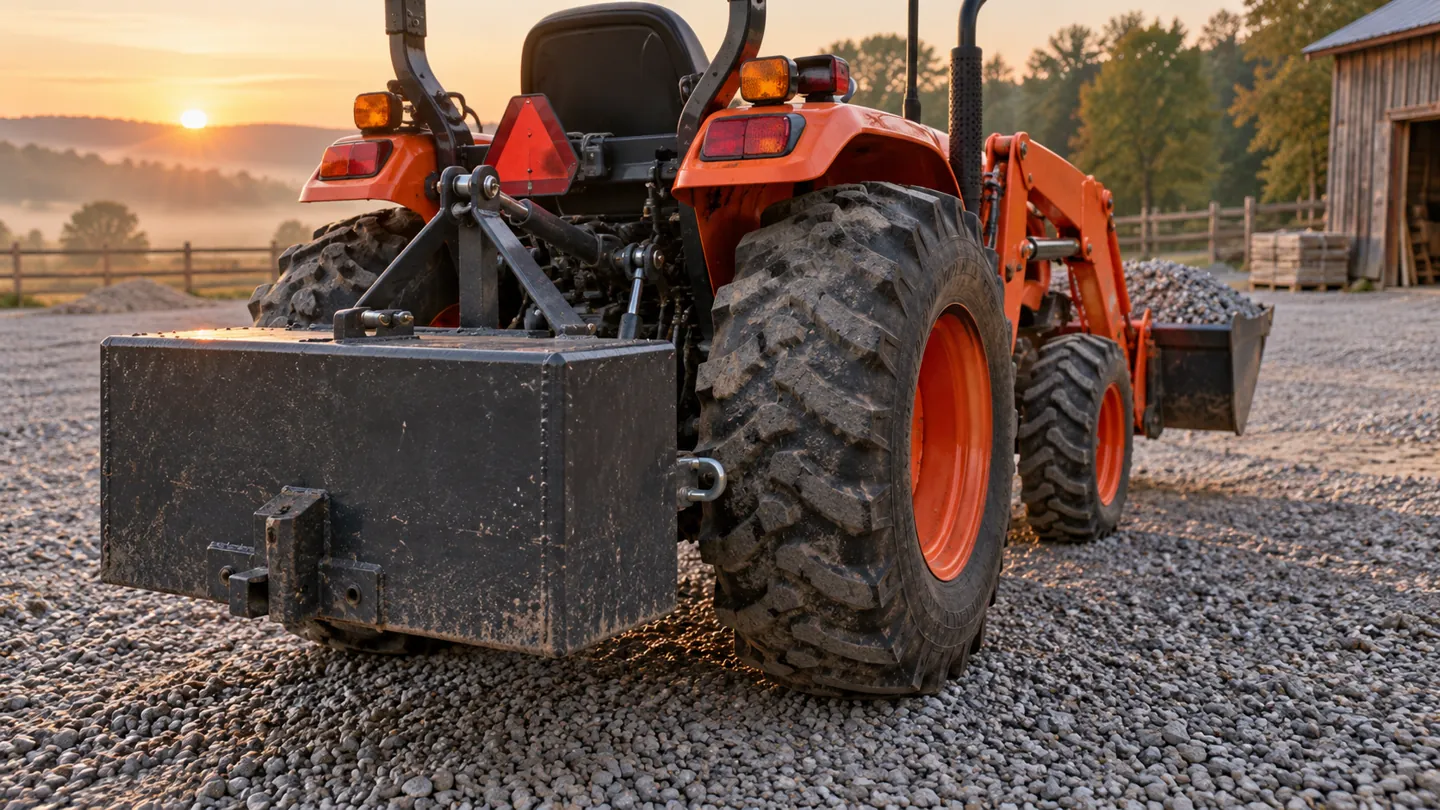
A ballast box is a steel box that hangs on the 3 point hitch. You fill it with concrete, sand, gravel or scrap steel. It is the cleanest answer to rear ballast for a loader.
The weight sits well behind the axle, where it levers the front end up. That takes load off the front tires and the front axle. Nothing else on this list does that as well.
For a Cat 1 hitch, the YINTATECH 800 pound 3 point ballast box fits most sub compacts and small compacts. Its listed capacity is far more than a BX class tractor needs. Fill it to your manual’s figure and stop.
Skip it if you already own a heavy box blade you use every week. If you are unsure which hitch size you have, see our 3 point hitch categories guide.
An implement as ballast
A box blade or rear blade is the cheapest ballast, because you already need the tool. Kubota’s BX chart counts one at roughly 420 pounds. Owners often report that a 300 to 500 pound blade is enough for a sub compact with a light loader.
The catch is that the hitch stays busy. If you want ballast while you load a trailer, the blade has to stay on and ride low. Our box blade buying guide covers weights by width, so you can pick one that doubles as ballast.
Wheel weights
Wheel weights bolt to the rear wheels, add traction and lower the center of gravity. Because they sit on the axle, they do almost nothing to lift weight off the front. Owners commonly report they are not enough on their own for heavy loader work.
Some tractors instead carry cast iron suitcase weights on a 3 point bracket. That puts them behind the axle where they count. A YINTATECH 3 point receiver with suitcase weight brackets holds them and leaves a receiver tube free.
The John Deere 42 pound suitcase weight, UC13263 is the OEM weight many of these brackets are built around. Confirm the part number and the bracket fit for your model and serial number before you order.
Read the fine print before you mix methods. Kubota’s BX manual says not to use rear wheel weights and liquid ballast at the same time, to avoid transmission damage. Pick one unless your own manual allows both.
Loaded tires
Filled rear tires add weight low down, where it helps stability on slopes. On the BX23S, each 26 inch rear tire holds about 99 to 123 pounds of liquid at a 75 percent fill, depending on the mix. That is a useful gain on a light tractor, but it is not hitch weight.
Owners repeatedly make the same point. Loaded tires make the rear heavier and steadier, but they do not take weight off the front axle. They sit on the axle rather than behind it.
Use them for traction and slope work, and add hitch weight for loader balance. The BX manual adds a note worth knowing: with a heavy implement mounted, liquid in the tires may not be needed. Many BX owners run a box blade on dry tires and never miss the fill.
Liquid ballast: what to put in the tires
The common liquids are calcium chloride solution, beet juice, windshield washer fluid and antifreeze. Each has a different weight, freeze point and risk. Plain water works in frost free climates, but it freezes and can wreck a tire.
| Liquid | Weight per gallon | Freeze protection | Main pros and cons |
|---|---|---|---|
| Water | 8.3 pounds | None | Cheapest. Freezes and can damage tires, so not for cold climates. |
| Calcium chloride solution (about 31 percent) | 11.3 pounds | Down to minus 58 F | Heaviest and cheap. Very corrosive, so inner tubes are required. |
| Beet juice (sold as Rim Guard) | About 11.0 pounds | Down to minus 35 F | Non corrosive and non toxic. Costs more. |
| Windshield washer fluid | 7.6 pounds | At least minus 25 F | Cheap and non corrosive. Lighter than water, so it adds the least. |
| Antifreeze (ethylene glycol, 50/50) | 9.4 pounds | Down to minus 34 F | Very toxic to animals if a tire leaks. Among the costliest options. |
The figures come from Yanmar’s liquid ballast guide. Other sources list slightly different weights for the same liquid. Treat them as close, not exact.
Calcium chloride: the heavy, cheap choice
Calcium chloride gives the most weight per gallon for the money and keeps the fill from freezing. Kubota’s BX23S manual lists three mixes for its 26 inch rear tire, all at a 75 percent fill.
About 2 pounds of calcium chloride per gallon of water gives 99 pounds per tire. It stays slush free to 14 F.
About 3.5 pounds per gallon gives 110 pounds and holds to minus 11 F. About 5 pounds per gallon gives 123 pounds and holds to minus 52 F.
The downside is corrosion. Calcium chloride eats steel rims. Yanmar says inner tubes are required or the wheels will corrode quickly.
Mixing also gives off heat, so the solution has to cool before it goes in. The BX manual sends you to a tire dealer for the service. Most owners agree that is the sane route for calcium.
Beet juice and the rest
Beet juice is the cleaner option. It does not corrode wheels, it is not toxic, and it weighs nearly as much as calcium chloride. The tradeoff is price, plus a trip to a dealer or tire shop that stocks it.
Windshield washer fluid is safe for rims, cheap and easy to pour yourself. It is lighter than water, so it adds the least weight of the group. Antifreeze is toxic to pets and wildlife if a tire fails, so most owners skip it.
Fill level and the tools you need
Fill tires to 75 percent of capacity, with the valve stem at the 12 o’clock position. The reason is simple physics. Air compresses like a cushion and water does not.
A tire filled to 100 percent has no give. The BX manual marks that fill as incorrect.
You need a way to push fluid through the valve and a way to check pressure afterward. An air water adapter kit for tractor tires is the tool if you fill your own tires with washer fluid or beet juice. The TR218A air liquid valve stems are the common replacement when an old stem corrodes or weeps.
Check pressure on a filled tire with the valve stem at the top, using a gauge made for air and water. An AstroAI pencil tire gauge reads the low pressures most small tractor tires run. A cheap gauge is also easy to replace when liquid gets into it.
Skip these items if a tire shop does the fill for you.
Front ballast for heavy rear implements
Front ballast is needed when a heavy implement on the 3 point hitch lifts the front wheels and you lose steering. Canada’s safety guidance says to add front end weights when raising heavy rear mounted equipment. The BX manual says the same in its own words.
Heavy pulling and heavy rear mounted implements tend to lift the front wheels. Add enough ballast to keep steering control and prevent a tip over. Remove it when you no longer need it.
The same manual sets a ceiling of 275 pounds of front weight on the BX23S and warns not to overload the tires. Other models have other limits. Find yours before you stack weights on the bumper.
A rotary cutter is the classic case, especially when you raise it to turn at the end of a pass. A heavy tiller or a loaded carry all does the same thing. Our rotary cutter buying guide lists cutter weights, so you can see what your front end is up against.
Do not fill the front tires with liquid or bolt weights to them. The BX23S manual forbids both, because it hurts steering control. Use the bracket mounted front weights your maker sells, and stay under the limit.
Ballast for sub compacts with a loader or backhoe
A sub compact with a loader needs weight on the hitch before you carry anything heavy. These are the lightest tractors that carry loaders, and a bucket of wet dirt is a big share of what the whole machine weighs. If you are still choosing a machine, our guide to front end loaders for compact tractors explains the lift ratings you will see.
Owners of 21 to 25 hp sub compacts commonly report running around 400 to 600 pounds on the hitch for loader work. They go heavier for rock and gravel.
That matches the shape of Kubota’s roughly 420 pound figure for a BX. They are owner reports, though, not a chart for your model.
Deere owners have the same job. The loader manual for a 120R on a 1023E, 1025R or 2025R carries the ballast chart. Deere now calls its sub compacts the 1E 23, 1M 25 and 1R 25, so you may see either name.
The 2018 recall above is the reason to make sure your copy is the corrected version. If the chart is missing or confusing, your dealer can print it.
Adding a backhoe
With a backhoe mounted, the backhoe itself becomes the rear counterweight. The BX23S chart lists the BT603 at roughly 586 pounds for that purpose. It says ballast is not required for normal work with the BX23S, LA340 and BT603 connected in factory settings.
It also says never to remove the loader while the backhoe is on. The loader keeps the tractor stable at the other end.
Liquid in the tires has to come out while the BT603 is installed. That surprises people who filled their tires for loader work, and it is why many BX23S owners run dry tires. Check your own backhoe manual before you run both.
Model specific manuals
If you own a BX, our Kubota BX maintenance guide lists fluids and capacities for the line. Deere owners can find the same in the John Deere 1 Series maintenance guide. Neither replaces your ballast chart.
Common tractor ballast mistakes
The most common mistakes are too little weight, too much weight and weight that is not secured. Each one shows up the same way. The tractor feels wrong, or something breaks.
Too little
Too little weight is the dangerous mistake. The signs are a light rear end with a loaded bucket, a wandering front end, and rear wheels that skip in turns. Raising a heavy load high makes all of it worse, so keep the bucket low when you travel.
Never let skill stand in for missing weight. Even with correct ballast, the BX manual says to drive slowly over rough ground with a heavy implement raised.
Too much
Too much weight is the quiet mistake. Extra pounds strain tires, axles, bearings and the transmission every hour the tractor runs. The manual’s maximums exist for that reason.
The BX manual says to add no more than the stated limits and to remove ballast when you no longer need it. A box left on the hitch all year is wear you are paying for. Drop it when the loader comes off.
Weight that is not secured
Weight that comes loose is a hazard to everyone nearby. Check that bolt on weights are tight and that hitch pins have their clips. Make sure whatever is inside a ballast box cannot shift or fall out on a slope.
Concrete poured in place is safest. Loose blocks or scrap need a lid or a strap. Look at all of it before each loader job, since a walk around takes a minute.
Mixing methods the maker doesn’t allow
Some combinations are banned outright. On the BX, rear wheel weights and liquid ballast cannot be used together, and liquid comes out when the backhoe goes on. That is why you read the manual before you buy ballast, not after.
Use the TractorFolk ballast calculator
TractorFolk has a free ballast worksheet on our free tractor tools page that does the subtraction for you. You enter the rear ballast your manual requires and the qualifying ballast already on the tractor, in pounds or kilograms. It shows the difference you still need to add.
Only weight your manual permits in the specified location counts. That is why the tool asks you to confirm that first.
It is arithmetic, not a stability calculation, and it does not guess a figure for you. Your manual’s chart still has the last word. Your axle, tire and hitch limits still need a separate check.
If you are still working out what machine you need, our tractor sizing guide is the place to start.
Bottom line
Match your tractor ballast to your loader and your manual’s chart. Put most of it on the 3 point hitch, where it levers weight off the front axle. Add loaded tires or wheel weights for traction, not as a substitute.
Take weight off when you don’t need it. If the rear feels light under a full bucket, add weight before you do anything else.
Frequently asked questions
How much weight should I put on the back of my tractor with a loader?
Start with what your loader manual’s chart calls for. If it is vague, a common rule of thumb is 75 to 100 percent of the loader’s lift capacity. Then test with a full bucket on level ground and add weight if the rear feels light.
Is a box blade enough rear ballast?
For many sub compacts with a light loader, yes. Kubota’s BX manual counts a box blade or rear blade at roughly 420 pounds as counterweight. Owners often add a ballast box or filled tires when they move rock or wet gravel.
Do loaded tires replace a ballast box?
No. Loaded tires add weight at the axle, which helps traction and stability. They do little to take weight off the front axle, and hitch mounted weight does that much better.
What is the best liquid to put in tractor tires?
Calcium chloride is the heaviest and cheapest, but it is corrosive and needs tubes. Beet juice weighs nearly as much and does not corrode wheels, but it costs more. Pick based on your climate and whether you want to pour it yourself.
Can I put ballast in the front tires?
Not liquid, and not wheel weights either on a Kubota BX. The manual says not to add liquid ballast or any other weights to the front tires. Use front weights mounted on the tractor instead, and stay under the maker’s limit.
Can I have too much ballast?
Yes. Too much strains tires, axles and the transmission, and the manual’s maximums are there for that reason. Add only what the job needs, and take it off when you’re done.
Is a counterweight the same as ballast?
For practical purposes, yes. A counterweight on a tractor is weight placed to offset a load on the other end, such as a bucket of dirt. Manuals and safety guides use both words for the same idea.