Maintenance
Tractor Hydraulic Fluid Guide: UTF, Brand Fluids and What to Use
Universal tractor fluid is not universal. Learn which spec each brand's manual wants, how to read a jug label, how much a compact holds, and what happens when the fluid is wrong.

IN THIS GUIDE JUMP TO A SECTION +
As an Amazon Associate, TractorFolk earns from qualifying purchases. Links to products on this page may earn us a commission at no cost to you.
“Universal” tractor fluid is not universal. The right tractor hydraulic fluid is the one your operator’s manual names. A jug that says universal only counts if the back label lists that exact spec.
The word on the front is marketing. The approvals on the back are the product.
Most compact tractors run one sump. It feeds the transmission, the hydraulics, the wet brakes and often the PTO clutch. One fluid has to do four jobs at once, and plain hydraulic oil does only one of them well.
This guide covers what those jobs are and which spec each brand wants. It shows how to read a label and what goes wrong when the fluid is wrong. It also covers the real exceptions, like log splitters and some vintage tractors.
The short version
- Use the fluid and spec named in your operator’s manual. Brand names on the jug matter less than the approvals printed in the fine print.
- Keep motor oil and ISO 32 or 46 hydraulic oil out of a shared sump. The only exception is a manual that names them.
- Kubota calls UDT and Super UDT2 fully interchangeable. John Deere says to match J20C to Hy-Gard and J20D to Low Viscosity Hy-Gard.
- Wrong fluid shows up as brake chatter, clutch slip, a slow cold HST and early wear.
- A sub compact holds about 3 gallons. A Kubota BX changes it every 400 hours and an LS MT125 every 500. A TYM T264 changes it at 50 hours, then every 500.
- Hydraulic oil still has a job on standalone systems such as log splitters.
Why does a tractor use trans hydraulic fluid instead of plain hydraulic oil?
A tractor uses trans hydraulic fluid because one reservoir has to do everything. It lubricates gears, powers the hydraulics, and keeps wet brakes and clutches working. The fluid is often called UTF, UTTO or THF, and they all describe the same family of products.
Think about what is sitting in that oil. Gears and bearings need anti wear protection. The hydraulic pump needs a fluid that stays at a steady thickness.
Wet brake discs and wet clutches need a specific amount of friction.
That last job is where plain hydraulic oil fails. Ordinary hydraulic oil has no friction modifiers tuned for wet brake discs. Without them, brakes can grab, squawk or chatter.
John Deere’s own Hy-Gard parts page lists what the fluid serves: transmissions, final drives, hydraulic pumps, wet brakes and wet clutches. Kubota says much the same on its lubricants page.
The LS MT125 manual says it outright. Its transmission oil also serves the hydraulic lift and the steering.
Some tractors split the work and keep a separate hydraulic circuit. The manual will show it with two fill points. If yours has one fill point and one dipstick, it shares a sump.
Is universal tractor fluid really universal?
No. Universal means a fluid is made to cover many jobs in one machine. It does not mean one jug fits every brand.
Each maker writes its own approval spec. Examples are Kubota UDT, John Deere J20C, Ford New Holland M2C134D, CNH MAT 3525 and Massey Ferguson CMS M1143. A fluid can meet several of these at once, and the best ones list each by name.
There is a second problem. John Deere states that no industry classification exists for transmission and hydraulic oil. It also says it does not monitor competitive or “will fit” oils, and some may not meet even its minimum requirements.
That is the maker protecting its own product, so read it with that in mind. It is still a fair warning. A claim on a label is only as good as the company that printed it.
Which tractor hydraulic fluid does my tractor need? Specs by brand
The spec depends on the maker, and in several cases on the model. This table shows what the makers publish in their manuals and parts pages. For brands whose manuals we could not read directly, it shows what owners report.
| Brand | Named fluid or spec | What to know |
|---|---|---|
| Kubota | Super UDT2 (UDT also permitted) | The BX manual lists Super UDT2 and permits regular UDT. Kubota calls the two fully interchangeable. Official. |
| John Deere | J20C (Hy-Gard), J20D (Low Viscosity Hy-Gard) | Hy-Gard sits between ISO 46 and 68. Low Viscosity Hy-Gard is ISO 32 and is built for cold. Use whichever the manual lists. Official. |
| Case IH and New Holland (CNH) | MAT 3505, MAT 3525, MAT 3540 | Mobil’s data sheet lists MAT 3505 and 3525 as CNH specs. Owners and dealers describe Hy-Tran Ultraction as the current CNH fluid under MAT 3540. No CNH data sheet was available to us, so confirm the MAT number in your manual. |
| Massey Ferguson (AGCO) | Permatran family; CMS M1143, M1145 | AGCO’s parts page lists M1143 and M1145 as the Massey transmission oil specs. Owners report Permatran 821XL as a 10W-30 blend for current compacts. The 821XL details are owner reports. |
| Kioti | Kioti branded UTF, or named Shell, Mobil, Exxon and BP fluids | Owners report manuals naming Shell Donax TD, Mobilfluid 424, Exxon Hydraul 560 or BP Tractran UTH. Front axles take gear oil or the same fluid, by model. Owner reports only. |
| Mahindra | Mahindra Universal Tractor Fluid | Owners report manuals naming only the brand. One eMax manual reportedly lists GL-4 80W on one page and the Mahindra fluid on the next. Owner reports only; read your lubrication table. |
| LS | API GL-4, ISO VG 32/46 (LSTH400G) on the MT122 and MT125 | From the LS operator’s manual, so official for the MT1 series. Owners report larger models calling for ISO VG 46/68. Front axle takes GL-4 SAE 80W gear oil. |
| TYM | API GL-4 UTF; named Caltex, Texaco and Chevron fluids | The T25 manual calls for a GL-4 fluid, ISO VG 32 below minus 4 F and ISO VG 46 above. The T264 manual names Caltex RPM Tractor Hydraulic Fluid, Texaco TDH or Chevron 1000THF. Official. |
Kubota, Deere, LS, TYM and AGCO rows come from material we read directly. The CNH, Kioti and Mahindra rows rest partly on what owners say their manuals state. Those reports sometimes contradict each other.
That is why the manual is the authority. If it lists a spec, buy a fluid that lists the same spec.
Kubota: UDT, Super UDT and Super UDT2
Kubota sells UDT and Super UDT2 and says they can be mixed into each other’s systems. The BX1880 to BX2680 operator’s manual recommends Super UDT2 “instead of standard hydraulic/transmission fluid”. It adds that regular UDT is also permitted.
Kubota describes Super UDT2 as an all weather fluid with better performance at high and low temperatures.
Owners argue about whether the upgrade is worth the extra money. A former Kubota dealer mechanic on one forum said the shop consensus was plain UDT. He saw Super UDT as mainly for very cold climates.
Plenty of other owners say Super UDT2 is worth the small difference. They put it at a few dollars a gallon.
Kubota’s page does not say what the base oil is. Owners disagree on whether UDT is mineral or a blend, so we won’t guess.
John Deere: J20C, J20D and Hy-Gard
Deere says Hy-Gard is for all applications calling for J20C. It says Low Viscosity Hy-Gard is for all applications calling for J20D.
The published operating ranges differ. Hy-Gard runs from minus 13 degrees F to 122 degrees F. Low Viscosity Hy-Gard runs from minus 40 degrees F to 86 degrees F.
Deere says Low Viscosity Hy-Gard is compatible with its older hydrostatic fluid.
One Deere retail listing says Hy-Gard works where either spec is called for. Deere’s parts material takes the stricter line. Follow the stricter line unless your dealer confirms otherwise in writing.
LS and TYM: specs the manuals actually print
The LS MT122 and MT125 operator’s manual lists the transmission oil as API GL-4, ISO VG 32/46. The recommended fill is the LS product LSTH400G. The same table calls for API GL-4 SAE 80W gear oil in the front axle.
Larger LS models reportedly step up to ISO VG 46/68, so check your own table.
TYM’s T25 manual asks for an API GL-4 grade fluid. It wants ISO VG 32 below minus 4 degrees F and ISO VG 46 above it.
The T264 manual instead names products. They are Caltex RPM Tractor Hydraulic Fluid or Textron TDH Premium, Texaco TDH Oil, and Chevron 1000THF. All are universal tractor fluids by another name, so match the GL-4 and viscosity callouts on the jug.
What does “meets J20C” really mean? How to read a jug label
“Meets J20C” means the maker of the jug says its product satisfies the Deere spec. It does not mean John Deere approved it. Deere says plainly that it does not approve JDM J20 oils from other companies.
That does not make every will fit fluid bad. Established lubricant makers print long approval lists and stand behind them. The skill is telling a real list from a vague one.
Four checks before you buy
- Find the spec in your manual and write it down exactly, including letters and numbers.
- Flip the jug and find that exact spec in the approvals or “meets or exceeds” text. A match on “Kubota UDT” is not a match on “Super UDT2”.
- Check the wording. “Recommended for” and “meets or exceeds” are different claims, and good labels say which one applies.
- Check the grade. Some approvals apply to one viscosity grade of a product line, not every grade. Mobil’s Mobilfluid 424 sheet, for example, lists the exact specs and gives viscosity numbers you can compare.
Be wary of labels that say only “for all tractors”. Avoid the cheapest general purpose bucket fluids sold as 303.
Owners across several brands warn against it, and one calls it molasses in the cold. A TYM dealer on one thread said never to use it in an HST.
What goes wrong when you use the wrong fluid?
The wrong tractor hydraulic fluid usually shows up first as noise and sluggishness, then as wear. The symptoms depend on which job the fluid fails.
Brake chatter and squeal
Wet brakes that chatter or groan on application often point to a friction problem in the fluid. Owners with J20C tractors report that an anti chatter additive in premium fluids is what keeps wet discs quiet. Deere sells a noise reducing fluid and a PEMO additive for this exact complaint on some older models.
Deere also warns that if chatter continues after a correct fluid change, the cause is probably mechanical. It suggests ruling out water contamination first. Do not assume fluid fixes every noise.
PTO or clutch slip
Wet clutches need enough grip to transmit power. A fluid that is too slippery lets the clutch pack slide. That feels like a weak PTO or a clutch that will not fully engage, and heat from the slipping then damages the plates.
A slow or sticky HST
A hydrostatic transmission is the most sensitive part of the system. It relies on fluid thickness and a clean supply to the pump. A heavy or wrong fluid makes the tractor slow to move, especially when cold.
Owners on several forums describe cold start sluggishness after using a thick general fluid. Some fixed it by moving to a lighter spec.
One Kioti thread warned that thick fluid can starve the pump and cause cavitation. Treat that as an owner’s warning rather than a manufacturer’s finding.
Seal and pump wear
A fluid with the wrong additives or thickness protects gears and pumps less than the maker planned. Deere warns that fluids outside its requirements could lead to premature failures. That wear is slow, so the bill often arrives long after the mistake.
Cold weather sluggishness
Cold makes any fluid thicker, so a spec built for warm climates gets worse in winter. Deere’s Low Viscosity Hy-Gard exists for this reason. TYM’s T25 manual drops from ISO VG 46 to ISO VG 32 below minus 4 degrees F, and Kubota says Super UDT2 performs better at low temperatures.
Can I use motor oil or ISO 32 or 46 hydraulic oil in my tractor?
No, not in a tractor with a shared sump, unless your manual names it. Motor oil and straight hydraulic oil are built for different jobs than trans hydraulic fluid.
The picture is not completely clean, because owners report some tractors whose manuals do specify engine oil for the hydraulics. One forum thread describes a dealer suggesting 15W-30 engine oil for a Mahindra. Other owners replied that the manual decides.
The rule is simple: the manual wins. If it prints a GL-4 and ISO VG grade, as LS and TYM do, buy a fluid that prints both.
Where hydraulic oil does belong
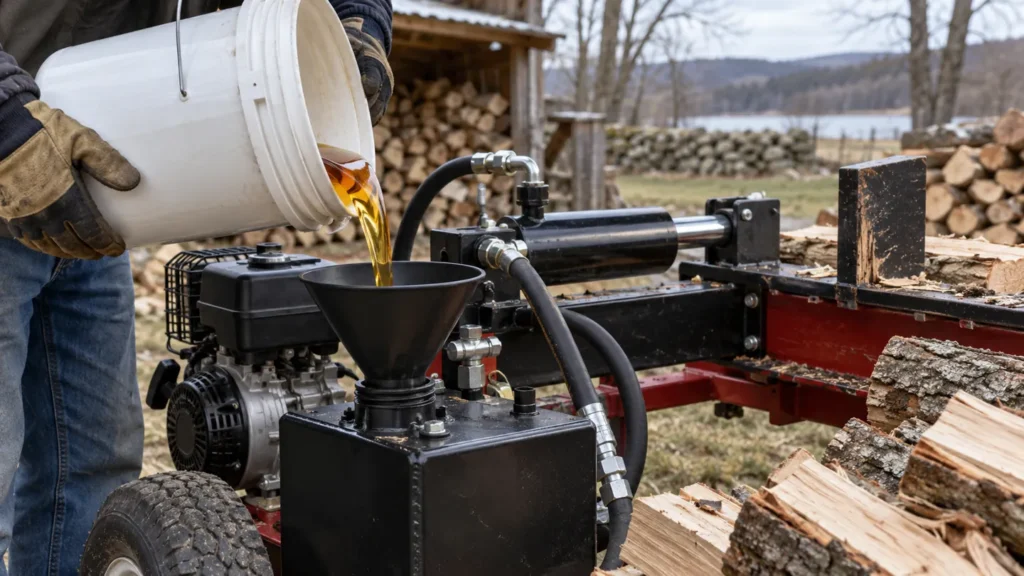
Standalone hydraulic systems are the exception. A log splitter or a dump trailer has its own tank and no wet brakes. These usually want an AW 32, 46 or 68 hydraulic oil, depending on the equipment maker.
If you own a splitter, AW hydraulic oil is the right product for it. Starfire AW32 hydraulic oil in a 5 gallon pail covers a splitter and a dump trailer, with plenty left over for top ups later. Check the splitter’s manual for the viscosity first, and never pour it into a tractor transmission.
Can you mix tractor hydraulic fluids or top up with a different brand?
You can usually top up a small amount with a fluid that meets the same spec. Mixing is still a compromise, not a best practice. Hydraulic fluids have no single industry standard, so “compatible” claims are loose.
Kubota is clear on its own fluids: UDT and Super UDT2 are fully interchangeable. Deere says Low Viscosity Hy-Gard can be added to systems that contain its hydrostatic fluid. Those are the safest mixes because the maker states them.
Across brands, owners disagree. Some say mixing is fine because the base oils are similar, and others say the additive packages can fight each other. One thread reports a CNH dealer saying two fluids separate when mixed, a claim we could not verify.
The practical rules are short.
- Top up a small amount with a fluid that lists your exact spec.
- If the tractor is low a gallon or more, plan a full change instead of stacking brands.
- If a previous owner put in something unknown, change the fluid and filter before you trust the machine.
One owner with an unknown fluid in a Deere got this advice: full drain, filter change, flush, then a J20C refill. That is one member’s advice, not a manufacturer procedure. Your shop manual has the correct steps for your model.
Synthetic vs conventional, and what to use in cold climates
Synthetic or conventional matters less than the spec. For cold climates, the viscosity rating matters more than the base oil.
Kubota does not publish the base oil of UDT or Super UDT2 on its lubricants page. Owners disagree about it. Look at the published numbers instead.
Mobil, for example, lists a pour point of minus 42 degrees C and a viscosity index of 145 for its Mobilfluid 424. Numbers like these let you compare cold performance.
In truly cold country, look at the low temperature spec your maker offers. Deere’s Low Viscosity Hy-Gard is rated to minus 40 degrees F. TYM’s T25 manual switches to ISO VG 32 below minus 4 degrees F.
Kubota owners in cold regions often choose Super UDT2 for easier winter starts, though the evidence is anecdotal.
A parked HST tractor in a warm shed also starts easier than one left in a cold barn. That costs nothing and helps with any fluid.
How much fluid does a compact tractor hold, and how often is it changed?
A sub compact holds about 3 gallons. The manual sets the change interval, which runs from 400 to 500 hours on the models below. These figures come from the operator’s manuals themselves, not from parts guides.
| Model | Transmission and hydraulic capacity | Fluid change | Filter |
|---|---|---|---|
| Kubota BX1880, BX2380, BX2680 | 11.3 liters (3.0 gallons) | Every 400 hours | First 50 hours, then every 200 hours |
| LS MT122, MT125 | 11.5 liters (3.0 gallons). With a loader first installed, 13.0 liters (3.4 gallons). With loader and backhoe, 17.7 liters (4.7 gallons). | Every 500 hours | First 50 hours, then every 250 hours |
| TYM T264 | 14.5 liters (3.83 gallons) | First 50 hours, then every 500 hours | First 50 hours, then every 500 hours |
Two details from those tables are easy to miss. The LS manual says to add fluid after a loader or backhoe is first mounted. The cylinders and hoses hold fluid that came out of the sump.
Kubota’s BX manual also calls for cleaning the transmission strainer at the same 400 hour fluid change.
Larger compacts and utility tractors hold more, often well past 10 gallons, and their intervals differ. Owners of the same model sometimes report different intervals because manual editions changed.
Read the maintenance chart in the manual that matches your serial number. The BX operator’s manual shows what a complete chart looks like.
Many owners change fluid and filter sooner if the tractor works hard or sits in dust. Our Kubota BX maintenance guide shows how a typical schedule fits together.
Tools that make a fluid change easier
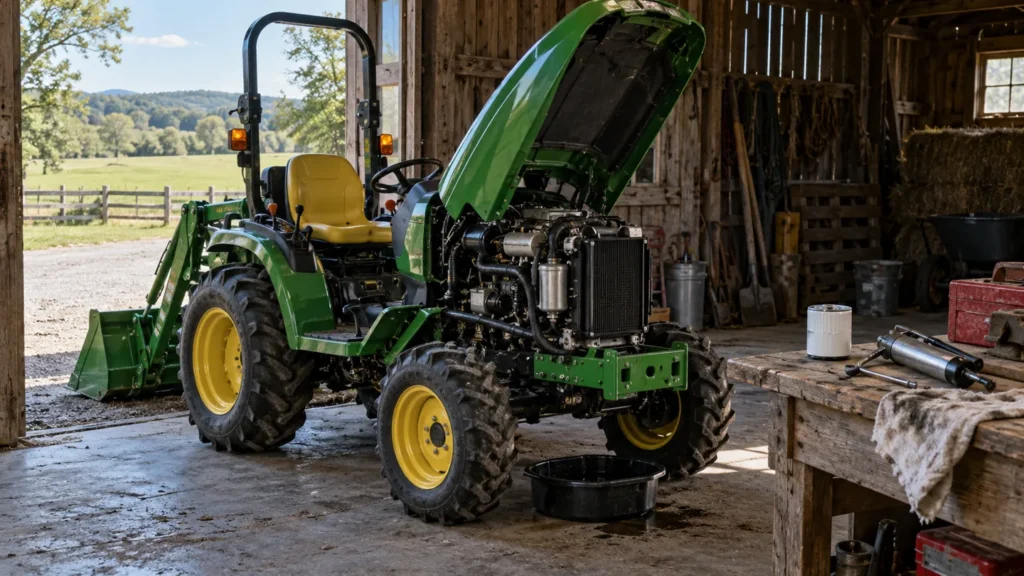
A drain pan with real capacity matters more than most owners expect, because even a sub compact lets out 3 gallons. A NEIKO 2 gallon drain pan catches a BX or MT125 in two pulls of the plug. A utility tractor needs draining in stages or a bigger pan.
Filling through a small port is slow with a gallon jug. A Slippery Pete pump for gallon jugs keeps it tidy and keeps dirt out of the fill. Skip it if you only top off a few ounces.
Which fluid should I buy? OEM or aftermarket
For tractor hydraulic fluid, buy the maker’s own fluid if your tractor is under warranty or has an HST. Consider a well labeled aftermarket fluid only if the tractor is older and you have confirmed the spec. OEM fluid costs more, but it removes the argument if something fails.
For a Kubota, genuine Kubota Super UDT2 in a 1 gallon jug is the safe choice. The fluid is interchangeable with UDT, so you do not need to match an older tractor’s original fill.
For a Deere that calls for J20C, John Deere Hy-Gard in a 1 gallon jug is the OEM answer. If your manual calls for J20D, you need Low Viscosity Hy-Gard instead, so check before you order.
Aftermarket universal fluids exist for owners who want one product across several machines. TRIAX Agra UTTO XL is a synthetic blend sold as a universal trans hydraulic fluid. Check that its current label lists the spec your manual names before you pour it in, and skip it for an HST under warranty.
What about vintage tractors?
Vintage tractors often predate modern universal fluids, and their specs changed over time. The Ford 8N is the familiar example, and what follows comes from owner reports, not Ford literature. Owners report that its transmission, rear axle and hydraulic lift share one sump of 4 to 5 gallons.
They say the original Ford spec was a mild EP gear lube, SAE 90 above freezing and SAE 80 below. Ford later moved to a multigrade fluid, the M2C134D spec, which CNH no longer makes. Many owners now use a universal tractor fluid that lists that spec.
Overfilling is a known problem on these tractors. One owner drained more than 3 extra gallons from a 1949 8N. The excess had leaked onto the brakes and axle seals.
Our Ford 8N buyer’s guide covers the tractor itself.
Other vintage tractors keep the hydraulics apart from the transmission, and we could not verify the fluid for each model. Find your tractor’s original manual, then compare it to what current fluid makers list. The vintage section has more on older machines.
Common mistakes to avoid
- Buying by the word “universal” without reading the approvals on the back.
- Putting gear oil or 303 fluid in an HST sump because the jug was handy.
- Assuming the front axle takes the same fluid as the transmission. LS and TYM manuals call for SAE 80W gear oil there. Kubota’s BX manual allows Super UDT2 or SAE 80 to 90 gear oil.
- Overfilling. Excess fluid can leak past seals, as one 8N owner found.
- Skipping the filter and strainer when changing fluid.
- Forgetting to top up after mounting a loader or backhoe for the first time.
When to call the dealer
Call the dealer when the fluid spec in your manual looks wrong or incomplete. Owners report manuals for some models that name only a brand or contradict another page. Your serial number can settle it.
Call before draining if the tractor is under warranty and you are changing brands. Call also if brake chatter or a sluggish HST continues after a correct fluid and filter change. By then the cause is likely mechanical.
More upkeep topics are in our Own section.
Bottom line
Match the fluid to the spec in your manual, not to the word universal. Use the OEM fluid when you are unsure.
Treat motor oil and straight hydraulic oil as wrong for a shared sump unless the manual says otherwise. Check the label approvals, keep the filter fresh, and change the fluid on the schedule your manual sets.
Frequently asked questions
Can I use Kubota UDT in a tractor that calls for Super UDT2?
Yes. Kubota says UDT and Super UDT2 are fully interchangeable, and the BX manual says regular UDT is permitted. If your tractor has an HST or runs in cold weather, many owners still prefer Super UDT2.
Is Hy-Gard the same as J20C?
Hy-Gard is Deere’s own fluid for machines calling for the J20C spec. Deere says its fluids exceed the minimum J20 requirements. A bottle that says “meets J20C” is a different product from another company.
Will the wrong fluid ruin my tractor right away?
Usually not. The first signs are brake noise, a weak PTO or a slow HST. Damage builds with use, so change the fluid early if you find a mistake.
Can I put hydraulic oil in my tractor loader?
If the loader runs off the tractor’s shared sump, no. It uses the same trans hydraulic fluid as everything else. Only a loader with its own tank might take AW hydraulic oil, and only if the manual says so.
Do I need a different fluid for the front axle?
Often yes. The LS MT125 and TYM T25 manuals call for GL-4 SAE 80W gear oil in the front axle, while Kubota’s BX manual allows Super UDT2 or SAE 80 to 90 gear oil. Check the manual because it varies by model.
Is Super UDT2 worth the extra cost?
Owners are split. A former Kubota dealer mechanic reports little real world difference between UDT and Super UDT. Others say it shifts smoother and handles cold better, and the few dollars a gallon are small next to a repair bill.
How do I know which spec my tractor needs?
Look in the lubricants and capacities section of the operator’s manual. If you lack the manual, a dealer can look it up by serial number. Browse the Kubota brand page, the John Deere brand page or the Kioti brand page for model guides.