Implements & Attachments
Pallet Forks for Tractors: Clamp On vs Quick Attach
A fork rating means little when your loader lifts far less at the end of the tines. Compare clamp on and quick attach pallet forks, sizes, standards and safety.
IN THIS GUIDE JUMP TO A SECTION +
As an Amazon Associate, TractorFolk earns from qualifying purchases. Links to products on this page may earn us a commission at no cost to you.
Kubota rates the LA344 loader on a BX2380 at 739 pounds at the bucket pivot pin. Move the load 500 mm (about 20 inches) forward and the rating falls to 509 pounds. That is a 31 percent drop before you add a single fork tine, and pallet forks put the load farther out than that.
The rating stamped on the forks matters far less than what your loader carries at the tine tips.
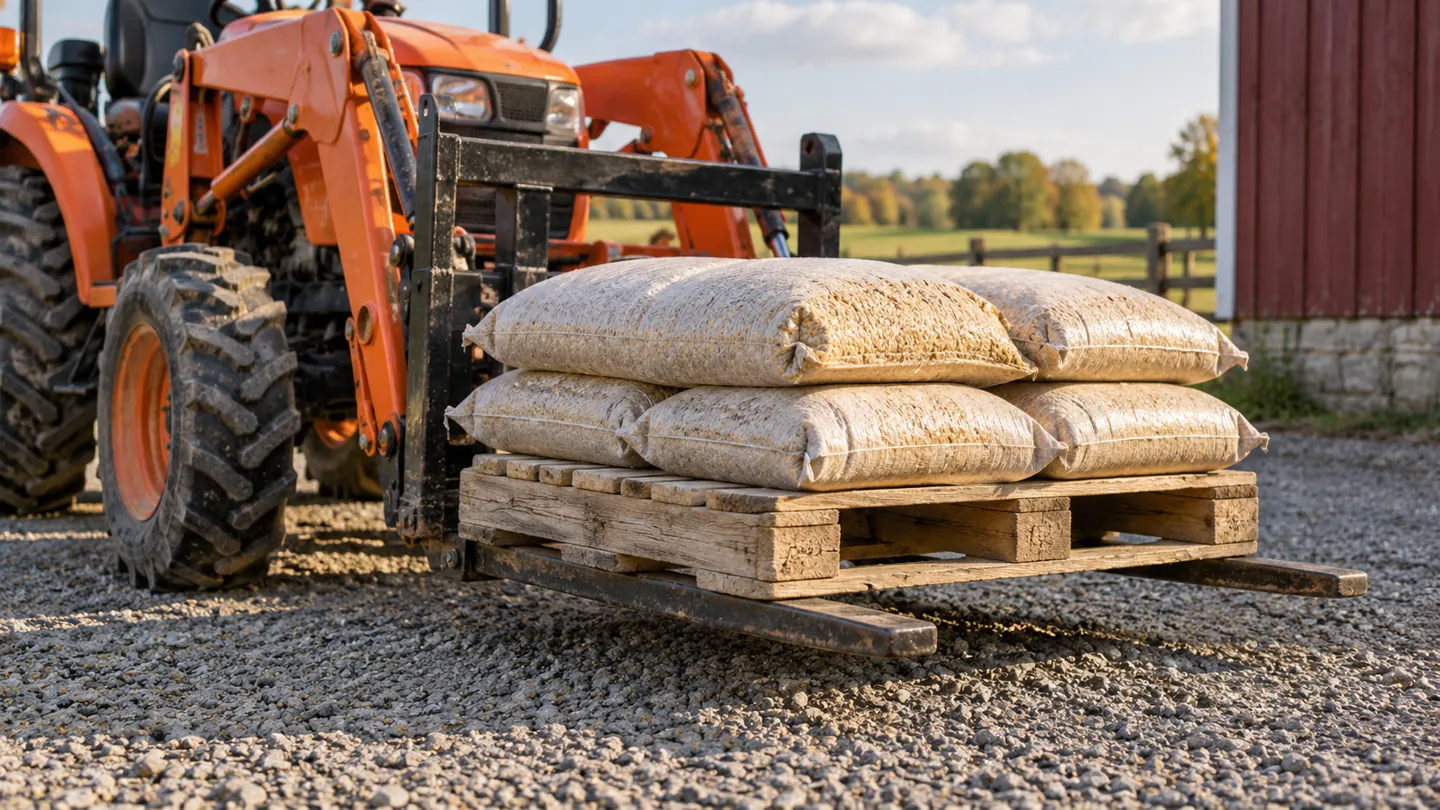
Clamp on forks are the cheap, light duty option that rides on the bucket you already own. A quick attach fork frame costs more, but it holds the load closer to the loader and stays square. Pick by how much you lift, how often you lift it, and which coupler your loader has.
The short version
- Your loader’s rated lift, not the fork rating, sets your real limit. Kubota’s BX figures drop from 739 lb at the pin to 509 lb at 500 mm.
- Clamp on forks suit light, occasional jobs. For regular pallet work, buy a fork frame that matches your loader’s quick attach.
- Shorter tines (32 to 42 inches) keep the load closer on a sub compact or compact tractor.
- Do not carry large round bales on forks. Use a bale spear or grapple.
- Keep the load low, add rear ballast, and strap clamp on forks to the bucket.
Clamp on vs quick attach pallet forks: how each mounts and who each suits
Clamp on forks fasten over your bucket lip with bolts, clamps or hooks. Quick attach forks ride on a frame that locks to your loader carriage in place of the bucket.
One is cheap and uses the bucket you own. The other is a dedicated tool.
Clamp on forks (bucket forks)
Each tine has a pair of bolts or a hook that grips the bucket’s cutting edge and floor. You slide the forks on, tighten them, and add a chain or strap. Most buyers pick them for the price and because nothing else on the loader has to change.
The downsides are real. The bucket sits behind the tines, so the load rides farther from the loader pins than it would on a frame.
The bucket also blocks your view of the tine tips. Owners report that the forks drift out of square and spin sideways when you push a pallet.
Clamp ons suit someone who lifts feed bags or fence posts a few times a month. They are a poor fit for daily work or heavy loads.
Quick attach fork frames
A fork frame mounts to the loader the way your bucket does. The tines sit closer to the pins, and the frame holds them square. Swapping from bucket to forks takes a couple of minutes.
Kubota lists a 2 lever quick coupler fork frame (BX2415) and 32 inch forks (K9184) as loader options for the BX series. Deere sells its AP11F fork, with 42 inch tines, for its 100, 200 and 300 series loaders.
Owners in several threads favor frame style forks for real lifting. They cost more and add weight, but they do not stress your bucket. If you move pallets more than occasionally, this is the better tool.
Fork capacity vs loader capacity: why a 2,000 lb fork rating means little
A fork rating tells you what the steel can carry, not what your tractor can lift. Many clamp on forks are sold at 1,500, 2,000 or 4,000 pounds. A compact tractor loader will run out of lift, or tip the tractor, long before it reaches those numbers.
Start with the loader. Kubota’s BX80 brochure rates the pin on LA344 (BX2380) and LA340 (BX23S) at 739 lb at the pivot pin. At 500 mm forward, both at full height, the figure is 509 lb.
The quick attach versions (LA344S and LA340S) drop to 613 lb and 423 lb. The coupler alone costs you 126 lb at the pin and 86 lb at 500 mm.
How load center cuts the number
Load center is the distance from the loader’s pivot to the center of the load. The farther out it sits, the less the loader can lift.
The pin rating assumes the load hangs at the pivot. The 500 mm rating assumes it sits about 20 inches out.
A pallet on 42 inch tines puts its center of weight roughly 2 feet from the frame face. The frame itself sits ahead of the pins. Fork makers rate forks at a stated load center for the same reason.
Dealer listings for the Land Pride PFL1242, for example, say its 1,200 lb rating assumes a load 24 inches from the frame face. A real pallet therefore sits beyond Kubota’s 509 lb test point, so expect less.
Kubota’s brochure prints no lift figure for its forks. One owner quotes Kubota customer service listing 242 lb for the frame and forks.
Another reports a 310 lb sticker on a BX25D carriage.
Treat both as owner reports. Read the decal on your own carriage, and ask your dealer if there is none.
Subtract the weight of the tool
Forks and frames eat into your lift. Deere lists the AP11F at 247 lb. Owners quoting Kubota’s dimension sheet put the BX2415 frame with two K9184 forks near 275 lb.
Either one is about half of a 509 lb rating before the pallet goes on.
Clamp on forks weigh less, but they hang past the bucket lip. The load sits well beyond the 500 mm point.
Treat the loader’s 500 mm number as a ceiling. Subtract the weight of your forks, then assume less again for the longer reach.
If a pallet weighs more than what is left, move half of it. The front end loader guide shows how pin and 500 mm ratings compare across brands.
Fork length and frame width for compact tractors
On a sub compact or compact tractor, 32 to 42 inch tines are the sensible range. Longer tines put the load farther out, and the extra 6 inches of thick steel costs usable lift. A frame about as wide as your bucket is easiest around gates.
The table shows example products from manufacturer pages and dealer listings. The tractor classes are rough groupings, not a rating for your tractor.
| Tractor class (rough grouping) | Typical tine length | Example fork | Frame width and rating |
|---|---|---|---|
| Sub compact (about 20 to 25 hp, such as a Kubota BX) | 32 inches | Kubota K9184 forks on the BX2415 frame | Frame about 45 inches wide (owner quoted Kubota dimension sheet); no published rating |
| Compact (about 25 to 45 hp) | 42 inches | Land Pride PFL1242, rated 1,200 lb at 24 inches out (dealer listings) | 45 1/2 inch frame, about 220 lb (dealer listings) |
| Compact to small utility with a Deere 100, 200 or 300 series loader | 42 inches | Deere AP11F, rated 2,000 lb | 49 3/8 inches overall width, 247 lb (Deere) |
| Utility (45 hp and up) with a skid steer carriage | 48 inches | Land Pride PFL4648, listed at 4,500 lb (dealer listings) | 45 7/8 inch frame, about 412 lb (dealer listings) |
Frame width matters because a frame wider than your bucket is harder to thread through gates and barn doors. Adjustable tines let you set the spread for the pallet in front of you. If you are still picking a tractor, the tractor sizing guide and the best sub compact tractor list show which loaders carry real weight.
Quick attach standards: skid steer style vs Euro/Global, and adapters
Two quick attach systems dominate loader forks: the skid steer style (often called SSQA or universal) and Euro/Global. They are not interchangeable without an adapter. Check which one your loader uses before you buy a fork frame.
The skid steer interface is covered by ISO 24410. It was written for skid steer loaders, and ISO’s summary says it can also apply to couplers on other compact machines.
Other coupler styles exist on skid steers, but they are not interchangeable with attachments built to that standard. That is why “universal” plates fit so many brands.
Euro/Global is the tractor loader interface common on European and larger North American loaders. ISO 23206 covers carriages for attachments on agricultural tractor front loaders up to 30 kN.
Dealers and owners generally treat Euro/Global as that interface. We could not confirm the match from the standard’s text, which is paywalled.
It is a different shape from the skid steer plate. A skid steer fork frame will not mount on it directly.
Many brands use their own version. Kubota’s BX loaders use a 2 lever quick coupler, which is why Kubota lists its own fork frame (BX2415). Deere names the loader series each attachment fits.
Adapters convert one standard to another. They add weight and push the load farther out. Forks that match your loader’s native coupler avoid both problems.
If your loader takes skid steer attachments, a frame such as the Titan 48 inch skid steer pallet fork frame is an option. It requires a skid steer quick attach loader, and 48 inch tines move the load farther out than a sub compact loader likes.
Clamp on fork safety: chains, bucket damage and curl
Clamp on forks fail in predictable ways: they shift, they slide, and they stress the bucket. Most of it comes from overloading, loose clamps, or no safety chain. A few habits prevent nearly all of it.
Reported failure patterns
Owners repeatedly mention the following problems on tractor forums.
- Forks swivel out of square with the bucket edge, and spin when you push a load sideways.
- Thin single sheet buckets develop a dent or “smile” in the floor when overloaded.
- Clamp bolts dimple the bucket floor, and the lip bends if the clamps sit close to the edge.
- Stabilizer bars between the tines can slide off when you dump the bucket.
- Usable lift falls well below the loader’s rating, because the load hangs past the bucket lip.
What owners do about it
Owners wrap a ratchet strap or chain around both forks and the bucket. They tighten the clamps well back from the lip.
Some add a steel plate under the clamp bolts. Several advise moving to chains or a frame once loads pass a couple of hundred pounds.
Curl matters too. Curl is the bucket’s tilt angle, and a slight backward tilt keeps a pallet from sliding off the tines. Do not tilt so far that the tine tips point at the sky.
The risk is not theoretical. An Iowa farmer died when a round bale spilled from a 3 point bale fork set loosely in his loader bucket. The fork was chained at the top, nothing more.
The NIOSH FACE report recommends attachments designed and properly installed for the job, and carrying loads low.
Clamp on forks worth a look
For a budget set for light work, the VEVOR 2,000 lb clamp on forks are a reasonable pick. Stay within your loader’s rated capacity, not the fork rating. The YINTATECH 60 inch set is a longer alternative.
Sixty inch tines reach deep pallets, but they push the load far out. On a sub compact, they cost more lift than they are worth.
What pallet forks handle on a small farm
Forks handle palletized feed, fertilizer, building supplies, strapped firewood and fencing materials. They are a pallet tool first. They are a poor fit for anything that rolls.
Pallets and bagged goods
A pallet of feed or mulch is the classic job. Check the load’s weight before you lift. A single pallet of bagged goods can outweigh what a compact loader lifts at the tine tips.
Round bales, and why a bale spear is better
Round bales are the job owners most often try with forks, and it is the one to avoid. A round bale rolls and shifts on tines. A bale spear pins it through the center, and a grapple clamps around it.
Round bales are heavy. Extension tables put a 4 by 4 foot bale at roughly 500 to 560 pounds. A 5 by 5 foot bale runs about 1,000 to 1,100 pounds.
Our hay bale weight guide has the full numbers. Set that against 509 lb for a BX loader at 500 mm, and a 5 by 5 bale is out of reach.
Penn State Extension advises removing the bucket and using a grapple or spear for large bales. A tractor grapple is the safer way to handle bales, brush and logs.
Firewood and fencing supplies
Forks work for strapped firewood bundles, stacked fence posts and wire rolls on a pallet. Keep the load strapped and the tines level. Loose logs roll off the tine tips, so a grapple or bucket suits those better.
Rear ballast and keeping the load low
Rear ballast keeps the front wheels on the ground and the tractor upright when a loaded loader reaches out. A load on forks acts like a long lever, and your tractor’s rear end is the counterweight.
Without it, the rear lifts and the steering goes light. The tractor can tip forward or roll.
Kubota’s BX23S manual says to put an implement or ballast on the 3 point hitch to improve stability when using a front loader. The amount depends on the tractor and the job. Our ballast guide shows how to size it.
Safety guidance from NIOSH and Penn State comes down to the same habits.
- Keep the loader as low as possible while you drive. A raised load makes a side overturn far more likely.
- Use a tractor and loader that are up to the load, with the ballast the maker recommends.
- Keep the ROPS up and the seat belt on, and stay off slopes with a raised load.
With forks, carry the pallet low and tilted slightly back. Raise it high only when you are stopped, level, and ready to set it down. Drive slowly over rough ground, because a bump can bounce a heavy load off the tines.
Build quality: tine steel, frame, step through frames and adjustable tines
Good forks have thick tines, clean welds at the frame corners, and tines that lock firmly at any spread. Thickness and welds tell you more than a capacity sticker. Thin steel rated at 4,000 pounds is worse than a lighter set built well.
Here is what to check when you compare forks.
- Tine size. Deere’s AP11F tines are 1.18 by 3.13 inches, and dealer listings give the Land Pride PFL1242 tines as 1 1/4 by 3 by 42 inches. Owners quote Kubota’s K9184 at about 1.57 inches thick.
- Frame height. A tall back frame stops the load from sliding toward you. Some frames have cutouts to save weight and improve your view.
- Step through frames. Some frames leave the center open so you can step between the tines and see the tips from the seat. Not every compact frame offers it, so look at photos before you buy.
- Adjustable tines. A rail with locking pins lets you spread the tines for a wide pallet. Dealer listings give Land Pride’s compact fork a 5 position rail, and Deere’s tines lock at any position with set screws.
- Weight. Every pound of fork is a pound the loader cannot lift. A heavier rating that you can never use is dead weight on a small loader.
We could not verify steel grades from any manufacturer. Judge by thickness and weld quality, and buy from a seller with a return policy.
Mistakes owners make with pallet forks
Most pallet fork trouble comes from reading the fork rating as the lifting limit and carrying loads too high. The mistakes below show up again and again.
- Trusting the 2,000 lb sticker. Check your loader’s lift at 500 mm, then subtract the fork weight.
- Skipping the strap or chain on clamp on forks. They shift without one.
- Buying 60 inch tines for a sub compact. Short tines carry more.
- Lifting round bales on forks. Use a spear or grapple.
- Driving with the load raised. Carry it low and tilted back.
- Forgetting rear ballast. The rear tires should stay planted.
- Buying a skid steer frame for a loader that does not take one. Match the carriage first.
- Entering a pallet at an angle. Square up and go in slowly, or a tine catches a stringer.
Kubota’s BX80 implement limitations sheet says not to use implements it does not sell or approve, or that exceed its listed maximums. Failures caused by improper implements are not covered by the warranty. Check the BX80 brochure for your loader’s ratings before you buy anything.
Bottom line
Forks are only as capable as the loader behind them. Ignore the fork rating, plan around the loader’s 500 mm figure, and subtract the weight of the forks.
Buy a matching quick attach frame if you lift often. Keep clamp on forks strapped and for light jobs.
You can check your tractor against your jobs with the free tractor size and ballast tools.
Frequently asked questions
Can I use clamp on pallet forks on my existing bucket?
Yes, most buckets work if the lip is not too thick for the clamps. Check the fork’s stated lip thickness range. Strap the forks to the bucket and stay well under your loader’s rating.
How much weight can a compact tractor lift with forks?
Less than the loader’s 500 mm rating, which is 509 lb on a Kubota BX loader. The forks themselves weigh part of that, and the longer reach reduces it further. Test with a light load first.
What length forks do I need for a compact tractor?
Between 32 and 42 inches suits most sub compact and compact tractors. Longer tines push the load farther out and cost lift. Go longer only if you have a bigger loader and need to reach deep pallets.
Are Euro/Global and skid steer quick attach the same?
No. The skid steer style follows ISO 24410, and Euro/Global is a separate tractor loader carriage, generally matched to ISO 23206. A fork frame for one will not mount on the other without an adapter.
Can forks carry round bales?
They can physically, but they should not. A round bale shifts on tines, and a bale spear or grapple holds it securely. NIOSH and Penn State both point to attachments designed for the bale.
Do I need rear ballast to use forks?
Yes, in most cases. A load on forks pulls weight off the rear tires. Kubota’s manual advises an implement or ballast on the 3 point hitch when you use a front loader.
Are clamp on forks safe?
They are acceptable for light loads when strapped and tightened. They are not a good choice for heavy or high lifts. Overloading can bend the bucket, and loose forks can slide.