Implements & Attachments
Tractor Grapples: Root, Rock and Log Grapples Compared
A grapple's own weight can eat most of a compact loader's lift. Learn which type fits brush, logs, rocks and bales, and what hydraulics and mounts you need.
IN THIS GUIDE JUMP TO A SECTION +
As an Amazon Associate, TractorFolk earns from qualifying purchases. Links to products on this page may earn us a commission at no cost to you.
A 48 inch compact tractor grapple weighs about 310 to 320 pounds. John Deere’s spec sheet rates the H120 loader at 512 pounds with the load 500 mm ahead of the pivot. That leaves roughly 190 pounds before you count a quick attach frame or a single stick of wet oak.
So size the grapple to your loader first and pick the type second.
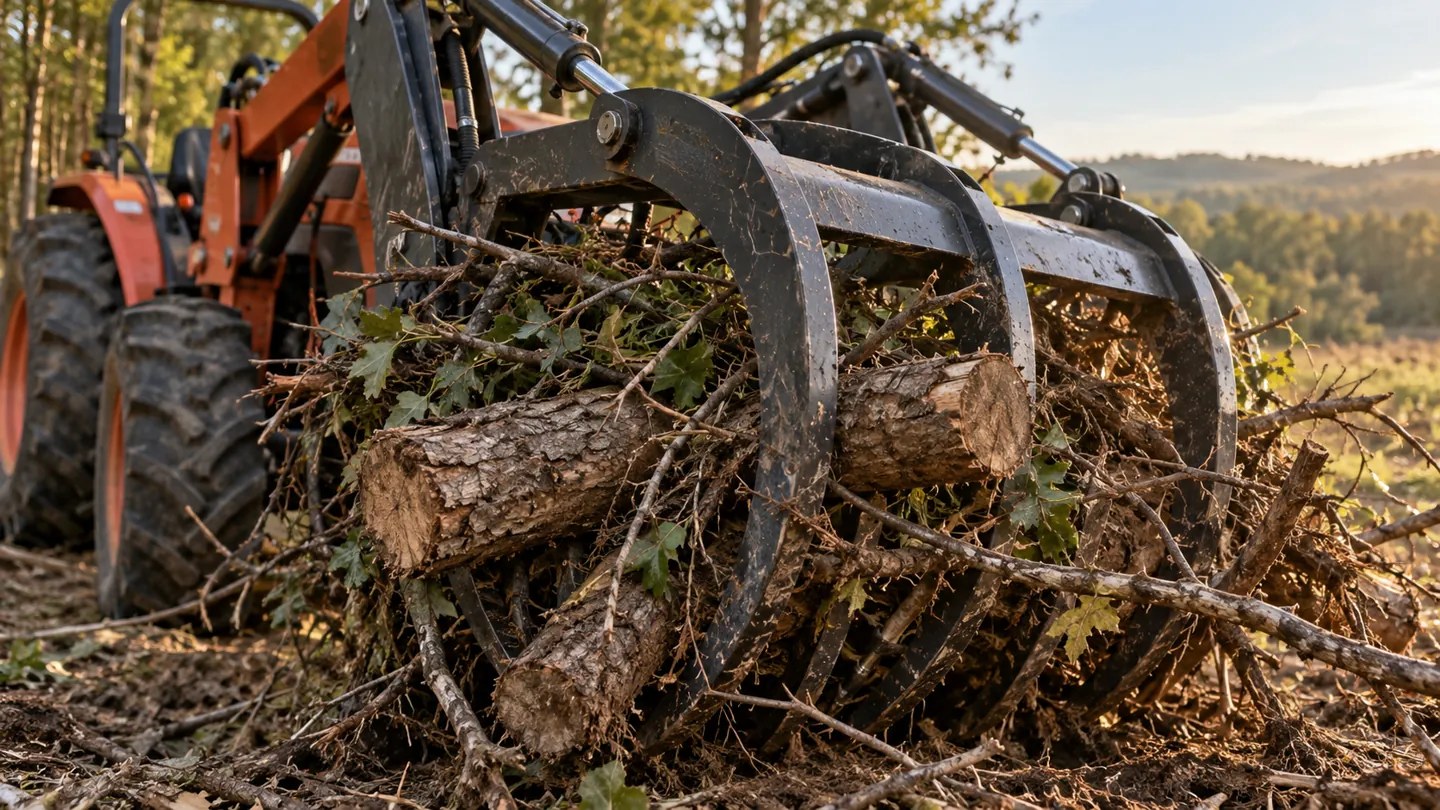
For most small acreage work, the right choice is a root grapple. It grabs brush, logs and fence posts, and loose dirt falls through the tines. A rock grapple earns its place only when rocks are the main job.
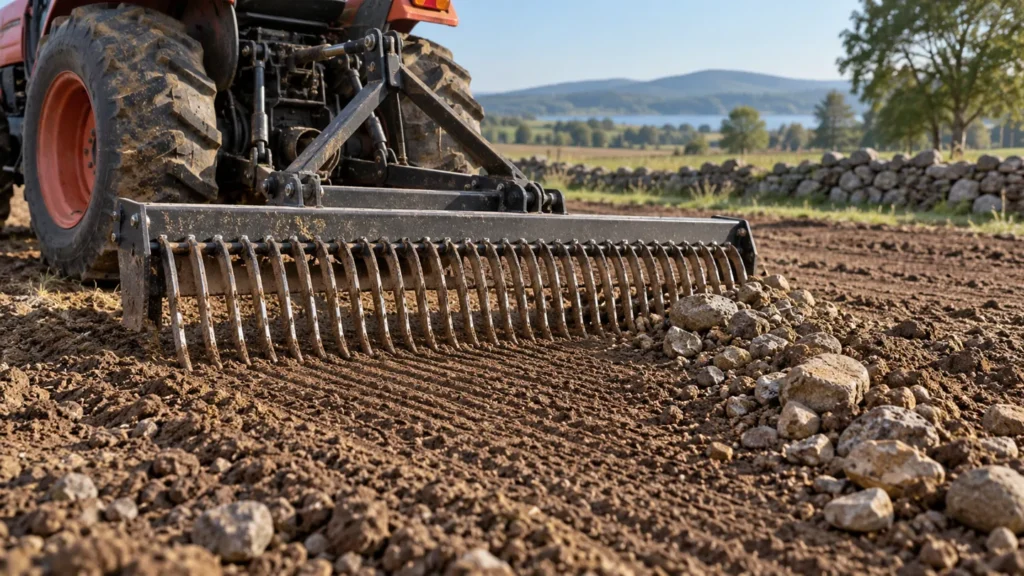
A root rake is a different tool, built for combing debris off the ground.
The short version
- Subtract the grapple’s weight from your loader’s rated lift before anything else. On a sub compact, what remains can be a couple hundred pounds.
- Root grapple for brush and logs. Rock grapple for rocks and demolition debris. Root rake for surface clearing.
- Most grapples need a third function valve or a diverter. A true third function is the better setup.
- Match the mount to your loader: skid steer, Euro/Global or hook and pin. Adapters work but add weight.
- Carry every load low, keep rear ballast on, and stay inside your manual’s limits.
What types of tractor grapples are there?
You will meet root grapples, rock grapples, log grapples and rake grapples. The names overlap in marketing. Tine spacing and tine shape tell you more than the label does.
Root grapple
A root grapple has wide gaps between its tines, often 8 to 9 inches. Dirt falls through, and brush, stumps and logs stay in. One compact root grapple lists 8.5 inch spacing on a 3/8 inch steel frame.
This is the general purpose pick for clearing land and building brush piles.
Rock grapple
A rock grapple uses tight tine spacing, near 5 inches in one owner comparison. That lets it sift soil and hold stones. Owners report the catch: the close tines also hold loose wet dirt, so the grapple starts acting like a solid bucket.
Tine spacing also sets the smallest rock you can keep. A 4 inch stone falls through a 5 inch gap. Some owners strap or weld cross bars to catch smaller stones.
Log grapple
A log grapple is the name for a grapple used mainly on round, heavy loads. On a compact tractor, a root grapple does most of this job. A grapple sold only for logs is more common on bigger tractors.
Rake grapple and root rake
A rake grapple, or tine grapple, has widely spaced tines and a short upper jaw. Worksaver’s compact version spaces its tines 15 inches apart on a 60 inch frame. It handles brush, limbs and loose debris, but it loses small material.
A root rake is different. It usually skips the upper jaw. Its short lower teeth are meant to dig into soil and comb out roots and stones.
Owners warn against ripping stumps with a loader mounted rake. Compact loaders are not built for that stress. Many point to a 3 point hitch root rake for real root pulling.
Single lid versus dual lid
A single lid grapple has one upper jaw that closes on the load. A dual lid has two, and each jaw can close on its own, so the grapple holds an uneven pile of brush and logs more evenly.
Dual lid models cost more and weigh more, so check the weight against your loader first. Owners describe a 435 pound dual lid root grapple as a light one for compact tractors.
Root grapple vs rock grapple: which should you buy?
Buy a root grapple unless more than half your work is moving rocks. It wins on brush, logs and mixed debris, and it leaves most of the soil behind.
A rock grapple costs you in wet ground, where tight tines pack with dirt. Owners also say a rock grapple pries stones and pulls roots well. They credit its short lower tines.
| Type | Typical tine gap | Best for | Weak spot |
|---|---|---|---|
| Root grapple | About 8 to 9 inches | Brush, logs, posts, mixed debris | Small stones fall through |
| Rock grapple | About 5 inches | Field rocks, concrete, demolition | Holds wet dirt |
| Rake grapple | 15 inches on one compact model | Brush, limbs, light debris | Loses small material |
| Root rake | Open, with short lower teeth | Combing roots and stones from soil | Not a holding tool |
The spacing figures come from maker pages and owner comparisons. Models differ, so check the spec sheet for the exact grapple you are considering.
Which tractor grapple for brush, logs, rocks, round bales and demolition debris?
Match the grapple to the material you handle most. Then check that your second job is not a poor fit.
- Brush and limbs: a root grapple or a rake grapple. A single lid is enough for light brush.
- Logs and firewood lengths: a root grapple. Keep logs short enough that the loader stays level.
- Rocks: a rock grapple with tines tighter than your smallest keeper rock.
- Demolition debris: a rock grapple or a heavy root grapple. Thick tines matter more than width.
- Round bales: a grapple holds a bale better than a bucket. Extension safety guidance favors a grapple or a rear spike, since a round bale can roll back down the loader arms.
Check what your bales actually weigh before you plan the lift. Our guide on how much a hay bale weighs gives real ranges.
One caution applies to small tractors. Owners of BX class tractors often say adjustable pallet forks do logs and brush better. Forks weigh far less than a grapple, so more of the lift goes to the load.
Sizing a tractor grapple to your loader
Size by lift capacity first and width second. The grapple’s weight comes out of the load your loader can raise, and so does the quick attach frame.
Do the weight math
Start with your loader’s rating. Compare the same measurement every time. Some makers rate lift at the pivot pins and others at a point 500 mm forward, and the pivot figure is always higher.
Deere’s sheet lists the H120 at 703 pounds at the pivot and 512 pounds at 500 mm. Its newer 120R page gives 517 pounds on a 1025R and 553 pounds on a 2025R, both at 500 mm.
Kubota’s BX80 brochure rates the BX loaders (the LA344 on the BX2380 and the LA340 on the BX23S) at 739 pounds at the pivot and 509 pounds at 500 mm, both at full height. The quick attach versions drop to 613 and 423 pounds. That 126 pound difference is the quick attach frame, and it is exactly the kind of weight people forget to count.
- Find your loader’s rated capacity at 500 mm (about 20 inches) forward of the pins.
- Subtract the grapple’s listed weight.
- Subtract any quick attach plate or adapter that is not part of the grapple.
- Treat what remains as your payload at short reach.
That payload shrinks as the load moves forward. BX owners report that a grapple leaves them with brush and a couple hundred pounds. They also advise about 300 pounds of rear ballast to reach full lift.
Typical grapple weights
| Grapple | Width | Listed weight | Source type |
|---|---|---|---|
| Worksaver CTMG-48 (hook and pin or skid steer) | 48 inches | 310 to 320 pounds | Maker page |
| Worksaver compact grapple rake | 60 inches | 359 to 364 pounds | Maker page |
| Land Pride RG1072 root grapple | 72 inches | About 408 to 410 pounds | Dealer copies of Land Pride specs |
| Everything Attachments single lid root grapple | 55 inches | 627 pounds | Maker page |
| Everything Attachments single lid root grapple | 73 inches | 665 pounds | Maker page |
| Kubota RG3074 (Land Pride built) | 74 inches | 947 pounds without shields | Dealer listing of Kubota spec |
The gap is large. Light compact grapples run about 310 to 410 pounds. Heavier root grapples with thicker steel and two big cylinders start near 600 pounds.
Width versus your bucket
Keep the grapple about as wide as your bucket, or a bit wider. Owners with 48 inch grapples on BX loaders call that size well matched. One owner reported that a 55 inch model weighed over 50 pounds more than the 48 inch version.
A narrower grapple also fits between trees and posts. Extra width only helps if your loader can lift what the grapple can grab.
Sub compact limits
A sub compact can run a grapple, but only a small one. Worksaver rates its 48 inch grapple for tractors up to 38 hp. Its 60 inch grapple rake is rated for up to 50 hp.
Both ratings assume a front loader. If your loader lifts around 500 pounds at 500 mm, treat a grapple as a brush tool.
For bigger jobs, see the sub compact tractors worth buying. Or step up a size with our guide on what size tractor you need.
Check the maker’s tractor limits
Some makers state limits openly. Everything Attachments builds its 55 inch single lid root grapple for tractors under 7,000 pounds. It lists loader capacity under 2,500 pounds for that size, and up to 3,000 pounds for the 73 inch.
If a maker lists no tractor weight or horsepower limit, ask the dealer. Our front end loader buying guide explains how to read loader ratings.
Hydraulics: what your tractor needs to run a grapple
A grapple needs its own hydraulic circuit. Your loader valve handles lift and curl, so the grapple’s cylinder needs a third function or a workaround.
Option 1: Third function valve
A third function valve adds a separate control for the grapple. On many small tractors it is a solenoid valve fed from the loader valve’s power beyond port. Summit’s Kubota kits use a 12 volt solenoid and a joystick handle with two buttons: one opens the grapple, the other closes it.
The big advantage is that it runs at the same time as the bucket. You can curl the bucket while you close the grapple. Owners strongly favor this setup over a diverter.
Cost varies, and the figures below are owner reports, not maker prices. One owner reported a dealer quote of $1,195 for a third function kit installed, and $3,195 for the grapple installed. Owners doing the install themselves mention $650 to $1,000 for the valve kit.
One maker’s price is on record. Everything Attachments listed its 3rd function kit at $970 when ordered with the grapple, as of October 2026.
Option 2: Diverter valve
A diverter uses your loader’s curl circuit and switches it to the grapple with a solenoid. It costs less, but owners call it clumsy. One reported weak closing until he pushed the stick past the detent, and the arm movements were hard to learn.
A diverter also means you cannot curl and grip at the same time. If you will use the grapple often, skip it.
Option 3: Rear remotes
If your tractor has rear remote ports, you can run hoses to the front. That works, but it means long hoses along the loader arms. Check that the remote flow suits the grapple’s cylinder.
Electric versus mechanical
Solenoid valves are on or off. Owners disagree on whether that matters.
Some say you cannot feather the close. Others call it a non issue, because you hold the button and release to stop.
Model specific kits
Third function kits are model specific. The loader code decides which kit fits, and the power beyond port may need a special adapter.
One Kubota L35 owner reported a missing adapter and extra hoses to buy. Another found the solenoid dropped to 9.6 volts on a shared circuit, so wire it to a dedicated power source.
For Kubota L series tractors, Summit Hydraulics sells a third function kit that is the usual starting point. It is model specific, so confirm the exact loader and tractor with the seller using your serial number. For Kubota MX tractors, check the MX version of the Summit kit.
Skip these kits if your tractor has a cab. Summit says the kit is not designed for closed cabs. Skip them too if you already have rear remotes you plan to use.
Deere offers a factory 3rd function valve for its newer sub compacts. Ask your dealer which loader and tractor pairs it supports, because third party sources disagree. Check the manual and our tractor hydraulic fluid guide before you top off the system.
Quick attach: Euro/Global, skid steer and hook and pin
The grapple has to match your loader’s mount. There are three common ones, and a mismatch is expensive.
- Skid steer (SSQA): the most common on US tractors under about 60 hp. Attachments and used gear are easy to find.
- Euro/Global: built for tractor loaders, with an auto latching design. Less common on small US tractors.
- Hook and pin: John Deere’s system on loaders like the 120R and H120. Some grapples, like the Worksaver CTMG-48JD, are made for it.
Adapters exist in both directions. An adapter adds weight, and that weight comes out of your lift. One owner’s math: a 700 pound rating, minus a 60 pound frame and a 100 pound bucket, left 540 pounds of payload.
Some grapples are skid steer style and some Deere loaders are hook and pin. For that mismatch, the Titan hook and pin to skid steer adapter is built for the job. Skip it if you can buy a grapple made for your mount, since that saves the adapter’s weight.
If you weld, a 1/2 inch skid steer weld on mount plate gives a home built bracket a standard face. Everyone else should buy the right mount.
Pin spacing matters too. One Kubota B2320 owner found his grapple was made for a specific loader’s pin spacing. Check pin spacing and bracket fit before you buy.
Build quality: tines, cylinders and hoses
Check three things: tine steel, cylinder protection and hose routing. They decide whether a grapple lasts or turns into a repair bill.
Tine and frame steel
Look for steel thickness and grade on the spec sheet. A 3/8 inch A572 Grade 50 frame with Grade 80 serrated tines is what one utility root grapple lists. Cheaper units often list less or nothing.
Tines can bend on light grapples. One owner of an import grapple reported tines that bent on debris and stopped springing back.
The maker declined warranty, and a dealer straightened and reinforced them. Builders also say the lower tines need gussets.
Cylinders
Compact grapples often use one cylinder. Worksaver lists a 2 inch bore by 8 inch stroke at 3,000 psi. Heavier units use two bigger cylinders, like the 2.5 by 10 inch pair on Everything Attachments’ 55 inch model.
More cylinders and a bigger bore give a stronger grip, at a weight cost. Look for rods that are tucked or guarded. One owner bent a ram near full stroke while moving brush, after necking the hoses down to a smaller size.
Hoses and fittings
Hose routing is where cheap setups fail first. Leave slack for full dump.
One owner found his hoses stretched tight at full dump, where they could snag. His fix was a bungee cord around the middle of the hoses.
Do not neck hoses down to fit a small port, since that pinches flow. Some makers include hoses that reach the side of the loader arms. Others ship without hoses, so the dealer sets the length.
Brands and price ranges for a tractor grapple
Expect roughly $1,300 for a basic import 48 inch grapple. A heavier root grapple from a US maker starts around $3,400. These are snapshots from October 2026 and shift with shipping and dealer pricing.
| Tier | Example | Listed price (Oct 2026) | Listed weight |
|---|---|---|---|
| Basic import | 48 inch root grapple from a Tennessee dealer | $1,320 plus $200 to $550 shipping | 350 pounds |
| Mid range | Titan 48 inch light duty root grapple rake (retail listing) | About $2,005 | 322 to 379 pounds, retail listings disagree |
| Heavier built | Everything Attachments 55 inch single lid root grapple | Base $3,440 | 627 pounds |
| Utility class | Kubota RG3074 (Land Pride built) | Ask a dealer | 947 pounds |
A 3rd function kit, hoses and installation usually come on top. Ask for the total.
Cheap import versus American made
Cheap does not always mean bad. It often means thinner steel, a single small cylinder and little warranty help. For occasional brush work on a small tractor, a light import can be enough.
For daily use, pay for the heavier build. A big American built grapple on a small tractor is the wrong trade, though. Its weight eats your lift.
Brands to know
Worksaver, Land Pride, Woods, Titan, Everything Attachments and Kubota (through Land Pride) all sell grapples for compact tractors.
Weights for the same model can differ between listings. Most dealer sheets put the 72 inch Land Pride RG1072 at about 408 to 410 pounds. One listing says about 630 pounds, which matches Land Pride’s heavier RG1572, so it looks like a mix up.
Titan’s 48 inch light duty rake shows 322, 325 and 379 pounds across retail listings, and one Walmart page contradicts itself. We could not reach Titan’s or Land Pride’s own spec pages. Get the number from the maker in writing before you do the lift math.
Worksaver ships its compact grapples without hoses, so ask about a hose kit. You can read the specs on the maker’s compact tine grapple page.
Grapple safety: load limits, low loads and rear ballast
Never lift more than your loader’s rated capacity after you subtract the grapple. Extension safety guidance is consistent on the rest.
- Keep the load low. Carry loads as low as possible and do not travel with the loader raised.
- Add rear ballast. Ballast the tractor and loader as the manufacturer recommends, or add wheel weights or a 3 point hitch weight.
- Work slopes carefully. Drive forward uphill with a loaded bucket and back down with the load.
- Use ROPS and a seat belt. Wear the belt any time you are on the machine.
- Respect the manual. Each loader attachment may have its own limits.
Ohio State’s front end loader safety sheet is a short, useful read. For how much rear weight you need, see our guide to tractor ballast.
A raised, loaded loader shifts the tractor’s balance, and that is how many loader upsets start. Keep people clear of the arms and out from under a raised grapple. Close the jaws fully before you move.
Common grapple mistakes
- Buying by width. A wider grapple weighs more and cuts payload. Size by weight.
- Ignoring the quick attach plate. It is extra weight on a small loader.
- Using a diverter for heavy daily use. Owners call it awkward.
- Ripping roots or stumps with the loader. Compact loaders are not built for that stress.
- Skipping rear ballast. A front heavy tractor with a raised grapple is an upset risk.
- Trusting a single weight listing. Numbers conflict between dealers, so ask.
The bottom line
Pick a root grapple that leaves a useful payload after its own weight and the quick attach plate. Add a true third function valve, ballast the rear and carry loads low. On a sub compact, keep it to brush and light loads, or use forks for logs.
Frequently asked questions
What is the best grapple for a compact tractor?
The best grapple for a compact tractor is the one that leaves real payload after its own weight. For most small compacts, that means a light root grapple near 48 inches and about 310 to 410 pounds. Bigger compacts and utility tractors can step up to 55 to 73 inches.
Do I need a third function to run a grapple?
You need some way to feed the grapple’s cylinder with oil. That means a third function valve, a diverter or rear remotes routed to the front. A third function valve is the best choice for regular use because it runs alongside the bucket.
Can a sub compact tractor use a grapple?
Yes, but only a small one and only for light work. BX owners say the grapple’s weight leaves brush and a couple hundred pounds of payload. Rear ballast helps you reach full lift.
How much does a compact tractor grapple cost?
Listings in October 2026 ran from about $1,320 for a basic import to $3,440 for a heavier root grapple. That does not include a third function kit, hoses or install. Check the current price with the seller.
Is a root rake the same as a root grapple?
They are different tools. A root rake usually has no upper jaw, so it combs roots and stones from the soil. A root grapple has a jaw that holds the load, so buy that to lift and carry.
Will a skid steer grapple fit my compact tractor?
It will if your loader uses a skid steer quick attach. If not, you need an adapter or a different mount. Match the mount and pin spacing to your loader before you buy.
Can I use a grapple to carry round bales?
Extension safety guidance favors a grapple or a rear spike over a bucket for round bales. Check the bale weight against your loader’s capacity after subtracting the grapple. Carry the bale low and drive slowly.