Implements & Attachments
Box Blade vs Land Plane: Which One Your Tractor Needs
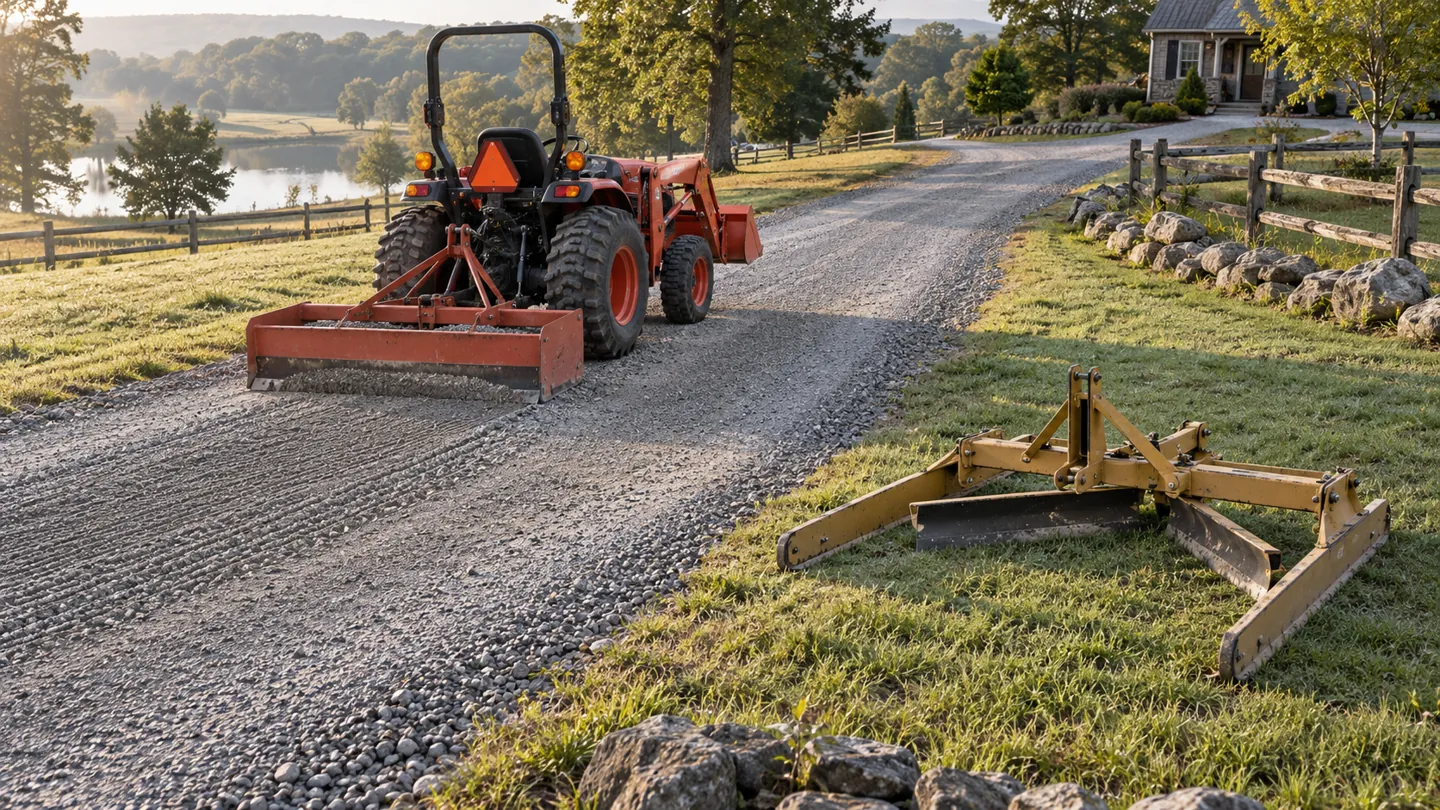
A box blade moves and cuts material, and a land plane levels and maintains it. Here is which one fits your gravel drive and your tractor.
IN THIS GUIDE JUMP TO A SECTION +
The box blade vs land plane debate starts with a myth. People say a land plane is just a lighter, cheaper box blade.
It isn’t, and it isn’t lighter either. A box blade digs and carries. A land plane skims and finishes.
That difference decides everything. The box blade moves dirt and gravel from where you have too much to where you have too little. The land plane shaves high spots and drops that material into the low ones a few feet away.
So the right pick depends on what your ground needs today. A rough, hard packed or washed out drive needs the box blade first. A drive that is already shaped and just needs keeping flat is what a land plane does best.
The short version
- Box blade: moves, cuts and carries material. Its scarifiers rip hard ground, and the box fills holes and low spots.
- Land plane: levels and maintains. It cures washboard and keeps a good gravel surface flat with almost no skill.
- A box blade builds a crown. A land plane holds one at best.
- Weights overlap. A 6 foot land plane runs about 530 to 590 pounds, a 6 foot box blade about 400 to 530 pounds.
- Buy the box blade first if you have to move material. Buy the land plane first if your drive is already shaped and only needs upkeep.
Which is better, a box blade or a land plane?
Neither is better overall. The box blade wins at moving and cutting material, and the land plane wins at finishing and maintaining a surface. Think of a shovel and a rake.
Owners who run both describe the same routine. They fix the bad spots and rebuild the base with the box blade. Then they run the land plane to make everything flat and tidy.
How a box blade works
A box blade is a steel box with a cutting edge at the front and another at the rear. A row of scarifier shanks sits ahead of the box. Material cut by the front edge collects inside, and you carry it where you want it.
You release it by raising the hitch a little so the rear edge lets material slide out. The side walls trap the load, which is why the tool can haul gravel across a yard. Those same walls make fine finishing harder, because you have to feather the load out at an even rate.
The scarifiers do the heavy ripping. Land Pride’s 72 inch BB1272, the box blade Kubota dealers stock, carries six shanks on a Cat 1 hitch. It weighs 183 kg, about 403 pounds, and is rated for 17 to 30 hp.
Your top link changes how the box behaves. Owners say a shorter top link tips the front edge down, so the blade bites and fills faster.
A longer top link lets material slide out and spread. Most owners call a hydraulic top link close to essential for a box blade.
How a land plane works
A land plane is a long, shallow frame with two angled blades set between two side plates. A skid shoe rides under each side plate. The blades sit diagonally, so they shave high spots and push the loosened material sideways and back toward the low ones.
Once the frame fills a little, material flows through and lays down evenly behind it. The skids hold the blades at a set depth, so the tool follows the surface instead of digging in. Land Pride says you set its grading scraper on the ground and drive, with little work on the 3 point controls.
Frontier’s LP20 series, sold through John Deere dealers, shows the usual layout. Its two reversible high carbon blades sit at a 10 degree angle.
The skid shoes adjust through 2.5 inches of height. Deere says they can be set differently on each side to shape a crown.
Many land planes take scarifier shanks, standard on the Frontier and optional on Land Pride’s. They are shallow rippers for light work. The LP2172’s shanks go to 4 inches below the blades, and the small LP2054L’s stop at 3 inches.
They are not the deep digging teeth of a box blade. Use them to loosen a crusty surface, not to break up hard pan.
Box blade vs land plane: side by side
The table compares 6 foot class units on a Cat 1 hitch. Weights and hp ranges come from Land Pride and Deere pages.
Neither maker posts a US list price. The price row is a relative comparison from dealer listings, not a figure to plan on.
| Feature | Box blade | Land plane |
|---|---|---|
| Best jobs | Moving and spreading material, filling potholes, backfilling, building and crowning a drive, ripping hard ground | Leveling a gravel or dirt drive, curing washboard, routine upkeep, finishing after a box blade |
| Worst jobs | Fine finishing, long smooth passes for a beginner | Digging, hauling material, hard packed ground, buried rock, building a crown from scratch |
| Weight (6 foot) | About 403 pounds (Land Pride BB1272) to the 494 to 534 pounds dealers list for the Frontier BB2072 | 528 pounds (Frontier LP2172) to 269 kg, about 593 pounds (Land Pride GS1572) |
| Tractor size | Land Pride rates the BB12 line for 17 to 30 hp; Frontier’s heavier BB21 goes to 70 hp | Both 72 inch units are rated for 25 to 50 hp |
| Learning curve | Steeper. Easy to dig too deep or leave ridges | Gentle. Set it down and drive |
| Typical price | In October 2026 dealer listings, usually the cheaper of the two at the same width; get a quote | Usually priced above a light box blade of the same width; get a quote |
In a box blade vs land plane comparison, the weights surprise people. The land plane is often the heavier tool. That matters on a small tractor, as you’ll see below.
Land plane or box blade for a gravel driveway
For routine upkeep of a gravel driveway in decent shape, a land plane is usually the better tool. For a drive with real damage, you need a box blade first.
Washboard
A land plane handles washboard better, as long as it has enough weight. Washboard is the ripple pattern across the road. It grows where traffic speeds up, slows down or turns, especially on loose gravel.
Michigan Tech’s gravel road manual says light washboard comes out with routine grading. Moderate or severe washboard often needs scarifying 3 to 4 inches deep and regrading. The manual says to add gravel if the road is short of it.
The land plane’s long skids ride over the ripples. Its two blades shave the crests into the troughs. Owners report one catch.
An unweighted land plane tends to skip across washboard instead of cutting it. Owners who strapped weight to a 500 pound unit say it then started to bite.
A box blade can fix washboard too, but it takes more skill. It tends to cut where you do not want it and leave its own ridges.
Potholes
A box blade is better for potholes, because filling a hole means carrying material to it. The land plane moves material only a short way. A deep hole gets partly filled and reopens.
The same manual treats a series of moderate potholes as a job for scarifying and regrading. Severe potholes need added gravel.
That fits how owners work. They rip the damaged area with the box blade scarifiers.
They pull gravel in from the edges and spread it. Then they finish with a land plane.
Grade when the gravel is damp
Grade when the surface has some moisture, ideally after a rain. The manual notes that moisture is needed for compaction.
Owners say the same. They also compact the surface afterward by driving over it or using a roller.
Building or crowning a drive, spreading gravel, digging and backfilling
For anything that involves moving material in volume, use a box blade. That covers building a drive, spreading new gravel, digging a shallow trench and backfilling.
Building or crowning a drive
A box blade can form a crown. A land plane can hold one but not build one. A crown is a gentle rise down the center so water runs off to both sides.
How much crown depends on the width.
Michigan Tech’s manual calls 4 to 6 inches of rise from center to edge normal on a full width gravel road. On a narrower driveway, graders commonly aim for roughly 1/2 inch of fall per foot from the center. That works out to about the same slope.
The manual says a flat road ponds water and softens the roadbed. To build a crown, pull material from the edges toward the center with the box blade. Then spread and compact it.
Deere says the LP20’s skid shoes can be set higher on one side to shape a crown. Owners say in practice a land plane will not create one from a flat road. Treat the skid adjustment as a way to keep an existing crown while you grade.
Spreading new gravel
Dump the gravel in piles or a line. Spread it roughly with the box blade. Then finish with a land plane if you have one.
A box blade used alone can do the whole job, but it takes patience. Use the rear edge to meter material out in thin layers.
Roll or drive over each layer before adding the next. Loose gravel dumped in one thick layer tends to work loose again.
Digging and backfilling
A box blade can dig a shallow trench or grade a pad. It can push the material back in.
A land plane cannot do either job. It has no box to hold material and no deep digging teeth. Land Pride puts it plainly: its grading scrapers are not designed to move large volumes of dirt from one place to another.
For longer hauls, a front end loader is the better partner. See front end loaders for compact tractors for what a loader adds.
Hard packed or rocky ground, scarifiers, and when neither is right
On hard packed ground, a box blade with scarifiers works and a land plane on its own usually does not. The shanks tear the surface so the blade can then move it.
Owners say a land plane suits a road that is already in shape. They call it a poor choice on a drive with buried base rock.
Set the scarifiers a little deeper on each pass and expect several passes. Do not try to fix a bad drive in one go.
Owners also warn that deep scarifiers can unearth buried stones the size of ankle breakers. Walk the ground first.
Weight matters here more than horsepower. A common owner rule is about 100 to 120 pounds of box blade per foot of width.
Some owners prefer more. Treat that as owner opinion, not engineering data.
When neither tool is right
- Deep ruts and a washed out base need new gravel hauled in first. No blade makes material that is not there.
- Gravel that has washed into ditches and shoulders is a rear blade job. You can angle it to pull material back onto the road.
- Large buried rocks call for a rock rake, a grapple or a loader, not more scarifier passes.
- Soft, wet soil needs drainage and a stable base before you grade.
Box blade vs land plane on a sub compact tractor
Lift capacity is the limit on a sub compact tractor. It can rule out a 6 foot version of either tool.
Kubota’s BX brochure rates the BX1880, BX2380 and BX2680 hitch at 680 pounds, measured 24 inches behind the lift pins. Its implement limits sheet lists 1,210 pounds at the lower link ends themselves.
A 6 foot land plane at 528 to 593 pounds leaves a thin margin against 680. A full box blade can weigh more than its empty rating once it fills with wet gravel.
The land plane is harder on the hitch than its weight suggests. Deere lists the LP2054L, LP2160 and LP2172 at 48 inches long and the bigger sizes at 54 inches. That puts a lot of the weight well behind the lift arms, where the 24 inch rating no longer applies.
Owners also report fit problems. The wide lift point spacing on some units forces the lift arms out. That can push the top link to its shortest setting.
Kubota’s implement limits sheet for the BX1880, BX2380 and BX2680 caps box blades at 60 inches wide and 375 pounds. It caps rear blades at 60 inches and 248 pounds.
Land planes and grading scrapers do not appear on the sheet at all. Kubota says failures caused by implements beyond the table are not covered by the warranty. Ask your dealer before you buy one.
That points you to a narrower, lighter tool. Frontier’s 54 inch LP2054L weighs 316 pounds and is rated for 18 to 30 hp on a limited Cat 1 hitch.
Land Pride’s 48 inch GS0548 is listed at 141 kg, about 311 pounds. Its 60 inch GS0560 is 159 kg, about 350 pounds. Both are rated for 18 to 33 hp.
All three sit under the 375 pound box blade cap, though that cap is written for box blades. For the full sizing picture, see what size tractor you need and the best sub compact tractors.
Weight, lift and traction trade offs
A heavier tool grades better, but your hitch and rear tires set the limit. A land plane needs weight to cut washboard. On a sub compact you may be near your lift limit before you add any.
Check the 3 point hitch category first. The 60 and 72 inch land planes need Cat 1, and the smallest Frontier runs on limited Cat 1.
Weight on the rear of the tractor also helps traction when a box blade bites. Read how much ballast a tractor needs before you add wheel weights.
Do you need both, and which should you buy first?
If you own a gravel drive, you will probably end up wanting both. You do not need both on day one.
Buy the box blade first if the surface is rough, holes need filling or you have to move material. Buy the land plane first if the drive is already shaped and only needs keeping flat.
The box blade is more versatile, so it is the safer first buy for most acreage owners. The land plane is faster and easier for upkeep, but it does one job.
Some owners find a good box blade does their maintenance just as well. A few prefer it and call the land plane a one trick tool.
Think about the second tool only after the first one earns its keep. See the box blade buying guide and the land plane buying guide for size, weight and what to look for.
Common mistakes
- Buying a land plane to build or crown a drive, then finding it only skims.
- Buying a 6 foot unit of either type for a sub compact without checking its weight against the lift rating and the maker’s implement limits.
- Skipping the hydraulic top link and fighting the box blade all day.
- Grading at speed. Michigan Tech’s manual says fast grading can create corrugations, and it recommends staying under 10 mph.
- Expecting one pass to fix a bad drive.
The bottom line
For box blade vs land plane, the short answer is this: the box blade moves and cuts material, and the land plane flattens and maintains it. Buy the box blade first if you have holes, hard ground or material to move. Add a land plane when the drive is in shape and you want faster, easier upkeep.
Frequently asked questions
Can a land plane replace a box blade?
Only for maintenance on a drive that is already in good shape. A land plane cannot dig, haul material or break up hard ground. If you need any of those, you still need a box blade.
Can a box blade level a driveway as well as a land plane?
It can with practice, and some owners prefer it. It takes more skill and more passes.
The box leaves ridges if you do not feather the rear edge. A land plane gives a flatter result with less effort.
Will a land plane fix potholes?
It fixes shallow ones, since it shaves nearby high spots into them. Deep holes need material carried in and compacted, which is a box blade job. Isolated holes can also be patched by hand with gravel.
Do land planes need scarifiers?
Not for a drive that is already loose on top. Scarifiers help break a crusty surface so the blades can cut. They come standard on some models and as an option on others.
They are shallow compared with a box blade. On hard packed ground, buy the box blade instead of leaning on land plane shanks.
What size land plane or box blade should I buy?
Match width to your tractor’s lift rating and hp, not to the biggest size you can afford. Land Pride and Deere rate their 72 inch land planes for 25 to 50 hp. A sub compact often needs something narrower, so check your manual’s implement limits.
Do I need a hydraulic top link?
For a box blade, owners call it close to essential, because you adjust pitch constantly while cutting. For a land plane it helps but matters less. Either way, it saves you from stepping off the tractor.
When should I grade a gravel driveway?
Grade after rain or when the surface has some moisture. Moisture helps the gravel pack back down. Light grading more often keeps the surface in better shape than one big repair a year.
For more on how these tools fit with your other attachments, browse the implements section.
Sources worth opening: Kubota’s BX80 series implement limitations sheet and the Gravel PASER manual from Michigan Tech. The Frontier LP20 series page lists land plane specs.