Implements & Attachments
Flail Mower vs Brush Hog: Which One Should You Buy
A flail mulches finer and throws less; a brush hog cuts thicker brush for less money and less upkeep. Here is how to choose for pasture, brush, trails, ditch banks and lawn edges.
IN THIS GUIDE JUMP TO A SECTION +
As an Amazon Associate, TractorFolk earns from qualifying purchases. Links to products on this page may earn us a commission at no cost to you.
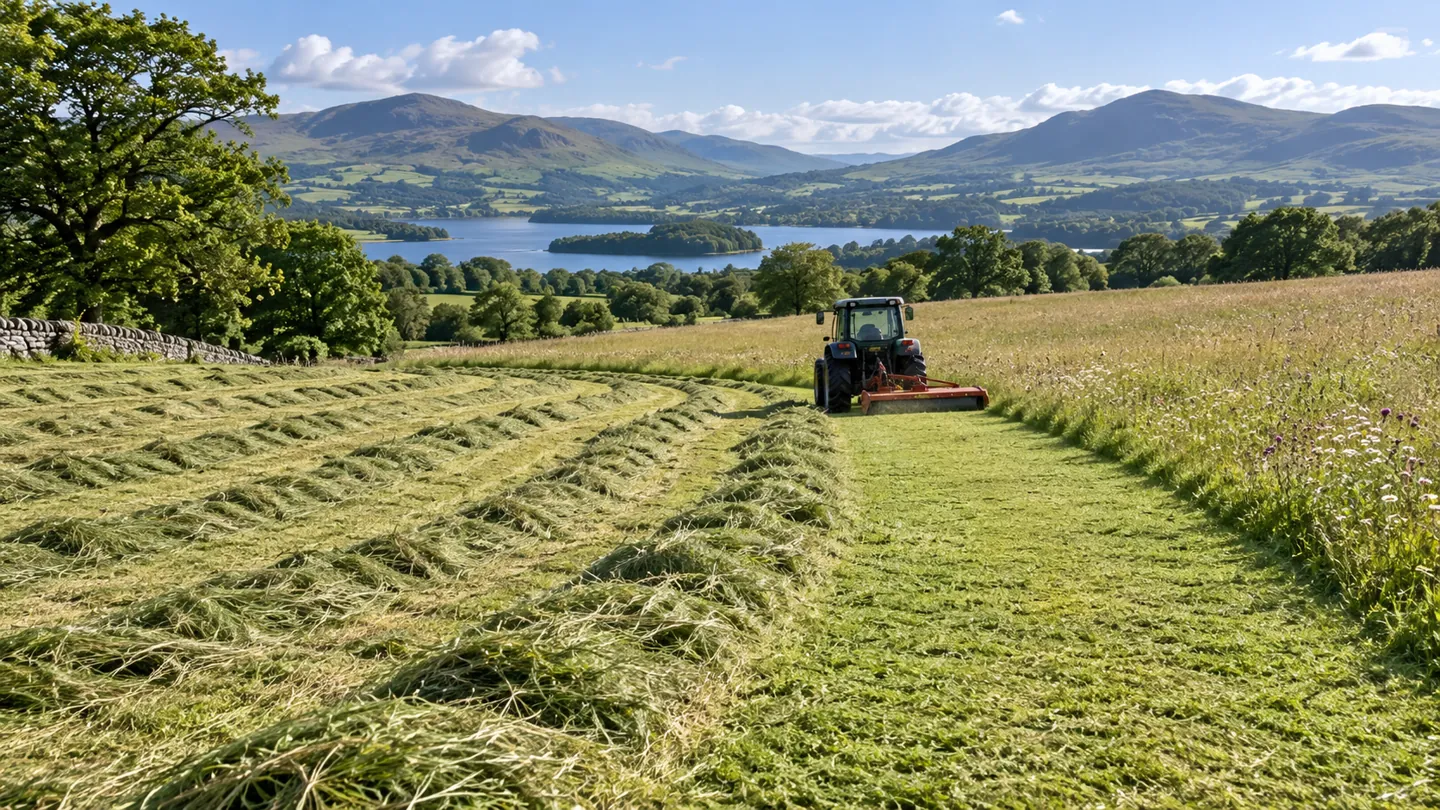
Picture one overgrown acre of goldenrod, briars and waist high grass as the flail mower vs brush hog test plot. Mow the left half with a brush hog and you get torn stems, chopped sticks and ragged swaths. Mow the right half with a flail and you get a short, even blanket of shredded mulch.
That difference on the ground is the whole question.
The flail gives a cleaner, safer cut and asks for more upkeep and usually more money. The brush hog gives raw toughness for less, and makes a mess doing it.
For most small acreages, a brush hog is still the better single machine for pasture, saplings and rocky ground. A flail wins where people, vehicles, buildings or looks matter.
The sections below cover how each one cuts, what your tractor needs and what each costs you in service. Then we get to which one to buy for the job you actually do.
The short version
- A brush hog (rotary cutter) spins two heavy blades flat on a vertical spindle. Deere’s 60 inch RC5M is rated for material up to 2 inches.
- A flail swings dozens of small hammers or knives on a horizontal rotor. Deere’s FL10 flails are rated for 3/4 inch, and a Land Pride 60 inch flail for 1 inch.
- Flails mulch finer and keep more debris under the hood. Bush Hog’s own manual says a rotary cutter can throw objects 300 feet or more.
- Flails need more routine service: more knives, rotor bearings to grease, belts on most models. Rotary cutters mostly need gearbox oil, sharp blades and a torque check.
- Pick a rotary cutter for pasture, rocks and woody brush. Pick a flail for trails, rough lawns, ditch banks and anywhere thrown debris is a problem.
How each one cuts
A brush hog cuts with blades spinning flat on a vertical spindle, like a giant lawn mower. A flail cuts with many short knives hinged to a rotor that spins crossways under a hood. That one difference shapes almost everything else about the two machines.
Rotary cutter (brush hog)
“Brush hog” started as a brand name. Most people now use it for any rotary cutter. A typical 3 point model has a gearbox on top, a spindle underneath and a heavy bar with two blades bolted to it.
The blades pivot on their bolts so they can swing back when they hit something solid. Deere’s RC5M, a common 60 inch model, uses blades 1/2 inch thick and 4 inches wide. Deere lists its blade tip speed at about 160 mph.
Blades that heavy and that fast carry a lot of momentum. That is why a rotary cutter smashes through saplings and thick weed stalks without bogging. It is also why it leaves a rough finish.
Sizing, gearbox ratings and duty classes are covered in our rotary cutter buying guide. This article sticks to how the two machines compare.
Flail mower
A flail has a horizontal rotor with rows of hammers or Y shaped knives hinged to it. Centrifugal force holds them out while mowing, and they fold back when they strike a rock or a stump. A rear roller sets the cutting height and smooths the ground behind the mower.
Deere’s 61 inch FL1061 carries 32 hammers on a rotor turning 2,600 rpm. Deere lists the tip speed at 8,622 feet per minute, or roughly 98 mph. Land Pride’s 60 inch FM2060 lists 60 knives on a rotor turning 1,980 rpm.
Deere’s FL10 spec page ships hammers as standard, with Y blades sold as a service kit for finer shredding.
Material stays under the hood longer and gets hit several times before it drops out the back. Because many small knives are always cutting, the load on your engine stays steady instead of spiking. Owners generally say hammers suit brush and Y blades suit grass, which is why many flails offer both.
Flail mower vs brush hog side by side
The table below puts numbers on the differences. It uses manufacturer ratings for comparable 60 inch class machines. Exact figures vary by brand and duty class, so treat them as typical rather than universal.
| Factor | Brush hog (rotary cutter) | Flail mower |
|---|---|---|
| Cut quality | Rough and uneven. Leaves chopped pieces and some windrows. | Fine mulch at an even height, close to a finish cut on turf. |
| Thickest material | 2 inches (Deere RC5M, 60 inch). Heavy duty models go thicker. | 3/4 inch (Deere FL10 series) to 1 inch (Land Pride FM2060). |
| Thrown debris risk | Higher. Bush Hog’s manual warns of objects thrown 300 feet or more. Chains or skirts required near people. | Lower. The hood and rear roller trap most debris. Nothing is risk free. |
| Tractor hp | 25 hp PTO minimum for the 60 inch Deere. | 25 to 45 hp for the 61 inch Deere, 20 to 45 hp for the 53 inch. Land Pride’s 60 inch has a 55 hp gearbox. |
| Weight | About 823 pounds (Deere RC5M, 60 inch). | 467 pounds (Deere FL1053, 53 inch) to 616 pounds (Land Pride FM2060, 60 inch). |
| Price | Usually lower for the same width. Check the current price. | Usually higher from name brands. Budget imports narrow the gap. |
| Maintenance | Gearbox oil, two blades, blade bolt torque, slip clutch or shear bolt. | Rotor bearings, dozens of knives, belts, gearbox oil, roller bearings. |
One surprise is weight. In these examples the flail is lighter than the rotary cutter at the same width, not heavier. The flail also hangs closer to the tractor, which makes it easier on a small 3 point hitch and easier to lift.
Check your tractor’s rear lift rating against the real weight before you buy either one. Our tractor sizing guide helps match machine to tractor.
Which is safer: thrown objects, roadsides and buildings
A flail is the safer choice near roads, buildings, livestock and people. Its hood and rear roller keep most debris close to the machine and send it down rather than out. A rotary cutter flings material sideways and backward, and it can launch stones, wire or sticks a long way.
Ohio State Extension warns that stones, tin cans and wire can be deadly when thrown by a mower blade. Bush Hog’s BH200 series operator’s manual is blunter. It says rotary mowers can throw objects 300 feet or more and tells you to keep bystanders 300 feet away.
The same manual says to raise the cutting height to at least 6 inches where thrown objects are a risk.
A flail is not slow, so do not assume it is harmless. Deere lists its FL10 tip speed at about 98 mph and Land Pride lists 99 mph. The safety gain comes from the hood, the roller and smaller pieces, not from gentle knives.
Flail makers say their machines drop thrown objects within a few feet. We found no independent test data, so treat that as a claim.
Owners agree flails are far safer near cars and houses. They also report flails flinging the odd rock and spitting out pieces of wire.
One more owner pattern is worth knowing. Crews who mow rough roadsides full time often say a well guarded rotary cutter takes far more punishment at lower cost. They save the flail for stretches with traffic and houses.
Making a rotary cutter safer
- Walk the field and remove wire, cans, rocks and fence pieces before you mow.
- Keep chain or rubber guards in place front and rear, and replace them when worn.
- Keep the PTO shield and driveline guards on, and keep people and animals well clear.
- Mow crossways in front of a house or road rather than toward it.
- Hold ground speed to the 2 to 5 mph that Bush Hog’s manual calls normal.
- Disengage the PTO, shut off the engine and set the brake before you get off.
Ohio State’s guidance adds that a 3 point mower can swing outward in a turn. Add front weight and set the rear wheels wide. Our ballast guide shows how much weight a tractor needs up front.
Finish: mulched clippings, windrows, lawn and pasture results
A flail leaves finer, more even clippings that settle into the grass. A brush hog leaves coarser pieces and often windrows them where the blades push material to one side. The flail’s hood and many knives chop material several times before it exits.
That matters on lawn and pasture. A flail leaves a surface you can walk on or drive over without wading through chopped stems. Pasture grass also recovers more evenly under fine mulch than under clumps.
Flails have two weak spots. Owners report standing “hairs” of uncut grass in tall, flattened growth, because a flail lacks the suction of horizontal blades. Owners and dealers also report that thin, lazy grass can mat under a flail or wrap around the drum.
A rotary cutter often does better on the first cut of the season. After that, a flail keeps regrowth looking tidy. Owners also report that a flail works well on sloped ground because its weight sits closer to the tractor.
Tractor requirements: PTO hp, rpm, gearbox and driveline
Both machines run off a rear PTO, and on compact tractors that is almost always 540 rpm. Deere’s 60 inch rotary cutter and both flails here list 540 rpm input. The 1000 rpm option shows up on big flex wing cutters instead.
Bush Hog’s flex wing literature lists 540 or 1000 rpm drivelines on its 15 and 20 foot cutters. Those start at 60 and 90 PTO hp. So 1000 rpm is a big tractor question, not a compact one.
Our PTO guide explains the speeds and clutch types if you need a refresher.
Horsepower
A 60 inch machine in either style needs about a 25 hp tractor at minimum. Deere lists 25 PTO hp minimum for the RC5M and 25 to 45 hp for the 61 inch FL1061.
The 53 inch FL1053 drops to 20 to 45 hp with a 1,400 pound minimum tractor weight. That brings it within reach of a sub compact.
More power helps a flail more than it helps a brush hog. Owners report that a flail keeps pace with a brush hog in dry, thin grass. In heavy, wet growth it must slow down to mulch cleanly.
Push it too fast in thick stuff and it stalls the tractor or burns up belts.
Gearbox, clutch and driveline
The two machines protect your tractor in different ways. Deere’s RC5M uses a slip clutch on an ASAE Category 3 driveline to absorb the shock of a stump strike. Cheaper rotary cutters use a shear bolt instead.
Land Pride’s flail gearbox has an internal over running clutch. It lets the heavy rotor coast down without driving the tractor forward. Most flails also run belts between the gearbox and rotor, which act as a second cushion and a wear item.
Land Pride lists a 55 hp gearbox for its 60 inch flail. Both machines mount on a Category 1 hitch at this size, and Deere’s FL10 is not iMatch compatible. Check 3 point hitch categories if you are not sure which yours is.
Maintenance: knives and bearings vs blades and gearbox
A brush hog asks for less routine work than a flail. Its upkeep is mostly gearbox oil, sharp blades and tight blade bolts. A flail has many more moving parts, so it needs more greasing, more inspection and more spares on the shelf.
Brush hog upkeep
- Check gearbox oil before each season and use the grade in your manual. Bush Hog specifies EP80W-90 or EP85W-140 for its BH200 series.
- Sharpen or replace blades when they round off or crack, and replace them in pairs.
- Check blade bolt torque. The Bush Hog BH200 series manual calls for 600 foot pounds on the blade nut and 450 on the pan nut, rechecked after the first 8 hours. A small torque wrench will not do.
- Inspect the slip clutch or shear bolt and the driveline shields, and keep chains or skirts intact.
Flail upkeep
- Grease the rotor bearings on schedule. Owners commonly grease before every session in heavy use, so follow your manual rather than guessing.
- Inspect knives and hammers for chips, wear and missing pieces before each use. A missing knife throws the rotor out of balance.
- Check belt tension. Deere’s FL10 runs two belts and Land Pride’s FM20 runs three. Owners report a set lasting a few seasons, less if you mow too fast.
- Check gearbox oil. Land Pride specifies SAE EP 90W, about 2 pints.
- Check the rear roller and its bearings. Owners report rollers are costly to replace after a hard rock hit.
Rocky ground is the flail’s enemy. Owners in rocky country report losing several sets of knives every spring. Most recommend buying a spare set with the mower.
Owners also report that wire can wrap around a flail rotor, so pull old fence wire before you mow.
Offset and ditch bank flail mowers
An offset flail slides its cutting head sideways so you can mow ditches, fence lines and banks without driving on them. Deere’s FL10S is the clearest example for compact tractors. The 45 inch FL1045S shifts hydraulically from 21.5 inches left of center out to 68 inches.
The 61 inch FL1061S reaches 83 inches. Weights climb with the reach: 592 pounds for the FL1045S and 663 pounds for the FL1061S. Deere lists a 2,600 pound minimum tractor weight for both.
Reaching sideways shifts the load, so a light sub compact can feel unstable. Extension guidance says to avoid steep slopes and keep speed down.
The hydraulic side shift is standard on the S models and uses 1/2 inch quick couplers. Your tractor needs at least one rear remote. Deere’s spec page does not say how many outlets, so confirm with your dealer.
Deere also sells FL11 series flails with manual side shift. They come in 63 and 69 inch widths for 30 to 55 hp tractors. A rotary cutter cannot do this job well, since it throws debris downhill and its deck does not float to the contour of a bank.
Which to buy for pasture, brush, trails and lawn edges
Buy a rotary cutter if your main job is pasture, rough fields and woody brush. Buy a flail if your main job is neat trails, lawn edges, ditch banks or mowing close to people. For one mower on a mixed property, owners lean toward a solid 6 foot rotary cutter.
Pasture
Choose a rotary cutter for pasture, since the flail vs rotary cutter contest favors the rotary on rough ground. It handles thick weeds, hidden rocks and fence line brush with less fuss, and it costs less. Pick a flail only if you mow often, want finer clippings and will accept slower going.
Brush and saplings
On brush, the flail mower vs brush hog answer is simple: choose a rotary cutter. Deere rates its 60 inch cutter for material up to 2 inches, and heavier classes go to 3 or 4 inches. A flail is rated for 3/4 to 1 inch, and owners report knife damage from hard hits.
Trails and paths
Choose a flail for trails. It leaves mulch you can walk or ride over and throws less debris at people and pets. A narrow flail is also lighter than a rotary cutter of the same width, which matters on a small tractor between trees.
Lawn edges and open ground
Choose a flail for rough lawns and edges around buildings. Expect a good cut on rough turf, not a golf course finish. For a true lawn look, a finish mower is the better tool.
Budget flail options
For a small tractor and light use, buyers sometimes look at imported flails. The MechMaxx 60 inch 3 point flail mower is listed for 15 to 35 hp tractors. The listing calls it standard duty and says it is not suited to quick hitches.
It is an option for grass, weeds and light brush, not a confident pick. Skip it if you clear woody growth or work in rocky ground.
The MechMaxx 48 inch light duty flail is the smaller alternative for a lighter tractor. Check the listed hp range, weight and your tractor’s lift capacity before you order. We could not confirm weights, rotor speed or knife counts for either one.
Common mistakes
- Buying a flail to clear saplings. Its rated capacity is 3/4 to 1 inch.
- Skipping the field walk. Wire and rocks hurt both machines and can hurt you.
- Running a rotary cutter without chain or rubber guards near roads or buildings.
- Skipping flail bearing grease. Follow the schedule in your manual.
- Mowing too fast with a flail in heavy, wet growth. Slow down until it mulches cleanly.
- Pairing a small tractor with a wide cutter. Match width to your hp and lift rating.
- Reaching out with an offset flail on a light tractor. Deere wants 2,600 pounds under the FL10S.
Bottom line
In the flail mower vs brush hog contest, a brush hog is the tougher, cheaper, more forgiving tool for pastures, saplings and rocks.
A flail is the cleaner and safer tool for trails, rough lawns, ditch banks and anywhere debris could do harm. If you can own only one, most acreage owners are better served by a rotary cutter. Add a flail when finish or safety near people is the job.
Frequently asked questions
Is a flail mower better than a rotary cutter?
A flail is better for finish quality and debris control. A rotary cutter is better for thick brush and rocky ground. Match the machine to the job you do most.
Can a flail mower cut small trees?
Only very small ones. Deere rates its FL10 flails for 3/4 inch material and Land Pride rates a 60 inch flail for 1 inch. Anything thicker belongs to a rotary cutter, rated up to 2 inches on Deere’s 60 inch model.
Does a flail mower throw rocks?
It can, but owners and flail makers say less often and less far than a rotary cutter. We found no independent test data. Clear wire and rocks first, and keep people well back.
What tractor do I need for a flail mower?
A 60 inch flail generally wants a 25 hp tractor with a 540 rpm rear PTO and a Category 1 hitch. Deere lists 25 to 45 hp for its 61 inch FL1061 and 20 to 45 hp for the 53 inch. Check the lift rating too, and expect offset models to need a heavier tractor.
Do flail mowers need more maintenance than brush hogs?
Usually, yes. Flails have more knives, rotor bearings and belts to service. A brush hog mostly needs gearbox oil, sharp blades and checked blade bolts.
What is a ditch bank flail mower?
It is an offset flail with a side shifting head that reaches over a ditch or bank. Deere’s FL1045S shifts hydraulically from 21.5 inches left of center out to 68 inches. The tractor stays on level ground while the flail works the slope.
Is a flail mower good for a lawn?
It is good for rough lawns, field edges and overgrown yards, and it cuts finer than a brush hog. It does not replace a finish mower on a manicured lawn. You will still see some stubble.