Implements & Attachments
Land Plane for Your Tractor: Size, Blades, Prices and How to Use One
A land plane smooths gravel and bare dirt faster than any other 3 point tool, but only if it matches your tractor. Here is how to size one, what the verified models weigh and cost, and how to set it up.
IN THIS GUIDE JUMP TO A SECTION +
A land plane is the best implement for keeping a gravel driveway, farm lane or bare dirt pad smooth. It is the right buy for anyone who maintains a few hundred feet or more of loose surface with a 20 hp or larger tractor. It shaves the high spots and drops that gravel into the low spots as you drive.
It levels. It does not dig, haul or cut ditches. Think of it as a finishing tool, not a construction tool.
Weight and build quality vary a lot between brands. The wrong size turns an easy job into wheel spin. This guide covers sizing, the features that matter, what these planes cost right now and how to set one up.
The short version
- It levels loose gravel, sand and bare dirt. It does a poor job in sod, weeds or deep potholes.
- Pick a width that covers about half your driveway. 5 to 6 feet suits most compact tractors, 4 to 5 feet suits a sub compact.
- Compare the implement’s operating weight to your 3 point lift rating, not just hp. Models run from about 310 to 770 pounds.
- Adjustable blades or skid shoes and scarifier shanks are worth having. Gauge wheels are rare on 3 point models.
- Verified October 2026 prices: about $1,550 for a 5 foot King Kutter at a farm retailer, and $2,840 to $3,550 for an Everything Attachments model.
- Keep a box blade or rear blade for moving material. Use the plane for the finish.
What is a land plane and how does it level ground?
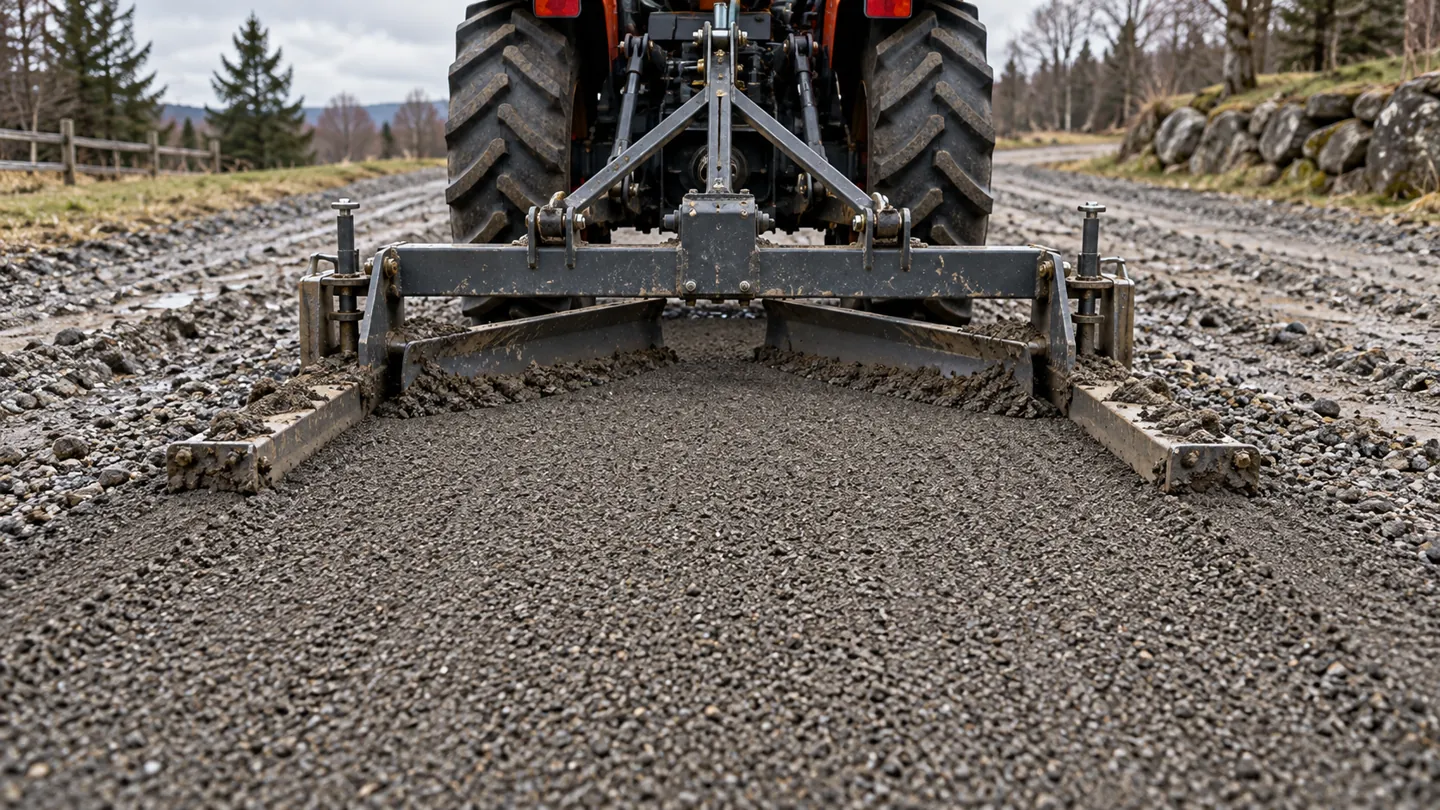
It is a long, flat steel frame that rides on skids. Two angled cutting blades sit between its side plates. It has no moving parts, no PTO shaft and no hydraulics.
The blades sit one ahead of the other, each pitched a few degrees off square. Deere’s LP21 series and ABI’s planes set them at 10 degrees. Land Pride’s GS15 grading scrapers use a 5 degree angle with 17 1/2 inches between the leading edges.
As you drive forward, the front blade shaves the high spots. Loose material rolls along the angled edge and spills into the hollows behind it. The second blade smooths what the first one left.
Length is what makes it level instead of just scrape. The side plates span 44 inches on a Land Pride GS15 and 55 1/2 inches on an Everything Attachments XTreme. That length bridges small dips instead of dropping into them.
Owners who build their own report the same thing. Longer rails cut flatter.
The tool goes by several names. Deere, Frontier and ABI call it a land plane. Land Pride says grading scraper, Everything Attachments says land leveler and King Kutter says dual edge land grader.
They are all the same implement. Nearly every model uses a Cat 1 hitch, and the 7 and 8 foot sizes add Cat 2. Our 3 point hitch categories guide explains how to tell which one your tractor has.
A box blade is the tool most people compare it to. The box carries material and digs, while the plane redistributes what is already there. Our box blade vs land plane comparison walks through which to buy first.
What size land plane do you need for your tractor?
For a compact tractor in the 25 to 50 hp range, pick a 5 or 6 foot model weighing about 480 to 700 pounds. For a sub compact under 25 hp, stay at 4 to 5 feet and 300 to 450 pounds. Three limits set the size: 3 point lift capacity, horsepower and driveway width, and the tightest one wins.
The table lists manufacturer figures from official spec pages and manuals. Land Pride GS15 weights include the optional shanks. Deere figures are operating weights.
| Model | Working width | Weight | Maker’s hp range |
|---|---|---|---|
| Land Pride GS0548 | 48 inches | 310 pounds | 18 to 33 hp |
| Land Pride GS0560 | 60 inches | 350 pounds | 18 to 33 hp |
| Deere LP2054L | 54 inches | 316 pounds | 18 to 30 hp |
| Land Pride GS1548 | 48 inches | 437 pounds | 20 to 50 hp |
| Deere LP2160 | 60 inches | 484 pounds | 25 to 50 hp |
| Land Pride GS1560 | 60 inches | 525 pounds | 25 to 50 hp |
| Everything Attachments XTreme 5 foot | 60 inches | 518 pounds | Not published |
| ABI AILP60 | 60 inches | 595 pounds | 25 to 65 hp |
| Deere LP2172 | 72 inches | 528 pounds | 25 to 50 hp |
| Land Pride GS1572 | 72 inches | 594 pounds | 25 to 50 hp |
| Everything Attachments XTreme 6 foot | 72 inches | 578 pounds | Not published |
| ABI AILP72 | 72 inches | 705 pounds | 27 to 65 hp |
| Deere LP2184 | 84 inches | 610 pounds | 40 to 90 hp |
| ABI AILP84 | 84 inches | 765 pounds | 32 to 65 hp |
| Deere LP2196 | 96 inches | 653 pounds | 40 to 90 hp |
Two things stand out. Weights for the same width differ by nearly 200 pounds between brands. The hp ranges overlap in ways that are not consistent.
Deere’s page lists two weights for each model, and only one matters to you. The LP2172 shows 528 pounds operating and 1,106 pounds shipping. Shipping weight is the freight figure for the crated unit, and Deere’s page does not explain the gap.
Compare the operating weight with your lift capacity. Ignore the shipping figure unless you are arranging freight.
Match the weight to your 3 point lift
Weight comes first. An implement heavier than your lift rating will not raise cleanly, and it makes the tractor light in the front with the plane up. Find the lift capacity at 24 inches behind the lift points in your operator’s manual.
Sub compact owners should check Kubota’s performance matched implement list for the BX80 series before buying. It includes the Land Pride GS0548 and GS0560 grading scrapers, at 310 and 350 pounds, for every BX80 model. It has no land plane category, so heavier planes from other makers are not on Kubota’s approved list.
That does not mean they will not work. Owners report running a 6 foot Titan of about 545 pounds behind a BX2380. They cite a lift capacity of about 680 pounds at 24 inches, so it fits.
It does mean you are outside Kubota’s matched list. Kubota’s BX implement limitations sheet has no land plane row, but it caps box blades at 375 pounds on the BX2380. Use that as a sensible ceiling and stay light.
Weight is also traction. A heavier plane bites harder on packed ground, while a light one tends to skate.
If your tires spin before the blades cut, add ballast rather than a heavier plane. Our ballast guide covers how much and where.
Match the width to your driveway
Choose a plane that covers about half the width of your driveway. You then work up one side and back down the other, never straight down the middle. That keeps a crown for drainage, and ABI’s own instructions say exactly that.
A very wide plane is harder to steer around trees, culverts and gates. It also needs more pulling power. A 6 foot model handles most 10 to 12 foot driveways.
Match the hp honestly
The published hp ranges assume flat, loose ground. Real driveways have grades, hard patches and wet spots. Owners with tractors near the bottom of a range report wheel spin after a few passes once the plane loads up.
A small tractor can run a small plane with shallow cuts. It cannot take big bites. Owners also report that mid size planes struggle on steep hills even behind larger tractors.
If you are still choosing a tractor, our tractor sizing guide covers what each hp class pulls. For the smallest machines, see our guide to the best sub compact tractors.
Fixed vs adjustable blades, scarifiers and gauge wheels
Adjustable blade height or adjustable skid shoes are worth paying for. They let you set cutting depth and keep cutting as the edges wear. Scarifier shanks are the second feature that earns its cost.
Gauge wheels are rare on 3 point models. Skids do the job better on a driveway.
Fixed vs adjustable blades
On a fixed design the blades sit at one height relative to the skids. That works for light smoothing. It leaves you little control as the blades wear down.
Adjustable designs move the blades relative to the skids. Land Pride’s GS15 has infinite vertical adjustment from level grade to 1 1/2 inches below. ABI lists 0 to 1 1/2 inches of blade height adjustment.
Deere takes the opposite approach. The LP21 blades are fixed, but the skid shoes on each side plate adjust through 2 1/2 inches. Setting one side higher than the other tilts the cut and helps shape a crown.
Everything Attachments leaves tilt to the tractor. Its instructions say to use the adjustable lift arm on your 3 point to crown a road.
Look for blades that are reversible and replaceable, which most name brands offer. Deere and the Land Pride GS05 use 3/8 by 6 inch edges. ABI and the Land Pride GS15 use 1/2 by 6 inch edges, which last longer and flex less on rocks.
Scarifier shanks
Scarifier shanks are ripper teeth on the front beam. They loosen hard ground before the blades level it.
Deere’s LP21 carries 4 to 7 points with depth settings down to 4 inches below grade. Land Pride’s GS15 shanks set 1 1/2 or 3 1/2 inches below grade. ABI’s 5 to 7 shanks raise and lower one at a time.
The usual method is to lower the shanks and break up the surface on one or two passes. Then raise them and let the blades level the loose material.
Owners report that scarifiers earn their keep on potholes, washboard and hard packed patches. On loose gravel you may rarely drop them.
Buy them up front if you think you will want them. Everything Attachments states that shanks cannot be added later to its XTreme model. The plain and shank versions differ by $545 at the maker’s October 2026 prices.
Keep the shanks up in ground full of roots or large rocks. A shank that hangs on a root shocks the 3 point hitch and can bend.
Gauge wheels
Gauge wheels hold part of the frame at a set height on a wheel. None of the 3 point models in the table above use them. They ride on skid shoes, which are long wear strips bolted under the side plates.
Skids make sense on a driveway. A wheel sinks into soft gravel and changes the cut depth. A 40 or 44 inch skid spreads the load and averages the surface.
Check that the skids are replaceable. They wear first.
Brands, build quality and what they cost
Build quality shows in four places. Look at side plate thickness, main beam size, blade thickness and skid shoe thickness. A thin plane flexes and leaves a wavy finish, so compare those numbers before you compare paint.
Here is what the official spec pages and manuals show for each brand.
- Deere and Frontier LP21 series (sold as LP20 in the United States): five sizes from 54 to 96 inches. Blades are 3/8 by 6 inch and reversible, skid shoes adjust, and the warranty is 1 year. The smallest is Cat 1 limited for sub compacts.
- Land Pride GS05 and GS15 grading scrapers: sold through Land Pride and Kubota dealers. The GS05 uses 3/16 inch side plates, a 4 by 3 inch main beam and 1/4 inch skids. The GS15 steps up to a 4 by 4 by 5/16 inch beam, 1/2 inch blades, 3/8 inch skids and optional shanks.
- ABI Attachments: 5, 6 and 7 foot models, the heaviest in the table. They have 1/2 by 6 inch blades, replaceable skid shoes and individually adjustable shanks. The warranty is 2 years.
- Everything Attachments XTreme Land Leveler V2.0: 5 to 8 foot widths with 1/4 inch side plates and 3 inch square tubing. The frame and hitch plate are 3/8 inch, the skids bolt on, and it fits Cat 1 and Cat 2 quick hitches. A smaller Compact model covers 48 to 72 inches.
- King Kutter dual edge land grader: 5, 6 and 7 foot widths with reversible edges and a Cat 1 quick hitch compatible frame. We could not reach a manufacturer spec sheet for weights.
- Titan Attachments: owners report a 6 foot model of about 545 pounds with shanks. We could not reach Titan’s site to confirm a current model or specs.
Kubota does not build its own plane. The Land Pride GS models are what a Kubota dealer will put in front of you. They are the only ones on Kubota’s BX80 matched implement list.
What do they cost right now?
Everything Attachments lists its XTreme Land Leveler V2.0 without shanks at $2,840 for 5 feet and $2,950 for 6 feet, as of October 15, 2026. The 7 foot is $3,060 and the 8 foot is $3,550. The version with Hardox shanks starts at $3,385.
Those are the only maker’s prices we could verify. On the same date, a farm retailer listed the King Kutter 5 foot dual edge land grader, model DEG-60-OP, at $1,549.99. A 6 foot version showed about $2,200 in a search result we could not open, so treat that figure as unconfirmed.
Deere, Land Pride and ABI do not publish purchase prices. ABI shows financing from $55 a month instead. The other two sell through dealers who quote locally.
Owner reports from past years put planes at roughly $160 to $200 per foot of width. Those posts are undated and prices have risen since, so use them only as a floor. Ask your dealer for a delivered, assembled price, and expect the lighter planes to be the cheaper ones.
How to set up a land plane
Set it so both blades touch the ground together and the skids sit flat. The top link is your main adjustment. Shorten it to tip the front down and bite harder, or lengthen it to lift the front and skim.
- Park on flat, hard ground. Pin the plane to the lower lift arms, or latch it onto your quick hitch.
- Lower it until it rests fully on its skids.
- Turn the top link until the side plates sit level front to back. A torpedo level on the top rail makes this easy.
- Level it side to side with the adjustable lift arm, so both skids touch at once.
- Set the blade height or skid shoes to a shallow cut. Lower the shanks only if the surface is hard, then lock everything.
- Make a 50 foot test pass and look at the result. Shorten the top link a turn or two if it rides over the high spots without cutting.
A quick hitch saves time if you swap implements often. Every brand in the table is Cat 1 quick hitch compatible. Confirm the plane’s hitch pins match before you buy, since bushings are usually sold separately.
Make a note of the top link setting that works. You will come back to it every spring.
Driveway and arena technique
Drive slowly and straight and let the implement do the work. Speed makes the frame bounce, and bouncing leaves washboard. A slow pass gives the blades time to cut and carry.
Work up one side and back down the other, overlapping each pass a little. Aim for a crown, a gentle rise in the center that sheds water to both edges.
State gravel road guidance targets about 1/2 inch of rise per foot of lane width, around 4 percent. Below about 2 percent water ponds. Far above it the fines wash off.
Owners disagree about whether a plane can build that crown on its own. It holds a crown well but builds one slowly, since it does not push material sideways. Shape a badly flattened drive with a box blade or rear blade first, then maintain it with the plane and tilted skid shoes or lift arm.
Moisture matters, and the advice conflicts. Everything Attachments says its leveler works best in dry conditions because wet material clumps. Owners generally prefer slightly damp gravel that holds together and raises less dust.
Either way, avoid mud. It packs between the blades and stops the flow.
If the surface will not smooth no matter what you do, it probably lacks fines. Fines are the small stones and grit that bind gravel, and clean stone just rolls around. Spread road base with fines, water it and compact it, then plane it.
Riding arenas
A plane suits arena base work and big grade corrections, not daily grooming. It cuts into the surface. Set it deep in an arena and it will pull base stone up into the footing.
Run it with the blades at a shallow cut and the shanks up, and test a small corner first. For daily grooming, an arena drag or groomer is the right tool. We found no manufacturer guidance on plane use in sand footing, so treat this as practical reasoning.
What it cannot do
A plane cannot dig, haul or reshape heavy ground. It plugs in sod, weeds and tall grass. It skims over deep potholes instead of cutting to the bottom of them.
- It will not cut a ditch or build a berm. That is box blade or rear blade work.
- It will not break hard pan unless you drop the scarifiers. Even then it only reaches 3 to 4 inches.
- It will not move material any distance. A loader bucket does that.
- It will not prepare a seedbed or pull rocks. A Harley rake or landscape rake does.
- It does poorly on steep slopes and sharp grade changes. Owners report overcutting at the crest and setup trouble.
Deep potholes need to be undercut and refilled. Drop the shanks to break the packed rim, fill with fresh gravel, then plane across to blend it in.
Used planes and DIY builds
A used plane is a good buy if the frame is straight and the blades are not worn down. There is almost nothing else to go wrong. A homemade one works if you copy a proven design and do not oversize it.
What to check on a used one
Set it on flat concrete. Sight down the skids and side plates. A twisted or bowed frame will never level correctly, and straightening heavy plate is not practical at home.
Check the blades for wear and whether they have already been flipped. Check each shank for bends and every weld for cracks. Look at the lift arm pins and top link bracket for egg shaped holes.
Confirm the hitch category and pin size match your tractor. A set of replacement blades costs far less than fixing a frame. A straight plane with worn blades is a fair deal.
Nobody publishes a used buying checklist for these. This is the same inspection you would give any welded 3 point frame.
DIY builds
Owners who build their own repeat a few tips. Copy a commercial plane that suits your tractor, and measure and photograph it. Keep the weight within your lift capacity.
Builders report setting the blades 5/8 inch to 1 1/2 inches below the rails on 60 inch frames, then fine tuning. Some use I beam sides with the bottom flange cut off as skids. Some reuse the cutting edges from a worn out box blade.
Longer rails give a flatter cut, so do not shorten the frame to save steel. If you do not weld well, a used commercial plane is the safer buy.
The official numbers behind this article are on the Deere LP21 spec page, the Land Pride GS15 specifications and the Everything Attachments XTreme Land Leveler page.
Bottom line
This implement does one job, smoothing gravel and bare ground. It does that better and faster than anything else on a 3 point hitch. Buy one that covers half your driveway, stays within your lift capacity and has adjustable blades or skid shoes.
Keep a box blade or rear blade for everything else. The implements section covers the rest of the grading lineup.
Frequently asked questions
What is the best land plane for a compact tractor?
There is no single best one. The strongest specs we verified belong to the Land Pride GS15, ABI and Everything Attachments XTreme models, with 1/2 inch blades or 1/4 inch side plates and adjustable cutting depth. For a sub compact, the Land Pride GS05 and Deere LP2054L are the lightest name brand options.
Is a grading scraper the same thing?
Yes. Land Pride uses the name grading scraper, Everything Attachments says land leveler and King Kutter says land grader. All of them are the same two bladed frame on skids, so compare them on width, weight, blade thickness and adjustments.
How wide should it be for a driveway?
About half the driveway width. That lets you work each side separately and keep a crown. A 5 or 6 foot model covers most single lane driveways.
Can a sub compact tractor pull one?
Yes, with a 48 to 60 inch model in the 300 to 450 pound range. Expect shallow passes and some wheel spin on hard ground. The Land Pride GS0548 and GS0560 are on Kubota’s matched list for the BX80 series.
Does it need scarifiers?
Not for loose gravel, where many owners rarely drop them. They matter for washboard, potholes and hard packed patches. If the maker will not let you add them later, buy them up front.
Will it remove potholes?
Shallow ones, yes, by moving loose material into them. Deep potholes need to be ripped out with the shanks and refilled with new gravel first. Then plane across them to blend the patch.