Hay & Livestock
Sickle Bar Mowers for Compact Tractors: Sizes, HP and Models
Sickle bar mowers still earn their place on small farms. Learn which 3 point models fit compact tractors, what to check on a used New Holland 451 or Ford 501, and how to run one safely.
IN THIS GUIDE JUMP TO A SECTION +
A sickle bar mower is the old way to cut hay, and small farms still buy them new. The design has outlived most of the machines built to replace it because it does one thing well on a small tractor.
It cuts clean, it needs little power, and it hangs off a plain 3 point hitch. A knife slides back and forth through fixed guards, like a giant pair of hedge shears.
That is why a 25 hp tractor can cut hay with one. A disc mower of the same width would be marginal. The price is slower ground speed, more upkeep, and plugging when you rush or run dull sections.
This guide covers how the machine works and which new models fit compact tractors. It also covers what to check on a used New Holland 451 or Ford 501. Then it covers how to run, service and stay safe around the knife.
The short version
- Current 3 point bars from Befco and John Deere list 20 or 25 hp as the minimum tractor, with a 540 rpm PTO.
- Widths run from about 69 to 96 inches. Weights run from roughly 500 to 670 pounds, and that weight hangs off one side of the hitch.
- Mow at 5 to 7.5 mph with the PTO at a steady 540 rpm. Change speed with the gear, not the throttle.
- Choose a belt driven bar for ditches and banks. A pitman arm bar loses its drive when you tilt it.
- Never touch the knife or clear a plug until the PTO and engine are off and the key is out.
How a sickle bar mower works and what it cuts best
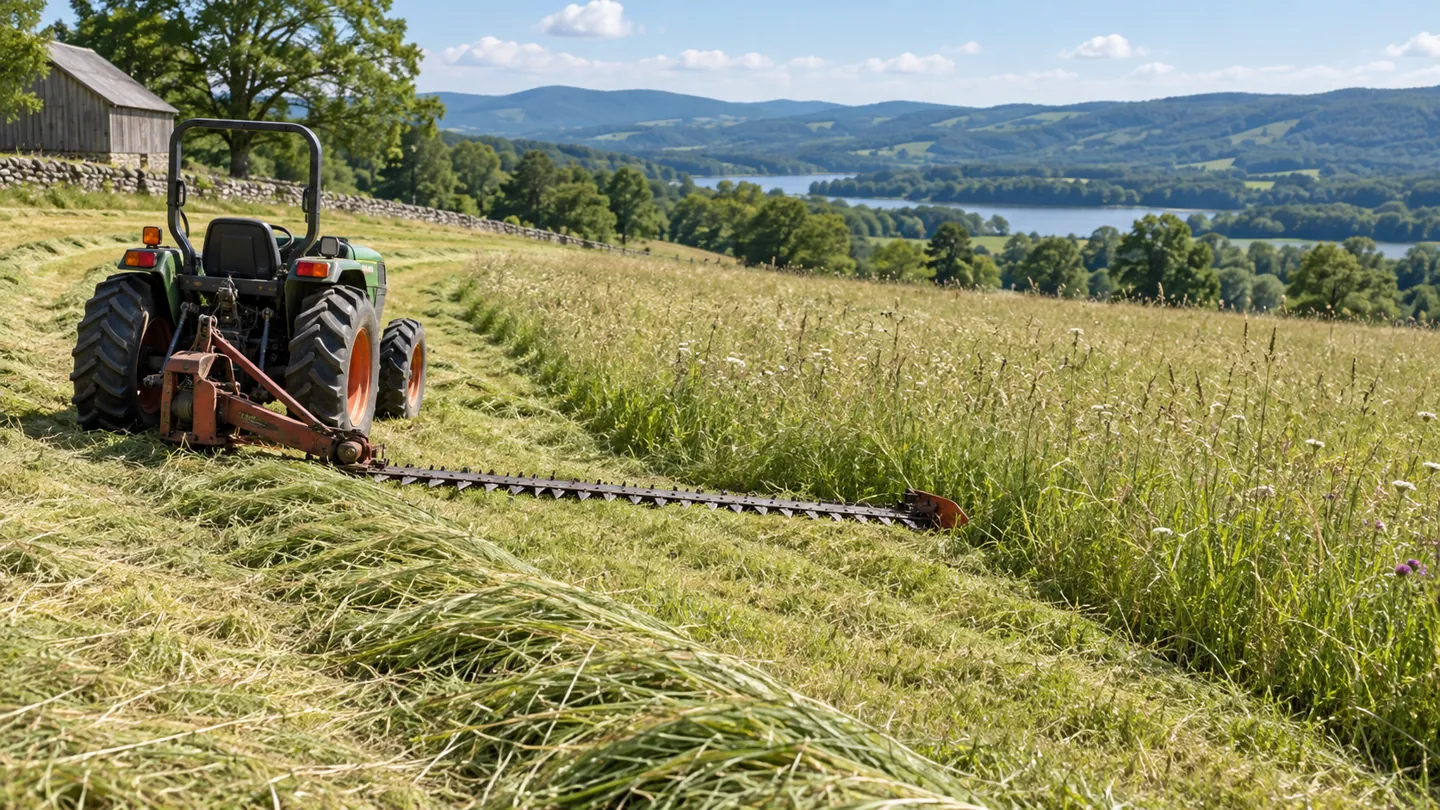
A sickle bar cuts with triangular knife sections riveted or bolted to a bar that slides between fixed guards. Each stroke shears the stems against the guard, so the cut is a scissors cut and not a tear.
Power comes from the tractor PTO. On modern bars a belt turns a crank at the cutter head, and a hydraulic cylinder lifts the bar. Older mowers use a wooden or steel pitman arm instead of a belt.
It cuts best in standing grass and legume hay on fairly clean ground. Befco says its bar can work banks and pond edges, and it does not recommend a conventional disc mower for those jobs. Deere’s Frontier literature makes the same ditch and bank claim.
Single knife versus double action
Older mowers have one moving knife and a fixed set of guards. Most current 3 point bars are double action. The knife and the tooth bar move in opposite directions.
Befco says this prevents jamming and allows a working speed up to 9 mph. Deere’s Frontier spec sheet calls its SB31 cutter bar double action too, and the Gaspardo operator manual for the same bars describes the two motion system. The trade is more parts to grease and replace.
Sickle bar vs disc mower vs rotary cutter for hay
For hay, a sickle bar wins on power and cut quality. A disc mower wins on speed, and a rotary cutter is the wrong tool.
Ohio State’s extension factsheet rates sickle bars low on horsepower and front end weight. It also calls them the slowest option. It says they need the most blade upkeep and can clog in heavy stands.
University of Wisconsin forage specialist Dan Undersander gives the numbers most often repeated. A sickle bar needs about half the power per foot of cut.
It costs 10 to 20 percent less per foot. It runs about 5 to 8 mph, against 12 to 14 mph for a disc.
| Feature | Sickle bar | Disc mower | Rotary cutter |
|---|---|---|---|
| Power need | Low | Medium | Medium, by deck size |
| Ground speed | About 5 to 8 mph | About 12 to 14 mph | Slow in thick growth |
| Cut quality | Clean shear, even swath | Better in lodged, tangled crops | Shreds and leaves debris |
| Blade upkeep | Most | Less than sickle | Blades and gearbox |
| Best for | Small hay fields, banks, ditches | Larger hay fields | Pasture clipping and brush |
Wisconsin trials on level, stone free fields found sickle bar maintenance about 20 percent higher than disc. A rotary cutter chops everything and leaves it where it falls, so it makes mulch and not hay. See our rotary cutter buying guide and flail mower vs brush hog for that job.
3 point sickle bar mower options and sizes
A 3 point sickle bar mower for a small tractor is a 6 to 8 foot bar that pins to a Cat 1 hitch. It runs off a 540 rpm PTO and lifts with a hydraulic cylinder.
Only a few makers sell them new in the US. These figures come from Befco’s product page and manual and from John Deere’s current product pages.
| Model | Cut width | Tractor hp | Weight | Hitch | Bar angle |
|---|---|---|---|---|---|
| Befco BSB-272 | 72 in | 20 to 75 | 628 lb | Cat 1 (see note) | 90 up, 55 down |
| Befco BSB-284 | 84 in | 20 to 75 | 650 lb | Cat 1 (see note) | 90 up, 55 down |
| Befco BSB-296 | 96 in | 20 to 75 | 672 lb | Cat 1 (see note) | 90 up, 55 down |
| John Deere Frontier SB3106 | 68.9 in | 25 to 50 PTO | 507 lb | Cat 1 and 2 | 90 up, 45 down |
| John Deere Frontier SB3107 | 80.7 in | 25 to 50 PTO | 525 lb | Cat 1 and 2 | 90 up, 45 down |
| John Deere Frontier SB3108 | 92.5 in | 25 to 50 PTO | 543 lb | Cat 1 and 2 | 90 up, 45 down |
Befco’s product page lists Cat 1 and 2, but its 2017 operator manual says Cat 1 or a Cat 1 quick hitch. Ask the dealer which applies to your serial number.
Deere sells its SB31 series under the Frontier name through John Deere dealers. The weights above are Deere’s operating weights, and shipping weights run about 100 pounds more. All three are belt driven, cut 1 to 3 inches high on adjustable skid shoes, and carry a 1 year warranty.
Deere’s Frontier spec sheet adds a double action cutter bar, a swath board, a park stand and a mowing speed of 6.2 to 7.5 mph. That sheet dates from 2013, so trust the current web page where the two differ.
The Frontier bars appear to be Gaspardo built. The Gaspardo FBR operator manual we read carries the Frontier name and matches the Frontier widths, so its setup advice applies, but it is a 2006 edition.
An Italian made Enorossi line, sold by importers, lists 165, 180 and 210 centimeter double action bars. It is a distributor sheet and not a US spec page, so treat it as a reference.
Sickle bar mower for compact tractor use: hp, weight and ballast
On a compact tractor, weight and balance limit you more than horsepower does. The listed minimum is 20 or 25 hp. Owners with 25 PTO hp tractors commonly report a 7 foot bar cuts through everything.
The real worry is 500 to 670 pounds hanging off one side. Befco’s manual wants at least 20 percent of the combined weight on the front wheels. It tells owners to weigh the rig and not guess, and not to exceed the ROPS weight rating.
A front loader, wheel weights or tire ballast all work. Our ballast guide walks through the math. Check three more things before you buy.
- Hitch category. Sub compacts with Cat 0 hitches need adapters. See 3 point hitch categories.
- Hydraulic remote. Befco and Deere bars both lift with a cylinder, so you need one remote with a hose that reaches.
- PTO shaft length: Befco wants 6 inches of overlap, and a quick hitch can break that. See our PTO guide.
New Holland 451 sickle bar mower: the used market favorite
The New Holland 451 is the classic used bar in owner threads, and it is the one most owners say to buy. It is belt driven, pitmanless and still well supplied with parts. We found no official New Holland spec sheet we could read, so the details below are owner reports and parts listings unless we say otherwise.
Owners describe a belt and a wobble crank at the cutter head, with the knife carried on a linkage instead of a pitman arm. They say it keeps cutting at any angle, even vertical, because nothing runs along the bar to bind. Several call it the smoothest running sickle mower they have owned.
Replacement knives are sold in 7 foot and 9 foot lengths, with 29 and 35 sections. Owners say the 450 and 451 differ mainly in the knife drive bearings. The 456 is the same mower on a trailed caddy, which solves hitch problems on a small tractor.
Running a 451 on a compact tractor
Owners with 451s run them at a full 540 rpm without trouble. One owner quotes the manual’s crank speed as 800 rpm, set by an adjustable pulley that covers PTO speeds from 540 to 720. Treat that as an owner setup note and check the manual for your serial number.
The common complaint on compacts is the hitch. The mower has a U shaped stabilizer frame that fastens to the top link, and owners report it needs a longer or universal top link on many compact tractors.
Its lift arm clamps can hit the stabilizer nuts or a backhoe subframe on a narrow tractor. Some owners trim the frame arms or build a top link extension to make it fit.
Set up right, the bar lifts straight up about a foot before it pivots toward vertical. One owner quoting the manual says the frame tube should sit 16 inches off the ground when lowered, with the outer shoe carrying about 35 pounds.
Owners warn of hidden grease fittings under the hitch assembly. They also say to grease the wobble drive often, but not the breakaway trip, or it will trip and make you back up to reset it.
Ford 501 sickle bar mower: a pitman era classic
The Ford 501 series is a pitman arm mower, and owners say it was built for the Ford N series. That makes it a fit for tractors the size of an 8N. Our Ford 8N buyer’s guide covers what that tractor can handle.
We found no Ford or New Holland spec sheet we could read. One owner quotes a Ford sales brochure at 454 to 476 pounds for the 7 foot narrow frame version, and another weighed his at 460. Owners report 5, 7 and 9 foot bars.
The pitman is a wooden stick that drives the knife from a crank at the frame. It wears and it breaks, so owners carry spares. Some have a sawmill cut extras from ash.
Because the pitman runs along the bar, owners say a 501 stops cutting when tilted far. That makes it a flat ground hay mower and not a bank mower. Ford’s later 515 dropped the pitman, and owners rate it the better machine.
Pitman mowers also shake. Owners say some vibration is normal and it usually eases at higher rpm. Shaking that gets worse with rpm points to a loose universal joint or a bent PTO shaft.
Hooking up a 501
Hookup is the recurring complaint. Owners call the stabilizer clamps on the lift arms the hard part, and several took two people and half an hour the first time.
A stand or blocks under the mower makes it easier. Owners who built a rack at hitch height say hookup drops to a few minutes.
The order owners describe is left lift arm first, then raise a little and hook the right arm. Then hook the top arm with its big spring unpinned, attach the PTO, raise the hitch fully and pin the spring. Different 501 model numbers are reportedly different attaching kits, so match the kit to your tractor.
Owners say New Holland dealers still stock many parts, and aftermarket knives are widely listed. Our vintage parts guide lists where else to look.
Using a sickle bar on ditches and banks
For ditches and banks, choose a belt driven bar with hydraulic tilt well past horizontal. Befco rates its BSB at 90 degrees up and 55 down.
Deere lists the SB31 series at 90 up and 45 down. Gaspardo’s manual gives 90 up and 75 down in its slope mode.
A safety release, often called a breakaway, lets the bar swing back when it hits a post or stump. Befco says to stop the tractor and not raise the bar. Check that the driveline halves are still together, then back up until the latch resets.
Befco says to avoid steep slopes and to test the ground with the PTO off first. Gaspardo says to remove the moving guide from the outer support on banks.
Owners say these bars are built for grass. Saplings under about an inch cut fine, and a few report hardwoods near 1.75 inches at a crawl. Bent brackets and broken guards are the price of brush work.
Sickle bar maintenance: knives, guards and grease
A sickle bar needs frequent grease and regular section changes. Befco’s schedule is a good model. Grease the blade head and tooth head every 8 hours, along with the driveline, and check belt tension.
Check hardware every 25 hours. Every 50 hours, grease the arm points and sharpen or replace worn blades. Replace the wear plate once a year or every 150 hours.
Knife sections, guards and hold downs
Sections wear, chip and loosen, so keep spares. Befco ships a spare blade section and suggests carrying six blades, 12 rivets and two teeth. Its section bolts take 20 foot pounds.
Guards matter as much as the knife. A reproduction of New Holland’s 451 manual says the guard ledger surfaces must line up for a clean cut. You tap high guards down and low guards up with a hammer.
The knife sections should then rest lightly on the ledger. Misaligned guards also wear the knife drive.
The same manual says hold down clips keep each section from lifting off the guards. Befco’s bar uses spring loaded upper blade guides for the same job.
Gaspardo says to check the tooth bar and blade guide fit each season. Remove a shim if the gap has opened.
Timing and register on pitman mowers
Owners say a pitman mower also needs the knife centered in the guards at both ends of its stroke. They call this being in register, and they set it with the bar lead and the pitman length. The belt drive Befco and Deere bars have no pitman to time, so follow your manual.
Cleaning, oil and storage
After each job, Befco says to clean the mower and spray the blades to stop rust. Gaspardo says to oil the cutters with heavy oil and fit the guards back on. Store the bar with the blade guard on, on hard level ground.
How to run a sickle bar: speed, tilt and plugging
Run a steady 540 rpm PTO and set speed with the gear, not the throttle. Befco says most conditions suit 6 to 7 mph, never under about 5 and never over 9. Deere’s Frontier sheet says 6.2 to 7.5 mph.
Owners agree that going too slow is the usual cause of plugging.
- Set the bar so the outer tip leads the inside. Befco says the tip should sit about 2 inches ahead of the arm base.
- Put the 3 point hitch in float, so the mower rides on its chain and follows the ground.
- Level the bar with the turnbuckle. Befco lists a bar tipped downward as a cause of hay clumping behind it.
- Keep the bar skimming the ground in tangled or flattened hay.
- Set the swath board and deflector stick for the windrow width you want.
Deere lists its cutting height at 1 to 3 inches. Befco says to cut higher at first in new fields, until you know where the rocks are. Raise the bar before you reverse or turn.
Sickle bar safety: knife, transport and PTO
The knife and the driveline cause the injuries. Penn State Extension’s forage harvesting guide says cutter bar incidents usually mean severe cuts or amputations, most often fingers and toes. They happen when the bar plugs in the field or during service.
Befco’s manual adds driveline entanglement and bystanders hit by thrown objects. It says to keep helpers and pets at least 50 feet away.
Penn State gives the order for clearing a plug.
- Stop and disengage the PTO.
- Raise the cutter bar and back up a few feet.
- Shut off the tractor and set the parking brake.
- Remove the key.
- Pull the material away from the bar wearing leather or synthetic gloves.
Check for broken guards or sections before you restart. Then engage the PTO at low speed and ease back into the standing crop.
- Handle the knife from its rear side when you change sections. Penn State says to pull a knife alone if you can, because two people out of step cut each other.
- Fit the blade guard on the knife whenever the mower is not working.
- Raise the bar to vertical and fit the transport lock rod before you drive anywhere. Add a slow moving vehicle sign on public roads.
- Use the PTO shaft supplied with the mower, with the tractor master shield and every driveline shield in place. Many old mowers have none, so add shielding before you run one.
- Pick up rocks and wire first. Befco says blades can throw objects up to 50 feet.
Never mow under low branches. Never step over a turning PTO shaft. Never tow the tractor and mower behind another vehicle.
Buying a sickle bar used vs new
Buy used if you can inspect it. A good old New Holland costs far less than a new bar, and 7 foot bars are more common and cheaper than 9 footers.
Buy new for steady haying, for slopes, or when you want a current Cat 1 fit and a warranty. Befco and Deere both cover 12 months, and Befco excludes blades and belts.
Owners say used bars are easy to find but often tired. Several report spending a couple hundred dollars on sections, guards, clamps and a belt after an auction purchase. Check current listings for prices.
Check these before you pay.
- Turn the knife by hand. If it binds, something is bent or worn.
- Look at the sections and guards for loose, missing or chipped pieces, and check the ledger plates under the sections.
- Check the breakaway links and frame for cracks and weld repairs.
- Check the belt, the wobble crank or pitman, and its pins and straps.
- Ask for the manual, and confirm the hitch fits your tractor before you load it.
Bottom line
A sickle bar suits you if you cut a few acres of hay and trim ponds and ditches. You must live with grease and section changes.
It works on modest tractors, but ballast the front and check the hitch fit. Buy a belt driven bar for banks.
Once hay is down, see how much a hay bale weighs. Befco’s BSB page, Ohio State’s forage mower factsheet and Penn State’s safe forage harvesting guide go deeper.
Frequently asked questions
How much horsepower does a sickle bar need?
Makers list 20 hp (Befco) or 25 PTO hp (Deere) as the minimum. Owners with 25 PTO hp report a 7 foot bar runs fine. Weight on the hitch is the bigger limit.
Can a sub compact tractor run one?
Only with a Cat 1 compatible hitch, a hydraulic remote, a 540 rpm PTO and enough front weight. Most 6 and 7 foot bars are heavy for a light sub compact.
What is the best PTO speed?
540 rpm. Befco and Deere both specify 540 and say never to exceed it. Some older New Holland bars have adjustable pulleys, so follow your manual.
Why does my mower plug?
The usual causes are low ground speed, dull sections, worn guards and a bar tipped down. Befco lists low speed and a tight swath board for clumping.
Can it cut brush?
Barely. It is built for grass and hay. Owners report small saplings cut, but bent brackets and broken guards are common.
Is the New Holland 451 still made?
Owner reports disagree, and we found no current New Holland page for it. Used units are common, and owners say most 451 and 456 parts still show on New Holland’s parts site. Ask a New Holland dealer.
Are old Ford and New Holland parts still available?
Owners say New Holland dealers still stock many parts, and aftermarket knives are widely listed for the 451 and the Ford 501. Confirm fitment by serial number.