Vintage Tractors
Where to Find Vintage Tractor Parts: OEM, Reproduction and Salvage
Search for vintage tractor parts in a fixed order, from the maker to specialty suppliers to salvage yards. Learn which parts never to buy cheap and how to match part numbers.
IN THIS GUIDE JUMP TO A SECTION +
Search for vintage tractor parts in this order. Start with the maker if it still supplies the part, then a specialty supplier selling new reproduction parts, then salvage yards.
Each step down usually costs less money and takes more of your time. Skipping the first step is how people end up paying twice for a part that never fit.
The right order also depends on the part. A gasket or a filter is cheap to get wrong. A brake shoe or a steering part is not.
The short version
- Get the model, serial number and any casting number off the tractor before you shop. Every supplier will ask for them.
- Buy a parts manual first. It turns a guess into a part number you can cross check.
- Never buy bargain parts for brakes, steering, wheel bolts or hydraulic seals.
- Reproduction parts range from excellent to unusable. Owners most often report fit problems on sheet metal and weak quality on gauges.
- For salvage parts, ask for photos with the part number visible and a written return policy before you pay.
Where to find vintage tractor parts
You can find vintage tractor parts in six places: the maker or its dealers, specialty suppliers, salvage yards, online marketplaces, swap meets and clubs.
Which one wins depends on how old the tractor is and how common it was. A Ford 8N or a Farmall H has deep support. A short production run orphan may have none.
Makers and their dealers
Start with a dealer for your brand, because a few makers still support old models. Massey Ferguson’s AGCO parts program, called 10+, covers the parts that wear out most on older tractors.
AGCO’s UK pages say the range spans the MF 35 through the MF 6400 series, built to original equipment specification, with a 12 month AGCO Parts warranty. Terms apply.
Massey Ferguson’s US parts page also mentions 10+ parts for older machines, though it gives no model list or warranty terms for North America. Ask a US or Canadian dealer what the range covers for your tractor.
CNH has also run an older model line. In 2009 it launched Gold Value parts through Case IH and New Holland dealers, covering Ford, International Harvester, David Brown, Fiat and Hesston equipment built before 1992.
The line included clutches, brakes, steering, engine and electrical parts, and gaskets. We could not confirm that the program still exists in 2026. Treat it as a reason to ask a dealer, not as a promise.
John Deere is mainly a source of information for old models. Its Technical Information Store sells operator’s manuals, parts catalogs, technical manuals and quick reference guides. The store itself warns that its search will not work for every machine, which matters for the oldest tractors.
Specialty suppliers
Specialty suppliers are the workhorse for most antique tractors. Steiner Tractor Parts, based in Lennon, Michigan, sells new parts for old tractors.
Its brands include Allis Chalmers, Case, Ford, International, John Deere, Massey, Minneapolis Moline and Oliver. It has also made its own items, such as tachometers for New Generation Deere tractors, a family that includes the 4020.
Yesterday’s Tractor Company is a large retailer of new aftermarket parts for many brands, including Allis Chalmers. Read its posted order terms before you buy. Return windows and restocking fees change, so do not rely on what someone quoted last year.
Those two are starting points, not endorsements. Quality varies by part inside any one catalog. The section below on reproduction quality explains how to judge it.
Salvage yards, marketplaces, swap meets and clubs
Salvage yards and online listings are the best source for used tractor parts. They also cover parts nobody makes anymore.
We cover how to buy from them below. Online equipment marketplaces list dismantled machines by make and model, and owners also post want ads there.
Swap meets and clubs matter for two reasons. You can hold the part and compare it to yours before paying. You also meet people who know which supplier has the good version of a part.
Owners also report finding new old stock through want ads in brand specific club magazines. That is a pattern from owner posts, not a guarantee, but it is cheap to try. Our vintage tractor section has the wider buying and ownership guides.
OEM vs reproduction vs used: which to buy
Buy original equipment parts when the maker still sells them. Choose reproduction when a good one exists, and used when the part is no longer made. Each type has a failure mode you should know before you spend money.
| Type | Typical strength | Typical risk |
|---|---|---|
| OEM, current stock | Matches the original spec and usually carries a warranty | Costs more, and may not exist for old models |
| New old stock (NOS) | Made to the original design, often by the original maker | Rubber and seals may have aged on the shelf |
| Reproduction, good source | Fits and works, and is available when OEM is not | Quality varies from part to part |
| Reproduction, cheap import | Low price | Fit problems, weak materials, wrong dimensions |
| Used or salvage | Often the only source for rare castings | Hidden wear, cracks, and wrong year versions |
The rubber point on NOS is our own caution, not a published figure. Old seals and hoses can harden on a shelf, so inspect them before you trust them.
Parts to never buy cheap
Never buy cheap parts for anything that stops the tractor, steers it or holds a wheel on. That means brakes, steering parts, wheel bolts and studs, and hydraulic seals. The cost of a failure here is far higher than the savings.
Brakes and steering already have a reputation on some models. Owners of Ford 8N tractors often describe the brakes as only so so, even after a rebuild.
Steering play from a worn ball nut bearing or kingpin is a standard item on the inspection list. Our Ford 8N buyer’s guide covers what to check.
For hydraulic seals, buy from a source that can tell you the material and the fit for your model. Read the tractor hydraulic fluid guide before refilling an old system after a seal job.
Where cheap parts are fine
Cheap is fine for parts that do not carry load or control safety. Examples are gaskets, hose clamps, decals, knobs and basic filters. A bad one costs you an afternoon, not an accident.
Use the same rule for tune up parts like spark plugs and points. They are standard items sold by many suppliers, and most are interchangeable by number.
Reproduction tractor parts quality: what owners report
Reproduction tractor parts quality is uneven, and owners report the same problems again and again. We have not tested any of these parts. The patterns below come from repeated owner posts, not from any one complaint.
- Sheet metal fit. Owners restoring Massey Ferguson 35 tractors report reproduction panels with misplaced hinge holes. Some brackets needed cutting to clear the clutch pedal.
- Why fit goes wrong. Owners explain that few reproductions use original dies, so makers copy a sample. Parts also change during a model run, so a late copy may not fit an early tractor.
- Gauges and instruments. Farmall restorers have reported new reproduction gauges that failed or read wrong at first start. Some then said replacement gauges were better but still not fully trusted.
- Radiators. Ford N series owners say new radiators range from fine to poor fit.
- Two cylinder Deere parts. Some owners say a number of cheap reproductions do not match the look or quality of the originals.
The conclusion owners reach most often is the same. New old stock beats reproduction when you can find it and afford it.
Where you cannot, buy from a supplier with a return policy. Test fit the part before you cut, drill or paint anything.
How to judge a reproduction part before you buy
You can judge most reproduction parts with three checks, and none needs special tools. Compare the part to the original or to photos of it.
Check the weight and material against the old part, then read the return terms. A part that feels thin or light compared to the original often is.
Ask the seller where the part is made and whether it is built to the original drawing. A good seller answers plainly. A seller who dodges is telling you something.
When you hold the part, mate it to the old one before installing. Check bolt hole spacing, shaft diameter and thread pitch. Do this before you drain fluid or pull other components.
Finding the right part: serial numbers, casting numbers and parts manuals
To find the right part, start with the tractor’s model and serial number. Then get the part number from a parts manual.
Use a casting number to confirm it. Most wrong part orders come from skipping one of these. The serial number tells the supplier which version of the tractor you have.
Ford 8N tractors show why this matters. The serial number is stamped on the left side of the block, just behind the oil filter.
Parts vendors split the run at serial 263,843, inside the 1950 range, and their fit ranges overlap. Two 8N tractors a year apart can need different components, so look at the part on your tractor rather than trusting the year.
Get a parts manual
A parts manual is a catalog of exploded drawings with part numbers. It is the best money you can spend on vintage tractor parts, because it ends guessing.
Deere’s store lets you search by model, part number, keyword or serial number. Its filters let you pick parts catalogs, operator’s manuals or technical manuals.
For other brands, ask a dealer or a specialty supplier about reprints. Be careful with free PDF sites that circulate scanned catalogs. They can be unreliable, and several search hits we saw for tractor catalogs looked like spam pages.
Cross check any number you find against a second source. A supplier’s catalog, a dealer lookup or the casting number on the old part will do.
Read the casting number
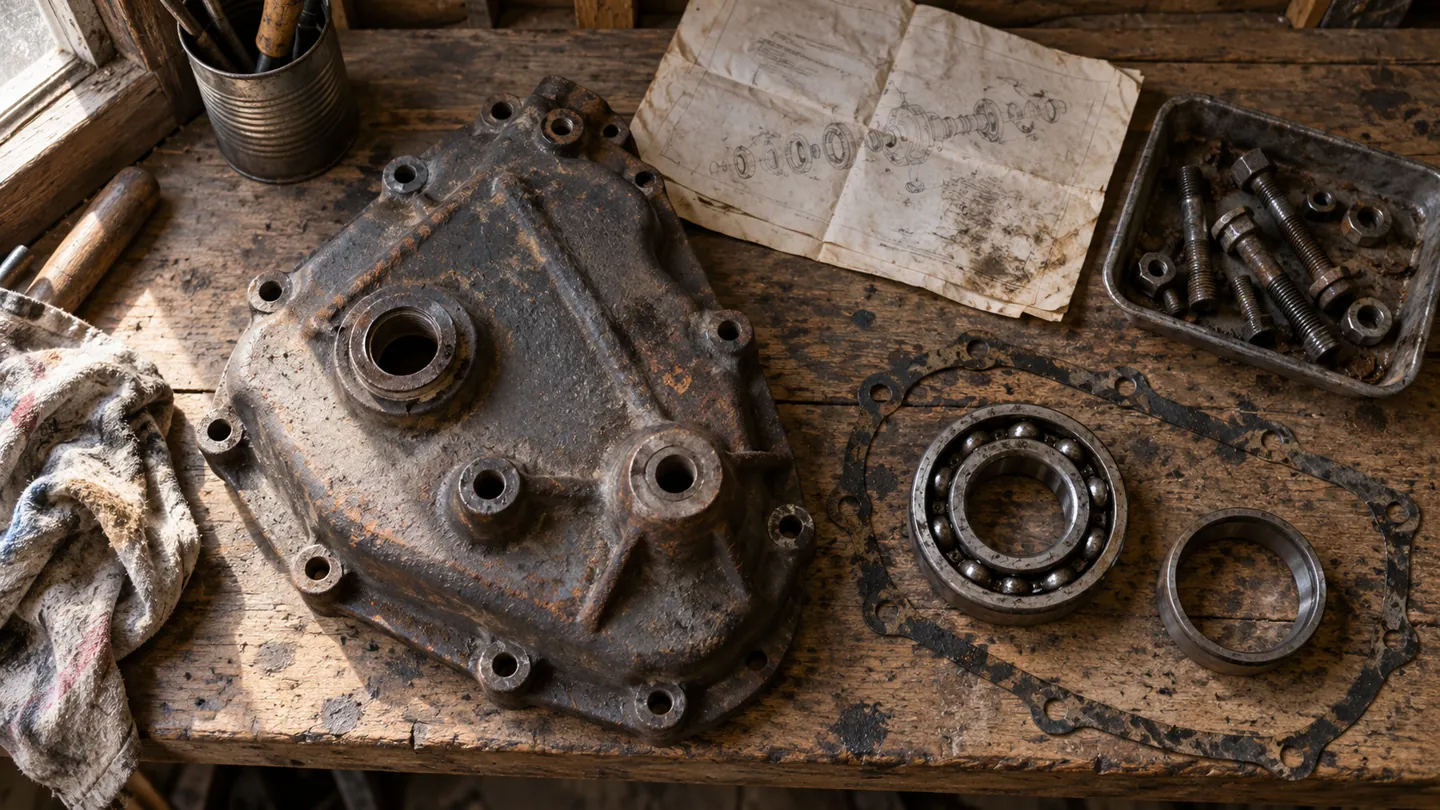
A casting number is the raised number molded into the metal of a housing, cover or block. It identifies the casting, not the finished part.
One casting can end up under several part numbers once machined. Clean the surface and use a light held at a low angle to read it.
Treat the casting number as confirmation, not proof. Photograph it and send it with your serial number when you ask a supplier for a match.
Brand by brand starting points
Each brand has a different best first stop. Some have better support than others. Use this table to choose where to start, then confirm the details with a supplier.
| Brand | Start here | Notes |
|---|---|---|
| Ford N series (9N, 2N, 8N) | Specialty suppliers with Ford catalogs, then salvage | Widely supported. Check serial range before ordering. |
| Farmall and International | Specialty suppliers, then a Case IH dealer for some older lines | CNH launched Gold Value older model parts in 2009. Ask whether the line still exists. |
| John Deere two cylinder | Deere store for manuals, then specialty suppliers and salvage | Owners report cheap reproductions of mixed quality. |
| John Deere New Generation (such as the 4020) | Deere parts catalog with your serial number, then specialty suppliers and salvage | Many parts are still listed, but some are marked no longer available. |
| Massey Ferguson | A dealer, asking about AGCO 10+ | UK pages list MF 35 through MF 6400. Confirm North American coverage. |
| Allis Chalmers | An AGCO dealer first, then specialty suppliers and salvage | AGCO has sold Heritage parts for these tractors. Confirm what is still stocked. |
Ford N series
The Ford N series has broad support from specialty sellers and salvage yards. The serial split and the model changes decide which part fits, so check them before you order.
Owners say some Ford seals can still be had from a CNH dealer, which today means a New Holland or Case IH store. That is an owner report, so call before you drive over.
Farmall and International
For Farmall, the best first stop is a specialty supplier that lists your exact model. For a few older lines, ask a Case IH dealer whether any Gold Value or other older model parts remain in the system. Their answer may be no, but the question costs a phone call.
John Deere two cylinder and New Generation
For Deere, information is easier to find than new parts. Deere publications help you identify the part, and specialty suppliers and salvage yards then supply it.
The 4020 is the easy case. Deere’s parts catalog still lists it, split at serial 201,000, though some items such as rollover protection kits are marked no longer available. Our John Deere 4020 guide covers what is still supported.
Deere’s corporate archives hold production records, including the Waterloo tractor registers from 1918 to 1972. Deere’s own newsletter says demand for those lookups is high, and that build records for some products do not exist. We could not confirm the current request process or any fee, so ask the archives before you rely on it.
Massey Ferguson
For Massey Ferguson, ask your dealer about AGCO 10+ parts before anything else. The range was built for older tractors and carries the maker’s warranty where it is offered. See our Massey Ferguson brand page for models we cover.
Allis Chalmers
Allis Chalmers owners lean on specialty suppliers and salvage yards, but ask an AGCO dealer first. AGCO owns the Allis Chalmers name and has sold a Heritage parts line for these tractors.
The catalog we found was a 2006 copy on a third party site, and it said any US or Canadian AGCO dealer could order the parts. Confirm what is still stocked before you count on it.
Tractor salvage yards: finding them and buying by phone
Tractor salvage yards sell parts pulled from dismantled machines. Most take orders by phone or online.
Look for yards that specialize in agricultural equipment rather than general auto salvage. They know the models, and they usually stock whole tractors.
Several are large operations. One national seller of used, new and rebuilt tractor parts runs several salvage yards.
It advertises a 1 year warranty on used tractor parts. Sources disagree on its yard count, so check the current number if it matters to you.
How to find a yard
Search by your tractor’s make and model plus the words salvage or dismantled. Online equipment marketplaces list dismantled machines with stock numbers and phone numbers. Owners also post want ads on those marketplaces with the OEM part number and let yards come to them.
Local yards sometimes have no website at all. Ask at your nearest tractor dealer or farm repair shop where they send customers.
Buying by phone without getting burned
Call with the model, the serial number and the part number written down. Then ask for photos of the exact part, with the part number visible if there is one.
Ask the seller to describe the condition in plain terms, such as no cracks or welds. Get that in writing.
Owners warn that “excellent condition” means different things to different people. Also ask who pays return shipping if the part is wrong. On a small part, return postage can cost nearly as much as the part itself.
Pay by credit card so you have a dispute option. Keep your invoice and photograph the part when it arrives.
Shipping heavy parts
Heavy parts such as housings, axles and blocks usually ship by freight carrier, not parcel post. The freight can cost more than a cheap part.
Ask for a shipping quote before you agree to the price. Ask whether the part ships on a pallet. Ask whether you need a loading dock or a pickup at a terminal.
Inspect the part before you sign for it. If a casting arrives cracked, write that on the delivery receipt and photograph it. We found no verified freight rates, so get a real quote for every heavy part.
Cross referencing bearings, seals and filters by industry numbers
Many bearings, seals and filters on old tractors are standard industrial parts. You can often buy them by industry number instead of tractor part number.
This is usually the cheapest fix on an old tractor. Owners report that a bearing race from a Deere counter cost more than the same race from an industrial supplier.
Owners say bearing and seal makers publish cross reference tools, and that some offer a search by size. You enter the shaft diameter, bore and width when the old part has no readable number. Owners also name industrial bearing suppliers and auto parts stores as places that can look up numbers.
How to cross reference a bearing or seal
- Clean the old part and read every mark on it. The full number matters. Small letters or digits can change the seal type, the ball count or the snap ring groove.
- Measure the shaft diameter, bore diameter and width with calipers. Write the numbers down.
- Look up the number in a bearing maker’s cross reference tool or ask an industrial supplier to match it.
- Compare the result to the dimensions you measured. Do not trust the lookup alone.
- Buy a quality brand. Owners warn about counterfeit and low quality bearings sold under familiar names, so buy from an established supplier.
Tapered roller bearings come in two pieces, a cone and a cup, and they must match as a set. Replace both together and make sure the numbers pair up.
Filters work the same way. Match the thread size, gasket diameter and height, or use a filter cross reference from the filter maker.
Avoiding scams and wrong parts online
Most online vintage tractor parts problems are not scams. They are the wrong part sold in good faith.
Or the seller misdescribed it without knowing the model. A few habits protect you from both.
- Insist on photos of the actual part. Stock photos prove nothing about condition or fit.
- Match the number, not the title. A listing that says fits many models may not fit yours.
- Read the return policy first. Look for restocking fees and who pays shipping on an error.
- Pay by credit card or a method with buyer protection. Avoid wire transfers and gift cards.
- Be wary of prices far below everyone else. A new part at half the usual price is often a poor copy or a counterfeit.
- Check the seller. A real business has a phone number that someone answers.
These are common sense steps, not the result of any study. If a seller pressures you to pay outside the platform, walk away.
When a part is truly unobtainable
When no one sells the part, you have three options. You can have it made, repair the old one, or adapt a part from another machine.
A machine shop can often copy a simple part like a shaft, bushing, spacer or bracket from your sample. Complex castings are harder and cost more.
Machine shops and fabricating
Bring the worn part, and the matching one if you have it. Ask for a quote before work starts.
Simple turned parts are the best candidates. Bushings, pins and shafts can often be made to size.
Ask the shop about the material. Do not make a high stress part from a guess.
That includes steering components, axle shafts and wheel studs. Ask a qualified machinist or welder, and use the original material specification when you can find it.
Repairing and adapting
Repair is often better than replacing. A worn bore can be sleeved.
A worn shaft can be built up and ground. A cracked housing can sometimes be welded by someone who knows cast iron. Each of these jobs needs a shop that does it regularly, so ask for references.
Adapting a part from another model works when the dimensions match and the part carries no safety load. Measure twice and test fit before you commit. Do not adapt brake or steering parts without expert advice.
If keeping one tractor running costs too much, think about a different tractor. Our tractor sizing guide helps you work out what job a replacement has to do.
The bottom line
Look for vintage tractor parts in a fixed order. Try the maker, then a reputable specialty supplier, then salvage.
Know your serial number and get a parts manual before you order anything. Spend real money on brakes, steering, wheel hardware and hydraulic seals. Save where a failure only costs you time.
Frequently asked questions
Are reproduction parts as good as original parts?
Sometimes, but not reliably. Owners report that quality varies a lot, and they commonly name sheet metal fit and gauges as weak spots. Buy from a supplier with a clear return policy and test fit every part.
Where can I buy used tractor parts safely?
Buy from yards or sellers that give you a written return policy and send photos of the actual part. Pay by credit card and keep your invoice. Ask who pays return shipping before you commit.
How do I find a part number for an old tractor?
Start with the model and serial number, then use a parts manual to find the number. Confirm it with the casting number on the old part. Deere’s store sells parts catalogs, but its own search warns it may not work for every machine.
Does John Deere still sell parts for old tractors?
Some, not all. Deere’s parts catalog still lists New Generation models like the 4020, with some items marked no longer available, and we found no program aimed at the two cylinder tractors. Ask a Deere dealer about the specific part with your serial number in hand.
Can I use a modern bearing or seal on a vintage tractor?
Often yes, if the dimensions and type match. Many old tractors use standard industrial bearings and seals.
Cross reference by number or by measured size. Check the fit before you press anything in.
What if nobody makes the part anymore?
Look for a used part first, then ask a machine shop about copying it. Simple parts are the easiest to make. Do not improvise brake, steering or wheel parts.