Implements & Attachments
Box Blade Buying Guide: Size, Weight and Scarifiers
How to choose a box blade for a sub compact, compact or small utility tractor. Covers width, weight per foot, scarifiers, hitch fit, build quality, brand prices and used buying.
IN THIS GUIDE JUMP TO A SECTION +
As an Amazon Associate, TractorFolk earns from qualifying purchases. Links to products on this page may earn us a commission at no cost to you.
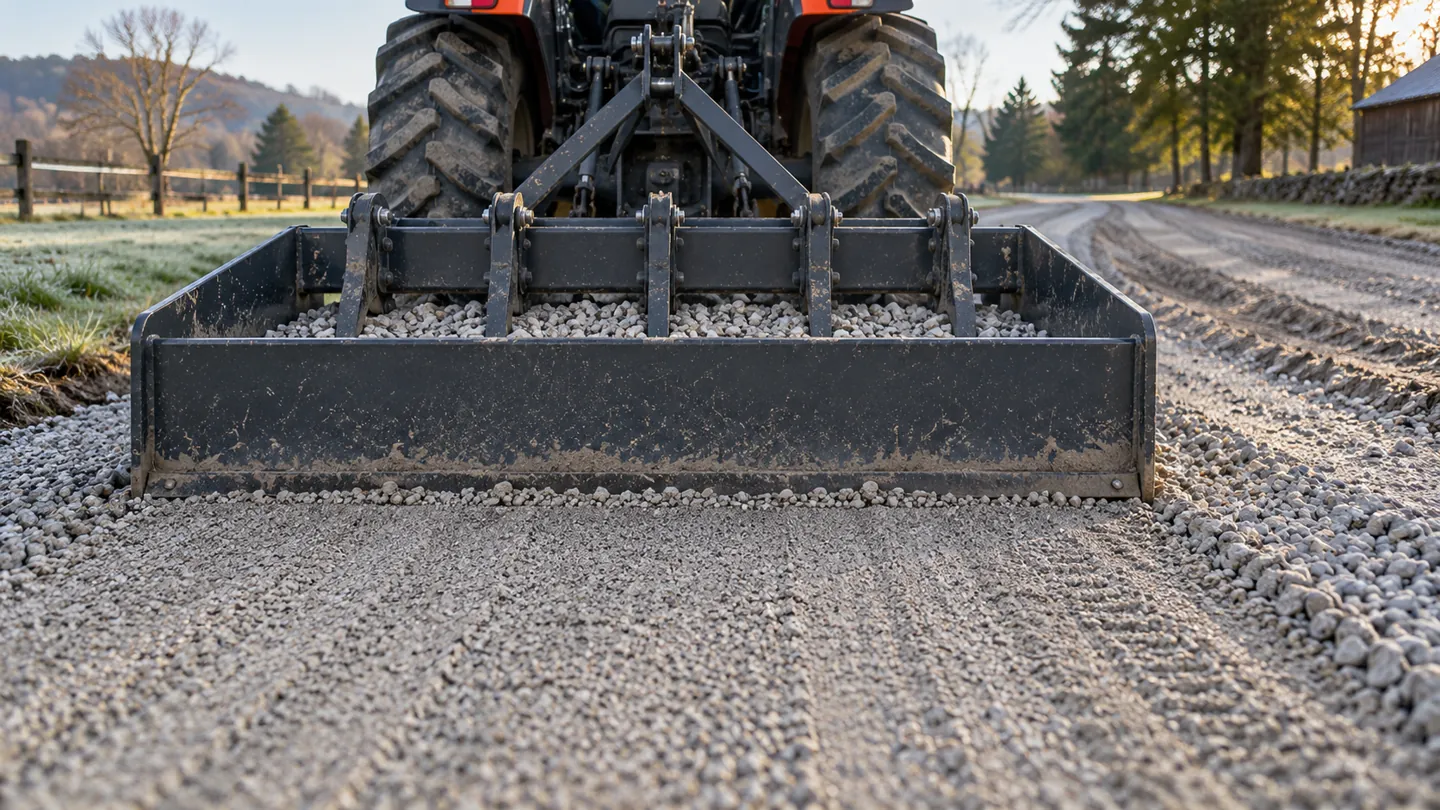
Picture a gravel drive with washboard ridges every few feet and a pothole that fills after every rain. A box blade with its shanks down chews those ridges apart on the first pass. With the shanks pinned up, it drags the loose stone into the low spots.
Three or four more passes leave the drive close to flat. No other 3 point tool does that job as well. Choosing the right one comes down to width against your rear tire track, weight per foot, and your hitch category.
The short version
- Buy a blade at least as wide as your rear tire track. For most sub compacts that means 48 to 60 inches. For most compacts it means 60 to 72 inches.
- Weight per foot of width decides how well it cuts. Compact class blades usually run 65 to 90 pounds per foot. Owners who grade a lot say 100 or more is better.
- Kubota caps box blades on the BX2380 at 60 inches and 375 pounds. Check your own maker’s implement limits before you buy.
- Match the hitch first: Cat 0, limited Cat 1 or Cat 1. A blade that does not fit your pins or quick hitch is the most common wrong turn.
- Look for a 3/16 inch moldboard or thicker, 3/16 to 1/4 inch end plates or thicker, reversible edges and 4 to 6 adjustable shanks.
What a box blade does, and what it is poor at
A box blade, also sold as a box scraper, cuts, carries, spreads and backfills soil and gravel. It hangs on the 3 point hitch.
It is an open bottomed box with a cutting edge at the front and another at the back. A row of scarifier shanks on the front beam rips hard ground before the edge reaches it.
- Cut: The front edge slices high spots when you lower the hitch and shorten the top link.
- Carry: The loosened material collects inside the box and rides along with you.
- Spread: Lift the hitch or tilt the nose up, and the rear edge lays that material down thin.
- Backfill: The same carrying action pushes dirt or stone into trenches, ruts and low spots.
It is poor at a few things. It does not finish as cleanly as a land plane, which rides over small bumps on a longer frame. It does not angle like a rear blade, so crowning a road or pushing material sideways takes more skill.
It is also a weak snow tool and a weak digger, because a 3 point hitch cannot push down. Owners often describe a learning curve. Loose stone piling up behind you on your first few passes is normal.
What size box blade do you need?
Buy one at least as wide as your rear tire track, and no wider than your tractor can pull with a full box. Width is a traction problem as much as a coverage problem.
Start with the rear track. Kubota’s BX brochure lists a rear tread of 32.2 inches and an overall width of 44 to 45 inches. A 48 inch blade covers that.
Owners commonly advise going a few inches wider than the tractor. That way the tires do not leave ruts in your finished surface.
Horsepower and tractor weight set the upper limit. One owner of a very light older Kubota pulls a 60 inch blade. He needs four wheel drive, a loaded front loader and a rear differential lock to do it.
He still calls it finicky. He says 54 inches is the sweet spot for small tractors.
| Tractor class | Typical horsepower | Typical hitch | Typical width | Notes |
|---|---|---|---|---|
| Sub compact | 18 to 30 hp | Limited Cat 1 or Cat 1, some Cat 0 | 48 to 60 inches | Start at 48 or 54. Go to 60 only with 4WD, loader weight and a diff lock. |
| Compact | 30 to 45 hp | Cat 1 | 60 to 72 inches | Most 60 inch Cat 1 blades are rated up to about 45 hp. Six feet is the common upper size. |
| Small utility | 45 to 80 hp | Cat 1 or Cat 2 | 72 to 84 inches | Look for heavy duty or Cat 1 and 2 models. Light compact blades are too light here. |
These are working ranges, not rules. Makers publish their own limits. Land Pride rates its BB12 series for 17 to 30 hp.
Bush Hog rates its light BBX line at up to 30 hp on 4WD or 40 hp on 2WD. Deere lists the Frontier BB50L at a maximum of 18 PTO hp and the much heavier BB2172 at up to 70 hp. Read the maker’s range for your exact model.
If you are still choosing the tractor itself, see our guide to choosing a tractor size by acreage and job.
Weight: why heavier cuts better
A heavier blade cuts better because a 3 point hitch cannot push a tool into the ground. The only downward force is the implement’s own weight plus whatever sits in the box. A light one skips over hard ground and refuses to bite.
Owners judge blades by weight per foot of width. A common owner rule says 100 pounds per foot is acceptable, 125 is better, and 150 or more is excellent. Those targets come from owners of larger tractors, so a sub compact cannot always follow them.
The weights below are the makers’ listed figures where we could reach an official page. Where only a dealer page listed the number, the table says so.
| Blade | Width | Listed weight | Pounds per foot | Class |
|---|---|---|---|---|
| Bush Hog BBX48 | 48 inches | 260 lb | About 65 | Light |
| Bush Hog BBX60 | 60 inches | 325 lb | About 65 | Light |
| Land Pride BB1248 | 48 inches | 143 kg (about 315 lb) | About 79 | Standard |
| Land Pride BB1272 | 72 inches | 183 kg (about 403 lb) | About 67 | Light to standard |
| Everything Attachments XTreme Duty | 60 inches | 385 lb | About 77 | Standard |
| Frontier BB50L | 50 inches | 360 lb | About 86 | Standard |
| Frontier BB2072 (dealer listings) | 72 inches | 494 to 534 lb | About 82 to 89 | Standard |
| Frontier BB2172 (dealer listings) | 72 inches | 667 lb | About 111 | Heavy duty |
| Woods BSS72P (dealer listings) | 72 inches | 551 lb | About 92 | Standard to heavy |
| Woods BSM84P (dealer listings) | 84 inches | About 750 lb | About 107 | Heavy duty |
Read the table this way. Under 70 pounds per foot is light duty, 70 to 95 is standard, and 100 or more is heavy duty. Light blades are fine for spreading gravel and smoothing a drive, but they struggle on hardpan and clay.
Notice that width alone tells you little. The 72 inch Land Pride BB1272 weighs less per foot than the 48 inch model in the same series. The three 72 inch Frontier and Woods blades span 494 to 667 pounds.
Dealer figures do not always agree either. Dealer pages show the Frontier BB2072 at both 534 and 494 pounds. Ask the seller for the shipping weight before you buy.
What a sub compact can safely lift
Kubota’s BX series brochure rates the Category I hitch at 680 pounds, measured 24 inches behind the lift pin. The brochure gives that one figure for the BX1880, BX2380, BX2680 and BX23S. Subtract the blade weight to see what is left for the load.
Hitch capacity is not the whole story. Kubota’s BX implement limitations sheet caps box blades on the BX2380 at 60 inches wide and 375 pounds. Going past a maker’s limits can also affect warranty coverage.
That cap rules out some popular 60 inch blades on a BX, including the 385 pound Everything Attachments model in the table above. A 260 pound blade leaves plenty of room. A full box of wet clay can weigh several hundred pounds more, so keep loads small.
One owner of an older, lighter Kubota with a 500 pound lift limit runs a 60 inch blade at 300 to 350 pounds. He said adding a 113 pound bumper pushed him close to the limit. He suggested staying under 350 pounds if you want headroom.
Spec sites disagree on the John Deere 1025R, listing 681 to 758 pounds at 24 inches. Use the number in your own operator’s manual.
Scarifiers: how many, fixed or adjustable
Scarifiers, also called shanks or rippers, are the teeth that loosen hard ground before the front edge cuts it. Most blades carry about one shank per foot of width or slightly fewer.
Land Pride’s BB12 series is typical. It runs 4 shanks on the 48 to 60 inch models, 5 on the 66 and 6 on the 72.
Fewer shanks put more weight on each point, so each one digs deeper. That is why some 4 foot blades ship with 3.
Owners in tough soil still favor more shanks, but traction limits how many you can pull. One owner pulled six behind a 33 hp 4WD Kubota, and only in moist soil.
An odd count has a small advantage. You can leave only the center shank down and rip one line straight behind the tractor.
Another owner uses the shanks on his 4 foot blade only 10 to 15 percent of the time. Do not overpay for a big shank bar if your ground is already loose.
Fixed versus adjustable shanks
Adjustable shanks are worth having. Frontier’s BB50L has four shanks with four positions each. Land Pride’s BB12 series gives you three vertical positions.
Everything Attachments sells adjustable ripper shanks on its compact model. Woods dealers list a scarifier beam you can set at 0, 1.5 or 3 inches.
Pin retention matters too. Buyers have complained about spring clips that pop loose on one popular 48 inch model. Pins are easier to live with.
Hydraulic scarifiers let you raise and lower the shanks from the seat. Owners say they add several hundred pounds, and one report puts a hydraulic version near 1,100 pounds against 800 to 900 for a manual one. They suit utility tractors more than sub compacts.
When to drop the shanks and when to pin them up
Drop the shanks to break up packed gravel, washboard, ruts or hardpan. Set them deep enough to reach the bottom of the washboard or the pothole, and no deeper. Then pin them up for the cutting and spreading passes.
- Lower the shanks and shorten the top link slightly so the nose points down.
- Make one or two passes to churn the surface just below the ridges.
- Pin the shanks up and level the blade side to side.
- Make three or four passes to move the loosened stone into the low spots.
- Finish with the top link a little longer and the hitch in float so only the rear edge touches.
If you leave the shanks down while spreading, they leave grooves. They also eat traction.
Hitch fit: Cat 0, limited Cat 1, Cat 1 and quick hitches
Your blade has to match your tractor’s hitch category, and pin size sets the category. Hitch guides commonly list Cat 0 at 5/8 inch pins. They list Cat 1 at 7/8 inch lower pins with a 3/4 inch top pin.
Deere’s iMatch bushing kit, which adapts Cat 1 implements to the quick hitch, fits those sizes. It uses a 3/4 inch top bushing and 57/64 inch lower bushings.
Cat 0 is for tiny tractors and some sub compacts. Cat 1 covers most sub compacts, compacts and small utilities.
Limited Cat 1 appears on some small Deeres such as the 1025R. Implements for those tractors should say they are compatible. Frontier’s BB50L, for example, lists Limited Cat 1 and iMatch.
Quick hitches add a wrinkle. Implements usually need quick hitch bushings so the hooks latch without slop. Buyers have also reported a Cat 1 blade with lower pin spacing that matched Cat 0, so measure before you order.
A budget Cat 0 option exists for the smallest tractors. The KUAFU 55 inch box scraper is a Cat 0 unit aimed at sub compacts. Skip it if your tractor has Cat 1 pins, or if you need more weight than a budget unit offers.
If you swap between a box scraper, a rotary cutter and other tools, a quick hitch saves time. The SpeeCo Category 1 quick hitch is a straightforward pick.
Its listing notes that implements need quick hitch bushings. If you own one implement, pinning it directly is simpler.
Build quality checklist
A good blade has a thick moldboard, strong end plates, replaceable edges, a stiff frame and several top link positions. These details decide whether it lasts for decades or bends in two seasons. Maker spec pages give you real numbers to compare.
- Moldboard thickness: 3/16 inch is common on compact blades. Deere’s BB50L and BB2172 and the Everything Attachments model all list it. Go thicker if you work rock.
- End plates: 3/16 to 1/4 inch is the floor. Land Pride lists 5 mm (about 3/16 inch) on the BB12 series, and Deere lists 5/16 inch on the BB50L and 3/8 inch on the BB2172. Wear plates on the leading edge are a bonus.
- Cutting edges: Look for two reversible, replaceable edges, front and rear. Deere’s BB50L and Land Pride’s BB12 list 3/8 by 6 inches. Everything Attachments and the Frontier BB2172 list 1/2 by 6.
- Edge shape: Curved edges roll soil better than flat ones. A recess in the moldboard lets a bolted edge sit flush.
- Frame and mast: A welded mast is stiffer than a bolt on one. Gussets at the mast and A frame show where the maker spent steel.
- Top link positions: Several holes let you change how the blade sits.
- Gauge wheels: These hold cutting depth on long runs. Everything Attachments sells them as an option at about $430 for a single wheel on its 48 to 60 inch models. Most owners of small tractors skip them.
- Rear wall: A curved rear wall helps material shed instead of sticking.
One owner argued that side plate thickness matters little unless you work rock all day. That holds for light use. For rocky ground, buy thicker plates.
Best box blade for a compact tractor: brands and price ranges
Expect to pay roughly $1,000 to $1,600 for a new compact class blade from a major brand. The prices below came from maker or retailer pages in October 2026. They will change.
| Brand and model | Width | Price seen (October 2026) | Notes |
|---|---|---|---|
| Everything Attachments XTreme Duty | 48 to 72 inches | $1,300 base, $1,345 to $1,510 by width | Maker’s page. Cat 1, 4 shanks to 60 inches, 6 on larger. 355 to 450 lb. |
| King Kutter Professional | 60 inches | $1,219.99 at one retailer | 5 shanks, dual 1/2 inch edges, Cat 1 quick hitch system. |
| Land Pride BB12 series | 48 to 72 inches | Dealers list the 72 inch BB1272 at about $1,260 to $1,564 | Cat 1, 17 to 30 hp, 315 to 403 lb. Dealer prices, no official list found. |
| Titan (3100 series) | 48 to 96 inches | A dealer listed a 5 foot model at $1,100 in 2026 | Cat 1 quick hitch, rated for 15 to 45 hp. |
| Frontier (Deere) | 50 to 84 inches | Dealer quote needed | Limited Cat 1 on the BB50L. Cat 1 and up to 70 hp on the BB21 series. iMatch compatible. |
| Woods | 54 to 84 inches | Dealer quote needed | BSS line for up to 45 hp. Heavier BSM line for larger tractors. |
| Bush Hog | 48 to 72 inches (BBX) | Dealer quote needed | Light BBX line, 260 to 390 lb. Heavier MBX and RBX lines for bigger tractors. |
We could not find posted retail prices for Woods, Frontier or Bush Hog. They sell mostly through dealers who quote by region. The Land Pride and Titan figures are dealer and retailer listings, not manufacturer price lists.
A few honest verdicts follow. Everything Attachments publishes the clearest spec sheet in the compact class, with weight and price for every width. Bush Hog’s BBX is the lightest on this list, which suits a very small tractor but not hard ground.
Land Pride’s BB12 is a natural pick for a BX owner, as long as you stay at 60 inches or narrower. Kubota dealers stock it, and its 17 to 30 hp rating matches the tractor. The 66 and 72 inch models exceed Kubota’s BX limits, so they suit larger compacts.
Frontier and Woods make sense if you want a dealer nearby for service.
For online buyers, the Titan box blade with scarifier shanks is sold in several widths for Cat 1 tractors. Confirm the width, shank count and shipping weight on the listing. Read recent buyer comments about hardware and paint.
Still matching an implement to a tractor you do not own yet? See our list of sub compact tractors worth buying.
Buying a used box scraper
A used box scraper is one of the safer implements to buy secondhand, because few parts can fail. Check that the frame is straight, the end plates and edges have steel left, and the pins are present. Then compare the asking price with new.
- Sight down the frame and moldboard. A bend means heavy abuse.
- Inspect the welds at the mast, end plates and A frame for cracks or old repairs.
- Measure the cutting edges. A thin edge is replaceable, but a worn moldboard under it is not.
- Check the end plates for wear and thin spots.
- Look at the shanks and their pins. Missing pins are common and cheap to replace.
- Confirm the hitch category by measuring the lower pin holes and spacing.
- Check the mast and top link holes for elongation or bending.
On price, owners commonly report used compact blades selling for $250 to $500. Heavier or nearly new units go for $550 to $950. One rule of thumb says a used implement rarely brings more than half of new.
A 5 foot unit in rough shape often sells for under $300. Check what similar blades bring in your area before you negotiate, and take off the cost of any missing pins.
Box blade vs land plane vs rear blade
Use the box when you need to cut, rip and move material. Use a land plane when the surface is already roughly graded and you only want it level. Use a rear blade when you need to angle material sideways, crown a road or clear a shoulder.
Owners with long gravel drives often rip up bad areas and fill potholes with the box first, then run a land plane for routine smoothing. A land plane is easier to use, but it moves little material and can leave larger stone on top.
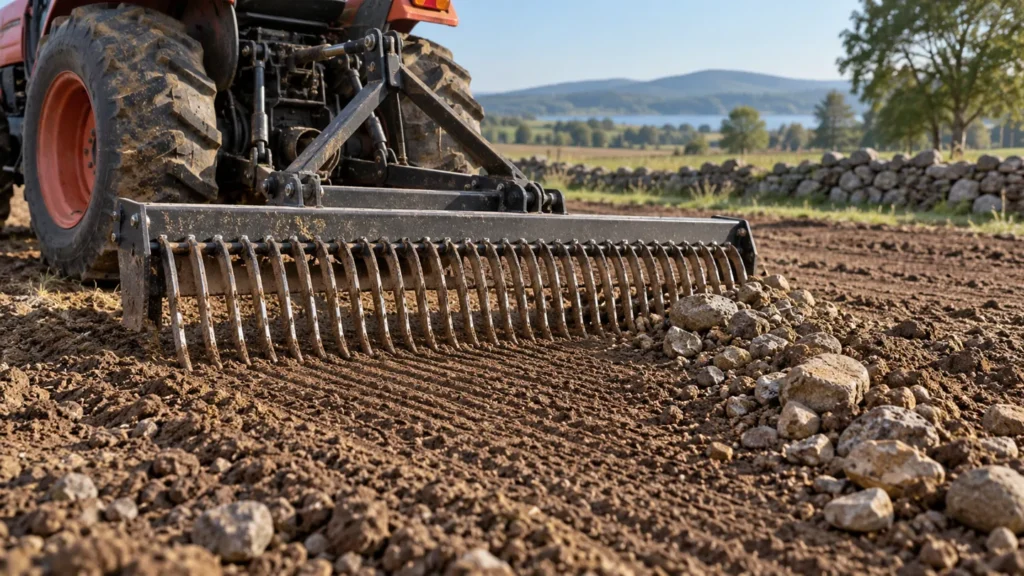
A Harley rake is another option if your real problem is rocky or sod covered ground you want to prepare for seed.
Is a hydraulic top link worth it for grading?
A hydraulic top link is worth it if you grade often or swap between several 3 point tools. It lets you change the nose angle from the seat while you move. That saves climbing on and off, and it gives better control when you cut and fill.
Owners mostly say yes for this kind of work, and one called his results unbelievable. The objections are cost and plumbing.
It needs a double acting rear remote. Dealer installs on some tractors have run several hundred dollars.
If you set the angle once and leave it, a regular top link is fine. The VEVOR hydraulic top link in Cat 1 is a budget way to try the idea. It needs that double acting remote, so skip it if your tractor does not have one.
A sturdy manual top link also helps. The SpeeCo 3/4 inch by 16 inch forged top link is an alternative if yours is bent or too short. Check the length against your tractor and implement first.
Mistakes buyers make, and basic setup
The most common mistakes are buying too wide, too light or the wrong category. Each one is avoidable if you do the math before you order.
- Too wide: One owner reported spinning the tires once there was more than about 6 inches of gravel in a 6 foot box. A narrower blade moves less material and keeps traction.
- Too light: A light blade skips on hard ground. It also will not hold the rear wheels down during a maximum loader lift.
- Wrong category: Cat 0 pins are smaller than Cat 1 pins, so the two do not interchange without bushings. Measure first.
- Too much added weight: Bolting weight onto a small tractor’s hitch can push you past its lift rating.
Basic setup in five steps
- Park on level ground and lower the implement fully.
- Check side to side level with a bubble level on the frame. Adjust the leveling arm on your lift arm until it reads flat.
- Set the top link for front to rear pitch. A shorter link gives more front bite. A longer link gives more rear carry and a smoother finish.
- Check the hitch pins, top link pin and tire pressure. Loose pins make grading uneven.
- Drive a short test pass and adjust. Compact any loose fill with your rear wheels.
Can it work as rear ballast or for snow?
A box scraper works fine as rear ballast when carried on the hitch, and it handles light snow. A rear blade or ballast box does both jobs better.
The ballast value comes from weight on the arms, not from digging. Many owners leave the blade on year round when they use a front loader.
One owner compared a dealer ballast box at about $225 with a 48 inch blade at about $479. The box weighs about 500 pounds filled, the blade about 300. Others said even a heavy blade was not enough for maximum loader loads and added weight to it.
The box is long, and owners warn that it is easy to back into a fence or tree. For snow, owner advice is to use a rear blade for light falls of 4 to 5 inches. For ballast sizing, try our ballast calculator before you add weight.
Bottom line
Match the box blade to your hitch category and make it wide enough to cover your rear tires. Choose the heaviest one your tractor can lift and pull.
For most sub compacts that is a 48 to 60 inch blade that stays inside the maker’s limits, which means 375 pounds or less on a Kubota BX. For most compacts it is a 60 to 72 inch blade with 5 or 6 adjustable shanks.
Buy thicker steel and reversible edges over fancy options. Spend on a quick hitch or hydraulic top link only if you will use them.
Frequently asked questions
Is a box scraper the same as a box blade?
Yes. They are two names for the same 3 point tool. Some makers put scraper in the model name, and others call it a blade.
What box scraper for a tractor under 25 hp makes sense?
Keep it small and light. A 48 to 54 inch unit of 300 to 370 pounds is realistic. Anything bigger will strain the hitch and the tires.
How many passes does a gravel drive take?
Plan on one or two passes with the shanks down, then three or four with them up. A typical washboard drive takes about an hour in total. Weave back and forth on the last pass so you do not leave a ridge.
Should the blade be wider than my tractor?
Yes, if you want a smooth finish. A blade wider than the rear track keeps your tires from leaving ruts. Do not go so wide that you lose traction.
Will a Cat 1 implement fit a Cat 0 hitch?
Not directly. Cat 1 pins are larger, so the implement will not slide onto Cat 0 lift arms. Buy a Cat 0 model, or one listed for limited Cat 1 with Cat 0 pins.
Does a hydraulic top link change my hydraulic fluid needs?
It runs off your tractor’s hydraulic system, so use the fluid your manual specifies. Our tractor hydraulic fluid guide explains the options.
Can a box scraper cut brush or tall grass?
No. That is a job for a rotary cutter. See our rotary cutter buying guide if you also need to clear brush.
For more on equipment that hangs on a 3 point hitch, browse our implements section.