Maintenance
Tractor Tire Chains: Sizing, Clearance and the Right Chains for Snow and Mud
Tractor tire chains work best on the rear tires, sized to the sidewall and paired with ballast. Learn the patterns, the clearance checks and how to tension them.
IN THIS GUIDE JUMP TO A SECTION +
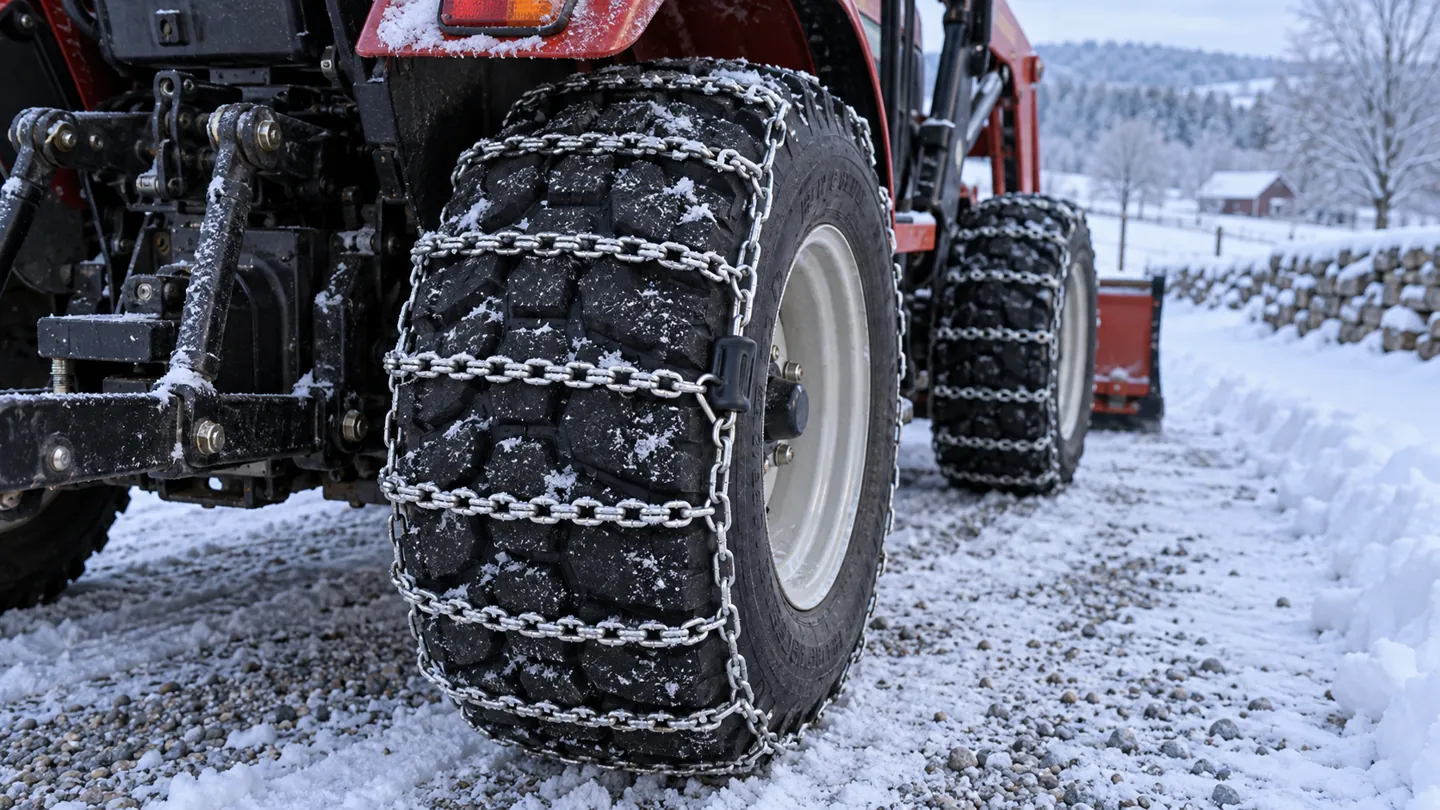
Put chains on the rear tires first, and put ballast on the tractor before you buy anything else. Tractor tire chains give a tire something to bite with. They only bite when enough weight sits on that tire, so chains plus ballast beat either one alone.
The right set matches the size printed on your tire sidewall. It also leaves room between the chain and your fender.
For most compact tractors that means a pair of ladder chains on the rear. Pull them snug, hold them with rubber tensioners, and recheck them after the first few hundred feet. Front chains are optional, and on four wheel drive they need a second thought.
Your operator manual probably says nothing about any of this. We searched the Kubota BX and Deere 1 Series manuals for a chain section and found none. The guidance below comes from the chain makers’ own instruction sheets and from patterns in owner reports, so your own clearance check is the step that matters most.
The short version
- Chain the rear tires first. They carry the drive and most of the weight.
- Buy by the exact size printed on the tire sidewall, for example 26×12.00-12 or 8.5-16.
- 2 link ladder chains ride smoother and grip more evenly. 4 link chains cost less and suit occasional use.
- Check clearance at the fender, loader valves and hydraulic lines before the first drive. Check again with the wheels turned.
- Drive 150 to 300 feet, stop, retighten. Take the chains off when the snow is gone.
When tractor tire chains help and when they do not
Tractor tire chains help most on packed snow, ice, slick mud and sloped ground, where a bare tire spins. They do little on dry ground. They do damage on turf and pavement.
Snow plowing is the classic case. A tractor with a loader or rear blade pushes against the load, and bare turf tires slide on packed snow. Chains turn that slide into forward motion.
Hills and mud are the other two jobs. Owners most often describe the sloped driveway, where a loaded tractor loses grip on ice halfway up. Chains help less in deep, soft mud, because the tire packs full and the chain has nothing firm to grab.
Chains are the wrong tool on turf you want to keep, and on blacktop or concrete. Steel cross chains cut sod and scar pavement. V bar and studded styles bite ice hardest and mark hard surfaces worst.
Skip chains entirely when the real problem is weight. A light tractor with an empty loader and nothing on the 3 point hitch spins because the rear tires are unloaded. The tread is not the problem, so fix the weight first, which gets its own section below.
Ladder, diamond, 2 link, 4 link: which chain pattern fits
A ladder chain with 2 link spacing is the safe default for a compact tractor on snow and ice. The other patterns solve narrower problems, and a few of them create new ones.
Two terms matter. The pattern is how the cross chains lie across the tread. The spacing is how many side chain links sit between cross chains.
So 2 link means a cross chain every second link. 4 link means every fourth.
| Type | What it is | Best for | Trade off |
|---|---|---|---|
| Ladder, 2 link | Straight cross chains every second link | Frequent snow, ice and slopes | Costs more and weighs more |
| Ladder, 4 link | Straight cross chains every fourth link | Occasional snow and general use | Rougher, noisier ride and less even grip |
| Diamond (also sold as Z pattern) | Diagonal cross chains for more even coverage | Smoother ride, side grip, even wear | Costs more, and owners disagree about it on deep lug tires |
| V bar | Cross chains with a raised ridge | Hard ice | Marks blacktop and concrete |
| Studded | Steel studs added to the cross chains | Glare ice | Hard on pavement and driveways |
Sellers say 2 link chains ride smoother and grip more consistently, because more cross chains touch the ground at once. They position 4 link chains as the lower cost choice for occasional use.
Owners agree on the ride but not on the traction. Several report little difference between 2 and 4 link in real snow. Treat the traction gap as disputed and the ride gap as real.
Twist link vs square link
Twist link and square link describe the shape of the steel in the chain. Square link is common on alloy tractor chains, and twist link appears on lighter and cheaper sets.
Pewag, which builds square link tractor chains, claims they last up to 8 times longer than twist link and pull up to 32 percent harder. That is a maker’s claim about its own product.
The practical difference for a compact tractor is height. Sellers quote square link at roughly 1/2 inch tall and call twist link the lower profile choice. We found no chain maker’s published comparison.
Treat link shape as a clearance question first. If your fender gap is tight, ask the seller for the link height of the exact set.
Where studs and cleats fit
Studs only make sense on glare ice. They help on a sloped driveway that stays frozen, and they hurt anywhere you cross pavement. Most compact tractor owners on snow and packed ice do fine without them.
Sizing chains from the tire sidewall
Read the size printed on the tire sidewall and buy chains made for that exact size. Do not guess from the tractor model, because the same model ships with several tire options.
Garden and compact tractor tires mostly use three numbers, such as 23×10.50-12 or 26×12.00-12. Chain sellers and tire listings read them the same way: height, then width, then rim diameter, all in inches. Kubota prints its BX rear sizes this way, 24×12.00-12 on the BX1880 and 26×12.00-12 on the BX2380 and BX2680.
The first number is nominal. Carlstar’s own listings for a 26×12.00-12 tire show mounted diameters from about 25.0 to 25.6 inches, depending on the tread. That is why chains are sold by the printed size, not by a tape measure.
Sizes like 8.5-16 use two numbers. Titan explains the two number style with a larger tire, 17.5L-24. The 17.5 is the width in inches, the dash means bias construction, and the 24 is the wheel diameter in inches.
By the same logic, 8.5-16 is about 8.5 inches wide on a 16 inch rim.
| Size on the sidewall | First number | Second number | Last number |
|---|---|---|---|
| 26×12.00-12 | 26 inches tall (nominal) | 12.00 inches wide | 12 inch rim |
| 18×8.5-10 | 18 inches tall (nominal) | 8.5 inches wide | 10 inch rim |
| 8.5-16 | 8.5 inches wide | Bias construction (the dash) | 16 inch rim |
We could not find a tire maker’s page that spells out the three number format. The table reflects how chain sellers explain it and how Kubota, Deere and Carlstar write their sizes.
Matching chains to R1, R4 and turf tires
Chains are sized per tire, not per tread, but the tread changes how they sit. The tire maker Yokohama OHT describes the three codes you will see. R1 is the deep bar lug ag tire built for soft ground.
R3 is the turf tire, with shallow blocks that ride on top of grass. R4 is the industrial tire, with a shallower, straighter bar lug for hard surfaces.
A deep lug R1 lets a straight cross chain drop between the lugs. A shallow R3 turf tire leaves the chain lying flat on the tread. An R4 sits between the two.
Owners split on what to do about deep lugs. One camp says a ladder chain that falls between lugs is a poor choice and a diamond stays on top. Another reports ladder chains working fine on loaded tires.
Treat the tread question as open and pick by size first. Tread names also vary by maker. Kubota lists its BX tires as Turf, Bar and Ind, and Deere lists R3 and R4 for the 1025R, so match the number and ignore the label.
The fit test before you buy
The chain makers’ sheets say to pre fit chains before you need them, whatever the brand. If your exact size is not listed, owners sometimes trim a close size to fit. They call the job fiddly, so test fit new chains before the first snowfall.
Do you need chains on all four tires?
No. Rear tire chains do most of the work on a compact tractor, and most owners stop there. Front chains are an add on, and on four wheel drive they bring a risk worth understanding.
The rear tires carry the drive and, with the loader empty, most of the weight. When owners ask about chaining only the fronts, replies mostly say fronts alone will not match rear chains. Some owners still chain the front for steering on a loader tractor that plows a slope.
What happens with four wheel drive
On a four wheel drive tractor, the front axle is geared to turn slightly faster than the rear. Owners commonly relay a dealer warning about chains on the front only. The chains make the front tires effectively taller, which can bind the driveline in 4WD even in a straight line.
Before fitting front chains, confirm approval for the tractor, tires, axle and chain design. Owner reports about using 4WD selectively do not establish approval. If the manuals do not resolve it, ask the manufacturer or authorized dealer.
The chain makers’ sheets do tell you to read your tractor manual before installing. If your manual or dealer says no to front chains, follow them.
A simple rule
Start with a rear pair. Add front chains only if you plow on a slope or lose steering in snow. Then buy matching sets for both ends.
Clearance: fenders, loader frames and 3 point arms
Clearance is the limit on most compact tractors, and the manual will not give you a number. A chain adds the thickness of its links to the tire. The gap behind a rear fender can be an inch or less.
The Kubota BX manual (BX1880, BX2380 and BX2680) has no tire chain section. Neither does the Deere 1023E and 1025R manual. Kubota covers wheel bolts and tread width, and Deere covers tire combinations and ballast.
Chain makers do not publish a minimum clearance for tractors either. Peerless and Pewag both put the question back on you: pre fit the chains and check the vehicle maker’s manual. So the clearance check is yours to do.
Owner reports on BX tractors point to the same trouble spots. BX2380 owners measure about an inch between the tire and a shield plate inside the right fender. BX23S owners note that the loader valve on the right rear fender sits very close to the tire.
Loose chains cause the real damage. Owners describe chains coming off and the inner hook bending brackets near the fuel tank. Check around fenders, brake rods, transmission parts and inside the wheel wells before you move.
- Install the chains snug on level ground, using the steps below.
- Look inside each fender with a flashlight. Check the loader valves and hydraulic lines on the right side.
- Slowly turn the steering lock to lock while someone watches the front fenders.
- Raise and lower the 3 point hitch if you carry an implement. Watch the lift arms near the tires.
- Check clearance using the chain and tractor manufacturer requirements, including permitted movement and steering travel. No universal finger width clearance is established here.
Wheel spacers are the usual fix for tight rear clearance on BX tractors. Several owners say they would not run chains on a BX2380 without them.
Ask your dealer about spacers that fit your axle. Kubota says you cannot adjust BX rear tread, and it warns about wheel orientation.
Tractor tire chains and ballast work together
Chains need weight on the tire to bite, so ballast and chains work as a pair. A light rear end spins even with chains, and a ballasted rear end with bare tires slides on ice. Chains are the grip, and ballast is the force pushing the grip into the ground.
If you plow or carry loads with a loader, the rear end is already light. Weight on the 3 point hitch puts force behind the rear axle, and chains turn it into pull.
Our guide to how much ballast a tractor needs covers the amount. The free ballast calculator does the subtraction for your setup.
Liquid in the rear tires adds ballast low and at the axle, but it changes how you install chains. Aquiline lists deflating the tire among its do nots. You cannot let air out to slip a tight chain on, so use the normal drape and roll method and take your time.
Mind the ballast rules in your own manual. Deere says to fill tubeless tires to at least valve stem level (75 percent). Tube type tires stay under 90 percent, and Kubota’s BX manual says not to combine rear wheel weights and liquid ballast.
How to install and tension tractor tire chains
Lay the chains flat, drape them over the tire, roll forward, fasten inside then outside, then tighten and retighten. Aquiline, Peerless and Pewag all publish this order. It works for most ladder style sets.
- Lay the chains out flat behind the tractor, with the cross chain hook openings facing up. Remove every twist and tangle.
- Drape each chain over its tire, centered, with the hook openings facing away from the tire. Tuck the loose ends under the tire.
- Roll the tractor forward slowly, about 2 feet, until the chain ends sit near axle height.
- Connect the fastener on the inside of the tire first. Count the same number of links on the outer side chain, and place the fastener through that link.
- Pull the tail chain tight and connect the shackle to the side chain. The chain should fit snug.
- Tie down or remove any unused links so nothing flails.
- Add rubber chain adjusters, then drive 150 to 300 feet, stop and inspect.
- Retighten by moving the fastener one more link until the chain fits snug around the tire. Check that every hook and fastener is secure.
This sequence follows the Aquiline tractor chain instruction sheet. The distance and tie down steps come from Pewag and Peerless. Your own set may differ, so read its sheet first.
Keep the same link count inside and out so the chain stays centered. There is no left or right chain, so either one fits either tire.
Rubber tensioners and the first run
Rubber tensioners pull the chain tight against the tire and keep it centered as it settles. Aquiline says adjusters give a more secure fit and extend chain life. The makers’ sheets recommend a multi arm adjuster, and Titan sells one in tractor sizes.
The first run is where the chain finds its seat. Pewag’s instructions say to drive 150 to 300 feet and let the chain center itself. Then check tightness and take up one more link if you can.
Owners report repeating that two or three times. After that the chain stays put.
Snug beats tight. The maker’s test is simple: you can get your knuckles under a cross chain and feel pressure. The same sheet warns that over tightening damages the tire.
Loose chains fall off and bend things. Check the rubber tensioners each time you check the chain, because they wear out too.
Speed limits with chains and how to avoid damage
Use the lower applicable tractor or chain maker speed limit. Stop if a chain loosens or contacts the machine. An unverified retail speed claim is not an operating instruction.
Kubota’s BX manual lists high range travel up to about 8 mph. Deere lists up to 9.1 mph for the 1025R on R4 tires. Neither manual gives a chain specific speed limit.
Stay in low range on snow and ice. Chains plus a high range sprint is how things break.
The chain makers agree on the habits that destroy chains and tires:
- Do not accelerate rapidly or spin the tires. Peerless says spinning wears out cross chains fast, and Aquiline lists it among its do nots.
- Do not hit curbing with chains on.
- Do not drive with a broken chain, and do not drive over the fasteners while installing.
- Do not use chains when towing other vehicles.
After every run, check for a broken cross chain, a stretched side link and a damaged hook. Take the chains off once the surface is clear. Dry ground wears them and the tire.
Recheck your wheel bolts too. Kubota’s manual says to recheck wheel bolt torque after 200 yards, after one day, and every 50 hours.
Which chains to buy
Buy by the exact tire size. Choose 2 link if you plow often, or 4 link if snow is occasional. Chains are sold as a pair, one per tire on one axle, so a rear set is one order.
For model specific service detail, see our Kubota BX maintenance guide and John Deere 1 Series maintenance guide. The front end loader guide explains why loader tractors need rear weight in the first place.
Bottom line
Choose chains approved for the actual tires and tractor configuration. Confirm clearance, tensioning and speed instructions before use. Front chains require a separate compatibility check, not just a reason to want extra traction.
Frequently asked questions
Are tire chains bad for my tractor tires?
Chains wear tires when driven on dry or cleared ground, and loose chains can cut sidewalls. Remove them once you are past the snow or ice. Keep them snug, not cranked down, and check them often.
Can I put chains on liquid filled tires?
Yes. Aquiline’s sheet says not to deflate the tire to install chains, and the drape and roll method works on a filled tire. Drive a short distance and retighten after the chain settles.
How tight should tractor chains be?
Snug against the tire, with the cross chains lying flat and the side chains centered. You should be able to get your knuckles under a cross chain and feel pressure on them. Rubber adjusters hold that tightness as the chain settles.
Is four wheel drive enough without chains?
Often not on ice, though views differ. Some owners report dealers saying 4WD makes chains unnecessary, and many of those owners buy chains anyway. Four wheel drive sends power to more tires, but only chains add grip at the tire.
Should I take chains off between storms?
Yes, if the driveway clears or you cross pavement. Steel chains wear fast on dry ground and mark blacktop. Keep them near the tractor, with the tensioners, so the next install goes quickly.
Do I need special snow chains for a compact tractor?
Not special, but sized. Compact tractors use small tires, so buy chains made for your size, such as 26×12.00-12. Pre fit them before winter, and expect them to come as a pair, one for each tire on one axle.