Maintenance
ISO 32 vs ISO 46 Hydraulic Oil: Which One Your Log Splitter Needs
ISO 46 is not simply the better, thicker oil. See what ISO 32 and ISO 46 mean, which grade splitter manuals from Champion, SpeeCo and Ariens actually list, and why neither belongs in a modern tractor sump.
IN THIS GUIDE JUMP TO A SECTION +
As an Amazon Associate, TractorFolk earns from qualifying purchases. Links to products on this page may earn us a commission at no cost to you.
Plenty of owners assume ISO 46 is the thicker, tougher oil, so it must be the better one. In the ISO 32 vs ISO 46 question, that is wrong. The right grade is the one your maker lists, adjusted for how cold it is at start up and how hot the oil runs.
For most log splitters that means ISO 32, sold as AW32, in cool or mixed climates. ISO 46 (AW46) fits where the manual names it or summers run hot. Several makers switch to automatic transmission fluid below freezing, and your manual decides that too.
This guide covers log splitters and other standalone hydraulic systems. It also explains why neither grade belongs in a modern tractor’s transmission sump.
The short version
- ISO 32 and ISO 46 are the same kind of oil. The number is the viscosity at 40 C: 28.8 to 35.2 cSt for ISO 32 and 41.4 to 50.6 cSt for ISO 46.
- Thicker is not better. ISO 46 resists heat thinning, but it is much slower to flow on a cold morning.
- Splitter makers disagree. Champion and Ariens list ISO 32, while SpeeCo manuals list AW46 on one model and AW22 or AW32 on others. Read your own book.
- Below 32 F, Champion, SpeeCo and Ariens manuals all allow automatic transmission fluid. Follow that only if your manual says so.
- Never put AW oil in a tractor with wet brakes, a PTO clutch or an HST. Use the fluid in the operator’s manual.
What does the ISO VG number mean?
The ISO VG number is the oil’s kinematic viscosity at 40 C, measured in centistokes (cSt). ISO 3448 sets the standard grades, and each grade is named for the midpoint of its band.
Shell’s lubricant classification table lists ISO VG 32 as 28.8 to 35.2 cSt and ISO VG 46 as 41.4 to 50.6 cSt. That is a band of 10 percent either side of the midpoint. ISO VG 22, the cold weather step down, runs 19.8 to 24.2 cSt.
Real oils land inside those bands. Chevron’s 2016 Rando HD sheet lists typical values of 30.4 cSt for ISO 32 and 43.7 cSt for ISO 46. Mobil’s DTE 10 Excel sheet lists 31.5 and 45.7.
The number says nothing about quality, brand or additives. It only tells you how thick the oil is at one temperature. Two ISO 46 oils can behave very differently in cold or heat, and that depends on the viscosity index, covered below.
AW, R&O and HV: what the letters add
The letters describe the additive package and the temperature behavior. They do not change the grade number.
- R&O oils carry rust and oxidation inhibitors. Chevron sells its heavier Rando grades this way, as AGMA rust and oxidation inhibited oils for gears and bearings. They are not sold as anti wear hydraulic oils.
- AW (anti wear) oils add protection for pumps under load. Chevron’s Rando HD 32, 46 and 68 list the ISO 11158 HM class, DIN 51524 part 2 and ASTM D6158 HM, and Chevron recommends them for vane, piston and gear pumps above 1,000 psi. This is what most splitters, trailers and power units expect.
- HV oils are anti wear oils with a high viscosity index. Mobil’s DTE 10 Excel lists the ISO 11158 HV class and DIN 51524 part 3. These thin less when hot and thicken less when cold, so they act like a multigrade.
If your manual prints one of those standards, match it on the jug. If it only prints a grade, any anti wear hydraulic oil of that grade is the normal choice.
ISO 32 vs ISO 46 side by side
ISO 46 is about 44 percent thicker than ISO 32 at 40 C. That gap shapes everything else.
Thinner oil flows easier when cold and wastes less energy as heat. Thicker oil holds a stronger film at high operating temperatures.
| Property | ISO 32 (AW32) | ISO 46 (AW46) |
|---|---|---|
| ISO 3448 band at 40 C | 28.8 to 35.2 cSt | 41.4 to 50.6 cSt |
| Typical AW oil at 40 C (Chevron Rando HD, 2016 sheet) | 30.4 cSt | 43.7 cSt |
| Typical AW oil at 100 C (same sheet) | 5.2 cSt | 6.5 cSt |
| Typical pour point (same sheet) | minus 33 C (minus 27 F) | minus 30 C (minus 22 F) |
| Cold flow | Easier at start up | Slower, pump works harder |
| Hot running | Thins sooner as oil heats | Holds film better in summer heat |
| Typical use | Cool or mixed climates, most splitters | Hot climates, makers who specify it |
Pour point is not the number to watch. The two grades sit only a few degrees apart there. Cold starts are limited by how thick the oil is long before it stops pouring.
Mobil’s DTE 10 Excel sheet shows the cold gap clearly. At minus 20 C (minus 4 F) the VG 46 reads about 2.5 times the VG 32. At minus 40 C it is over 6 times thicker.
That is a high viscosity index oil. A standard AW oil can show a wider gap than this.
ISO 32 vs ISO 46 for a log splitter: which oil does it need?
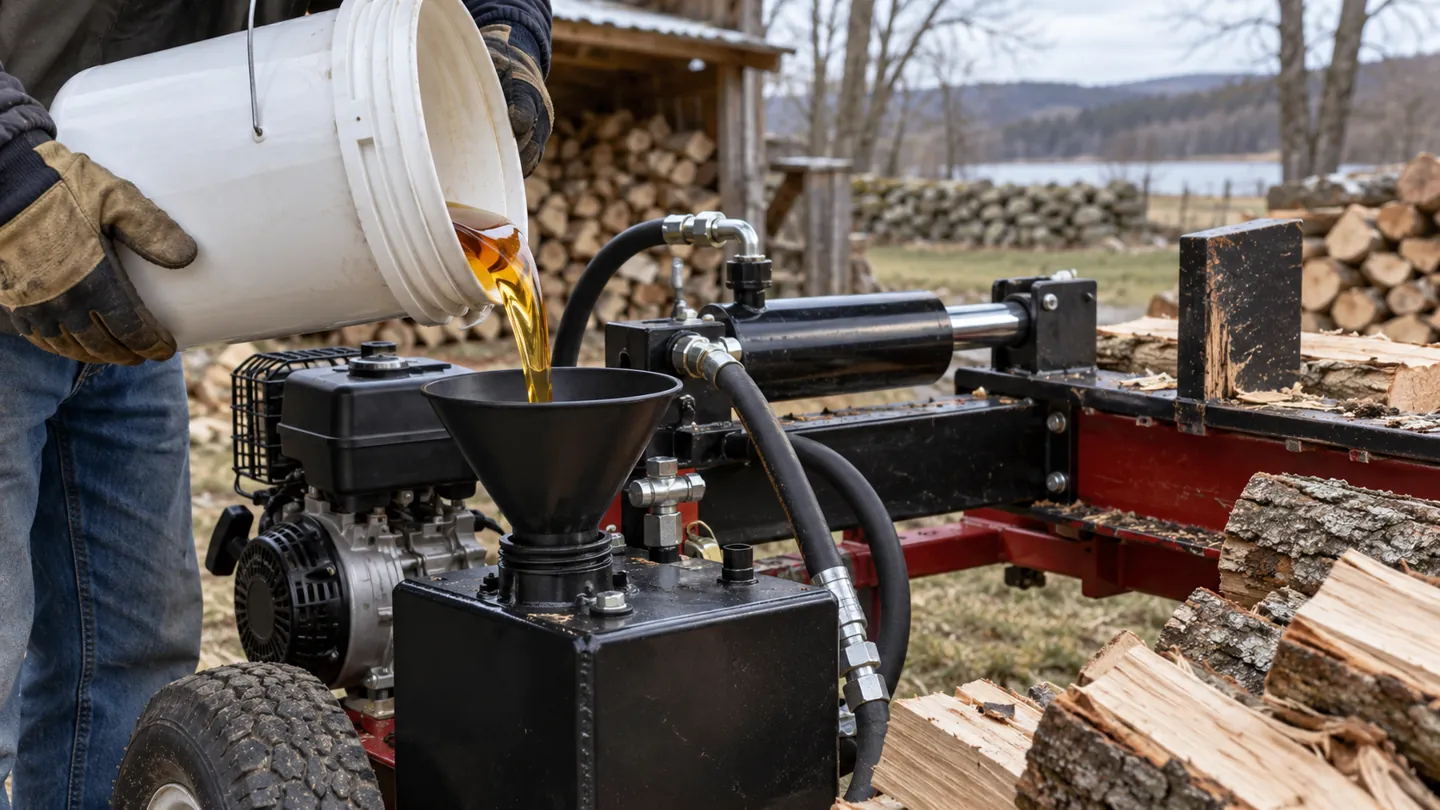
For ISO 32 vs ISO 46 in a splitter, use the grade its maker lists, and most of the manuals we read list ISO 32 or AW32. Champion, Ariens and SpeeCo’s newer PowerPro manuals all land there. SpeeCo’s 22 ton manual is the main exception, and it calls for AW46.
Here is what the manuals actually say. Model numbers matter, because the same brand changes its answer from one book to the next.
| Splitter manual | Normal oil | Cold weather | Total capacity |
|---|---|---|---|
| Champion 28 ton (201496) | ISO 32 / SAE 10W above 32 F | ATF below 32 F | 5.8 gallons |
| Champion 37 ton (100250) | AW32 above 40 F | Dexron III type ATF below 40 F | 6.8 gallons |
| Champion 9 ton (100624) | ISO 32 / SAE 10W; chart also shows ISO 46 above 32 F | Dexron III ATF below 32 F | 1.5 gallons |
| Ariens 917033 / 917034 | ISO 32 (Ariens part 00069100) | ISO 32 multi viscosity oil (00069101) or Dexron III / Mercon ATF | Up to 2 gallons |
| SpeeCo 22 ton (40123300) | AW46 | ATF below 32 F | 5 gallons |
| SpeeCo 28 ton (40123100, 2008 manual) | “SAE 20 hydraulic oil” | ATF below 32 F | 31 quarts |
| SpeeCo PowerPro 25, 30 and 35 ton (2020 manual) | AW22 or AW32 | ATF below 32 F | 4.5 to 6.6 gallons |
| DK2 Power 27 ton | AW32 or AW46 | Not stated on the spec sheet | 6.5 gallons |
| Mader 65575 | ISO 46 oil, or several ISO 22 oils, “or equivalent” | Not stated | Not stated |
Three things stand out. ISO 32 is the common default, and ATF below freezing is near universal among the US brands. And SpeeCo moved from “SAE 20” to AW46 to AW22 or AW32 across three generations of manuals.
Huskee splitters are SpeeCo built, and owners often report AW46 with ATF in the cold. That matches the 22 ton SpeeCo book, so check which SpeeCo model yours really is. If your manual only says SAE 20, call SpeeCo for the current AW grade rather than guessing.
We found no Southland manual that states a grade. Southland owners should go by the decal on the tank until they have the book.
Pick by climate when the manual leaves a choice
Use this rule when your manual lists both grades or gives no grade.
- Choose ISO 32 if winter starts happen near or below freezing. The pump fills faster and the ram moves sooner.
- Choose ISO 32 if you split only a few hours at a time. The oil rarely gets hot enough to need the thicker film.
- Consider ISO 46 only if the manual allows it, and only if summers run hot or the tank gets too hot to touch.
- Stay with the grade on the label if the manual lists only one.
Owners with a manual that lists only AW32 sometimes ask about AW46 for summer. A forum post is not a reason to change the grade. If you want to deviate, ask the maker.
What to buy
For an ISO 32 splitter, a 5 gallon pail is the usual size. Most of the full size splitters above hold 5 to 7 gallons in the whole system, and the small ones hold about 2.
One option is Starfire AW32 hydraulic oil in a 5 gallon pail. If you only need a top off, the MAG 1 AW32 gallon jug is a smaller buy.
If your manual calls for ISO 46, as the SpeeCo 22 ton does, CAM2 Promax AW46 in 5 gallons fits. Skip it if your manual says AW32 and you split in winter. None of these three belongs in a tractor transmission.
Read the Champion 28 ton operator’s manual if you want to see how a maker words the temperature split.
Other standalone hydraulic systems: trailers, power units, processors and loaders
Systems with their own reservoir and a plain gear or vane pump usually run AW32 or AW46. That covers dump trailers, hydraulic power units and wood processors.
The same rule holds. Follow the maker’s plate or manual, and pick ISO 32 when you must choose in a cold climate.
- Dump trailers and power units: Many small pumps are specified at AW32 or AW46. Cold start matters most because the pump sits outside all winter.
- Wood processors: These run longer and hotter than splitters. Hot oil is where ISO 46, or an HV oil, earns its place, if the maker allows it.
- Older loaders and backhoes with separate reservoirs: Check the decal or the loader maker’s manual before you buy anything. We found no maker spec to quote here, so do not assume AW oil is right.
A front end loader plumbed into the tractor’s own hydraulics uses the tractor’s fluid, not AW oil. Our front end loader guide covers how those circuits tie in.
Why ISO 32 and ISO 46 don’t belong in a tractor’s transmission sump
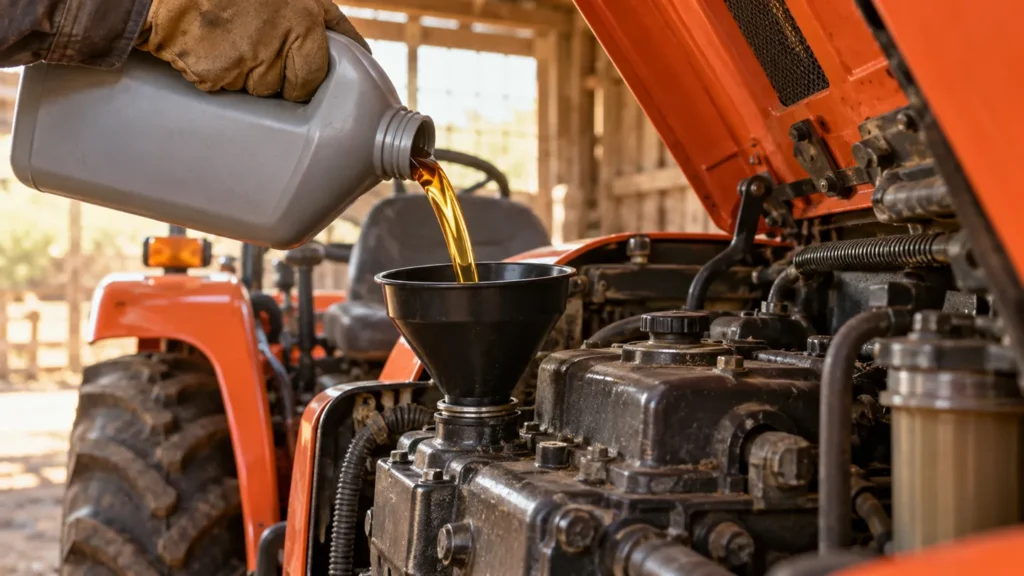
A modern compact tractor shares one sump for the transmission, hydraulics, wet brakes and often the PTO clutch. Plain AW oil has no friction modifiers for those parts. That is why makers specify a universal tractor fluid.
John Deere states that Hy-Gard sits between ISO 46 and 68 and serves transmissions, wet brakes and wet clutches. Its Low Viscosity Hy-Gard is an ISO 32 fluid with the same tractor additives. The ISO grade is only part of the spec.
Deere also says it does not monitor will fit oils. It warns they “could result in premature failures.”
Kubota is similar. The BX manual lists Super UDT2 for the transmission case, and regular UDT is permitted. Neither is a hydraulic oil you pick by ISO number.
A few tractor manuals do print ISO numbers. The LS MT125 manual lists API GL4 with ISO VG 32/46 and names LSTH400G as the recommended fill.
The TYM T25 manual lists API GL4 with ISO 32 below minus 4 F and ISO 46 above. Those entries describe a tractor fluid that also meets the API class, not permission for AW hydraulic oil.
HST tractors are the least forgiving. The pump and motor depend on the right viscosity and friction properties. Use the fluid in your operator’s manual.
Our tractor hydraulic fluid guide sorts out UTF, brand fluids and what to buy. The Kubota BX maintenance guide and the John Deere 1 Series maintenance guide give model fluids and schedules.
What does AW32 vs AW46 naming mean?
AW32 and AW46 are retail names for anti wear hydraulic oil in ISO grades 32 and 46. “AW” stands for anti wear, and the number is the ISO VG. You will also see HM 32, HLP 46 or “hydraulic oil 46” on drums from the same family.
The AW additive package protects the pump’s moving parts when load breaks down the oil film. The same oils carry rust and oxidation inhibitors plus foam control, which keep deposits and froth down. A good AW sheet lists all four jobs together.
Labels on the shelf are not all equal. Check that the jug says anti wear hydraulic oil, not a general purpose oil. If your manual lists a specific standard, match that standard and not only the number.
Can you mix ISO 32 and ISO 46?
You can mix them in an emergency and get an oil somewhere between the two grades. Both are the same type of mineral anti wear oil, so they do not clash chemically. We found no maker statement that approves mixing the two grades, so treat that as general practice, not a rule.
Owners report topping up an AW46 splitter with AW32 with no problems. Do not do this as a habit. The mix is a viscosity you can’t predict, and it may not match your manual.
Hydraulic oil and ATF are where makers split. Champion’s manuals say do not mix them and to drain all of one before adding the other.
Ariens takes the opposite view. It says every oil on its list, including ISO 32, AW32 and Dexron III or Mercon ATF, is compatible with the others. Follow your own book on this one.
How to switch grades or move to cold weather fluid
- Run the splitter a few minutes so the oil is warm and drains well.
- Relieve the pressure by cycling the valve with the engine off.
- Drain the tank fully and replace the filter.
- Check the drained oil for metal chips or milky water, which signal trouble.
- Refill to the dipstick or sight glass mark. Do not overfill, since extra oil can run hot and will spit out the breather.
- Start the engine and cycle the ram slowly several times to purge air.
Filter and oil intervals are close across brands. Champion lists the hydraulic filter at the first 50 hours, then every 100 hours or each season. SpeeCo’s PowerPro manual says the first 25 hours, then 100 hours or seasonally, and Ariens says oil and filter every season or 100 hours.
Moisture can condense in a tank stored unused. That is another reason to change the oil at season’s end.
Cold weather: pour point, ISO 22 and multigrade (HV) oil
In cold weather you need a thinner oil, an HV oil, or the maker’s cold fluid. Start up viscosity matters more than pour point. A pump pulling cold, thick oil cavitates, whines and wears.
Most US splitter makers handle this with ATF. Champion switches below 32 F on its 9 and 28 ton models and below 40 F on the 37 ton. SpeeCo’s manuals say ATF “should be used” below 32 F, and Ariens lists Dexron III or Mercon ATF as an approved fill.
If your maker offers the same option, follow it. If your manual says to drain first, drain first.
ISO 22 is the thinner step down. SpeeCo’s PowerPro manual allows AW22, and a Mader manual lists several ISO 22 oils. Chevron shows an ISO 22 AW oil with a pour point of minus 36 C.
Use ISO 22 only if your manual allows it. A pump built for ISO 32 can run too thin when hot.
HV oils flatten the temperature curve. Ariens sells one as its low temperature fill, an “ISO 32 multi viscosity” oil, which is the clearest maker endorsement of the idea we found.
Mobil’s DTE 10 Excel sheet describes a zinc free, shear stable, high viscosity index oil. Mobil reports field and lab use as low as minus 34 C (minus 29 F). Confirm your pump maker allows a zinc free HV oil before you buy.
Signs the oil is wrong or worn
The common signs are a slow ram, a noisy pump, foaming, and oil that runs hot or smells burnt. Each points to a different cause. Rule out the simple ones first.
- Slow or erratic ram: Air in the system is a common cause. Cycle the ram fully several times. If it stays slow, the oil may be too thick for the weather.
- Whining or growling pump: Cold, thick oil or a low tank starves the pump. Check the level and warm the machine slowly.
- Foaming: Champion says some froth is normal from agitated oil. Heavy foam that stays points to air leaks, a low level or water.
- Overheating: Too much oil, a restricted filter or oil that is too thin can run the tank hot. Hot oil thins further and loses film strength.
- Milky, dark or burnt smelling oil: Water or heat damage. Drain, filter and refill.
Mader’s manual also says to check drained oil for metal chips as a warning of pump wear. Fix the cause before refilling, or the new oil goes bad fast.
Bottom line
Use the grade in your manual. If the ISO 32 vs ISO 46 choice is yours, pick ISO 32 for cool or mixed climates. Pick ISO 46 only for hot weather or hot running systems that allow it.
Keep both out of a modern tractor’s transmission. That needs the fluid your operator’s manual names. More maintenance help is in the Own section.
Frequently asked questions
Is AW46 better than AW32 for a log splitter?
No, not by default. AW46 is thicker, which helps in hot weather, but it is slower on cold starts. Most splitter manuals we read list AW32 or ISO 32, and only SpeeCo’s 22 ton book calls for AW46.
Can I use tractor hydraulic fluid in a log splitter?
Owners often do, and posts say it does no harm. Check the manual first, because the maker’s spec governs the warranty. The reverse is the real mistake, since AW oil does not belong in a tractor transmission.
Can I use ATF in a log splitter?
Only if the maker says so, and many do. Champion, SpeeCo and Ariens all list Dexron type ATF for cold weather. Champion says to drain the hydraulic oil fully before switching, so check your own manual’s rule on mixing.
How much hydraulic oil does a log splitter hold?
It varies by model. Champion lists 5.8 gallons for its 28 ton, 6.8 for its 37 ton and 1.5 for its 9 ton.
SpeeCo lists 5 gallons for the 22 ton and 4.5 to 6.6 gallons for the PowerPro line. Check the dipstick after a full cycle, since the cylinder and hoses hold a lot.
What is the difference between ISO 32 and ISO 46 pour point?
The gap is small, a few degrees on Chevron’s AW oils. The bigger difference is thickness at start up. ISO 46 is much thicker than ISO 32 at very low temperatures.
Is AW32 the same as 10W hydraulic oil?
The two are close in thickness, and Champion’s manuals pair ISO 32 with SAE 10W. They are different scales, though, so match the ISO grade on the label to what your manual lists. An older SpeeCo manual that says “SAE 20” is a different case, so ask SpeeCo for the current AW grade.