Vintage Tractors
Ford 8N Buyer’s Guide: Is It a Good Small Farm Tractor
The Ford 8N is the most common old tractor in America, and a good one is still a cheap, repairable tool for light farm work. Here is what it can and cannot do, what to inspect, and what it sells for in 2026.
IN THIS GUIDE JUMP TO A SECTION +
As an Amazon Associate, TractorFolk earns from qualifying purchases. Links to products on this page may earn us a commission at no cost to you.
The Ford 8N is the most common old tractor in America. It is a good small farm tractor only if your jobs match what it was built for. It mows, grades, disks and plows light ground well, and it is a poor fit for loader work, heavy brush or anyone who wants a safe, comfortable machine.
Ford built about 524,000 of them between 1947 and 1952. That put the Ferguson 3 point hitch on a huge share of American farms, and it is why one turns up for sale every week in every state. Some of those buyers should take it home, and some should keep walking.
The difference is whether you know what you are looking at. This guide covers what the tractor can handle and what to check before you pay. It also covers what it sells for and where it stops being a bargain.
The short version
- About 23 PTO hp and 22 drawbar hp in its 1950 Nebraska test. That is real work for a few acres, not for a loader or a 6 foot cutter.
- No live PTO and no remote hydraulics. A rotary cutter needs an overrunning coupler.
- Auction sales from March 2025 to September 2026 had a median of $1,210. The range was $264 to $6,800.
- No rollover protection. NIOSH designed a retrofit ROPS for this tractor, and you should plan on one.
- Before you offer, check for a 12 volt conversion, milky hydraulic oil, a drifting lift and steering slop.
What is the Ford 8N?
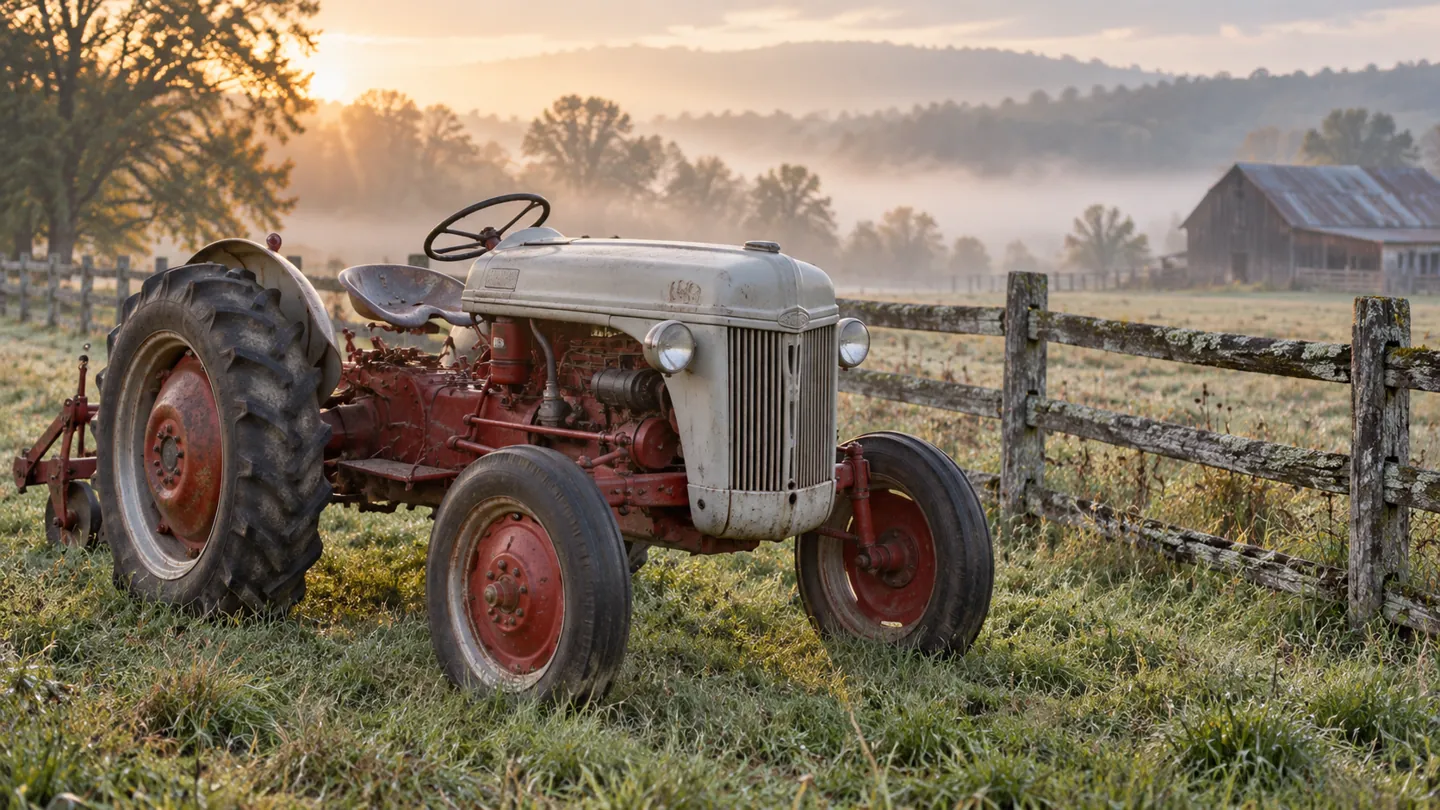
The Ford 8N is a small utility tractor built from July 1947 to 1952. It has a 4 cylinder gas engine, a 4 speed transmission and a Ferguson style 3 point hitch. It replaced the 9N and 2N and was the last of Ford’s original N series.
Engine, power and transmission
The engine displaces 119.7 cubic inches from a 3.188 inch bore and a 3.75 inch stroke. Rated speed is 2,000 rpm. The oil sump holds 6 quarts and the cooling system 12 quarts.
In Nebraska Tractor Test 443 (June 1950), the gas 8N made 23.24 hp at the PTO. It made 21.95 hp at the drawbar and 25.49 hp at the belt, with a maximum pull of 2,810 pounds. The Nebraska test record is archived by the University of Nebraska.
Some owners quote about 27 belt hp from service literature. The lab number is the one to plan around.
The tractor weighs 2,410 pounds as shipped and about 2,717 pounds in working trim. The wheelbase is 70 inches, the fuel tank holds 10 gallons, and rear tires are 10 by 28. Front tires are 4.00 by 19 or 6.00 by 16.
The Ferguson 3 point system
The hydraulic lift is the reason people still want one. Ferguson draft control senses the load on the implement and adjusts working depth for you. The 8N added a position control setting that holds an implement at a set height.
The hitch is Category I and lifts roughly 700 to 800 pounds. The exact number depends on whom you ask and how healthy the pump is. The system runs about 1,700 psi and holds about 5 gallons.
That fluid is shared with the transmission and rear end. Remember that when you inspect one.
How it came to be
Harry Ferguson and Henry Ford made a handshake deal in 1938. Ford would build a tractor around Ferguson’s hitch, and the result was the 9N in 1939.
Henry Ford II ended that deal in 1947. Ford kept building a similar tractor through its new Dearborn Motors company, and Ferguson sued for $251 million.
The lawsuit did not slow sales. More than half a million 8Ns went out the door in five years.
How do you tell an 8N from a 9N or 2N?
The quickest tells are the transmission, the pedals and the running boards. An 8N has 4 forward speeds, while a 9N or 2N has 3.
On an 8N the clutch pedal is on the left and the two brake pedals are on the right. It was the first Ford tractor laid out that way, and it has running boards.
Check the serial number too. It is stamped on the left side of the block, just behind the oil filter. 8N serials run from 1 in 1947 to about 524,076.
Parts do not always interchange across the three models, so confirm which one you have before you order. For the wider picture on old work tractors, see our vintage tractors section.
Is a Ford 8N a good tractor for a small farm today?
An 8N is good for light, slow, careful work on a few acres. It is a poor choice for loader work or constant heavy PTO use.
It is simple, cheap to run and easy to repair in a home shop. It is also more than 70 years old and built to an earlier idea of safety.
What it does well
- Mowing pastures and trails with a 5 foot rotary cutter and an overrunning coupler.
- Grading a driveway with a 5 foot box blade or a 6 foot rear blade.
- Disking a garden or small field with a 5 foot 3 point disk.
- Pulling a 2 bottom, 12 or 14 inch plow in decent soil with the right tires and weight.
- Pulling hay wagons and trailers at low speed.
It does these jobs cheaply. Parts are common, the engine is easy to work on, and a good one holds its value. For a weekend operator with a few acres of pasture, that is a strong case.
What it cannot do
There is no live PTO. The PTO shaft is driven through the transmission, so it stops when you push the clutch in. A heavy implement does not stop with it, and that has safety consequences covered below.
There are no remote hydraulics either. Nothing on the tractor can run a loader, a grapple or a cylinder on an implement.
Loaders do get hung on N series tractors with add on pumps. On a 2,700 pound tractor with manual steering, that is a lot to ask.
Power is modest. A 6 foot rotary cutter in tall brush will bog it down. Heavy ground work needs ballast and good tires.
The brakes are a known weak point. Owners often describe them as only so so, even after a rebuild.
Then there is comfort and protection. No rollover structure, no seat belt, no cab, and a seat that passes every bump straight through.
Who should look elsewhere
Skip an 8N if you need a loader for gravel, manure or bales. Skip it if you will mow steep ground or run a tiller all day.
For those jobs a used modern sub compact is the safer, more capable tool. Our guide to sizing a tractor by acreage and job will help you decide.
6 volt vs 12 volt, and the 1950 distributor change
An original 8N is a 6 volt, positive ground tractor. Converting to 12 volt is common. A 6 volt system works fine on a healthy engine with good cables and a good battery.
Many owners convert for faster cranking. Others convert because the engine is tired and needs all the help it can get.
That second reason is the red flag. A conversion is not proof of a worn engine. It is a reason to run a compression test on every cylinder before you pay.
What a 12 volt conversion changes
A generator based 12 volt system can keep the original positive ground. An alternator conversion needs a negative ground, which means reversing the battery cables and the ammeter wiring.
If you keep the original 6 volt coil, you need a resistor in front of it. Otherwise you fit a 12 volt coil.
If you want to keep a tractor on 6 volts, a battery maintainer that handles both voltages is useful. The NOCO GENIUS5 maintainer works on 6 volt and 12 volt batteries, which suits a tractor that sits between jobs. Skip it if your charger already supports 6 volt.
If you decide to convert, an alternator kit saves hunting for a rebuilt generator. The All States Ag Parts alternator conversion kit is made for the N series. Confirm it matches your distributor type before you order.
Front mount vs side mount distributor
Ford moved the distributor from the front of the engine to the side in 1950. The Proofmeter appeared the same year. Early 8Ns have a front mount distributor and later ones a side mount.
Parts vendors commonly put the break between serial numbers 263,843 and 263,844, which falls inside the 1950 range. Their fit ranges overlap, though, so look at the part on your tractor rather than trusting a year.
The two are not interchangeable, and they use different point gaps. Front mount is 0.015 inch and side mount is 0.025 inch. Ordering a tune up kit for the wrong one is a common mistake.
If you need points, cap and rotor, check your distributor first. The OEG distributor tune up kit is listed for the 8N. Confirm whether it matches a front mount or side mount before you buy.
What should you inspect before buying?
Start with the engine and the hydraulics, because those are the expensive parts. Bring a flashlight, a compression gauge, a jack and a friend who has worked on old tractors. Walk through the checks below in order.
- Look up the serial number. It is on the left side of the block behind the oil filter. Match it to a year, and note whether the distributor and axle seals fit that year.
- Cold start it. A healthy 8N starts without drama. Long cranking, heavy smoke or a rough idle point to wear or tuning problems.
- Test compression on all four cylinders. Pull the plugs for this. Do it first if the tractor has been converted to 12 volt.
- Check the engine oil and the coolant. Milky oil means water. Look for oil in the radiator and for rust in the coolant.
- Pull the hydraulic fill cap and look at the fluid. Milky or foamy fluid means water in the shared sump. That is a drain, flush and refill at best.
- Test the lift under load. Raise a heavy implement and shut the engine off. A lift that drifts down can mean a worn piston or cylinder, a bad top cover gasket or a leaky relief valve.
- Run the governor. Set a throttle position and watch for it creeping back toward idle. Surging or lazy response can point to worn governor balls, a worn housing groove or loose linkage.
- Engage the PTO. Listen for noise and look for leaks at the PTO seal. Note whether the stub is the original 1 1/8 inch size.
- Test the clutch and brakes. A slipping clutch, grabbing brakes or a pedal that goes to the floor all cost money. Heavy pedal pad wear says more about use than the hour meter does.
- Check the rear axle seals. Look for oil around the axle housings and in the brakes. Owners report that 1949 tractors have only an outer seal and that an inner seal came in 1950, though we have not confirmed that against Ford documents.
- Jack up the front and check steering. Turn the wheel lock to lock and feel for play. Play at the top of the steering hub points to a worn ball nut bearing, and a clunk to a worn kingpin.
- Inspect the tires. Look for dry rot, sidewall cracks and mismatched sizes. Rear tires are normally 10 by 28.
A good running 8N that passes these checks is worth a fair price. A leaking rear axle, milky hydraulics and a bad lift can together cost more than the tractor is worth.
Pay attention to the hour meter
An 8N from 1950 or later may have a Proofmeter with an hour meter. These get replaced and they stop, so a low reading means little. Wear on the clutch pedal, brake pedals and running boards tells you more.
The rest of the walk around
Look for cracked castings, repaired welds and missing sheet metal. Check the radiator for leaks and the fan belt for wear. Turn the key and watch the ammeter, or bring a meter to confirm the tractor is charging.
Look at what it comes with. A rotary cutter without an overrunning coupler is a safety problem, not a bonus.
A tractor with no battery or a stuck engine is a parts machine. Price it that way.
How much is an 8N worth now?
A typical 8N sold for about $1,200 at auction between March 2025 and September 2026. That figure comes from the Ford 8N auction results page at Construction Equipment Guide, checked October 15, 2026. It listed 23 sales with a median of $1,210 and a range of $264 to $6,800.
The listing does not state each tractor’s condition. The table below is our own rough reading of that spread and a handful of dated sales. It is not a published price guide.
| Condition | What you see at auction and in ads | Rough price range (2025 to 2026 auctions) |
|---|---|---|
| Non running or parts | Seized, missing parts, no battery, unknown history | Under $1,000 |
| Running but rough | Starts and moves, leaks, tired paint, needs work | $1,000 to $2,500 |
| Sound user | Runs well, lifts, good tires, no major leaks | $2,500 to $5,000 |
| Restored or exceptional | Repainted, rebuilt, correct parts, documented | Up to $6,800 or more |
A few dated sales show how wide the spread is.
In April 2025, a 1952 8N with a replaced hour meter and starting problems sold for $1,210. In May 2025 a non operating one with no battery sold for about $743. In August 2026, two 1952 tractors sold for $2,500 and $6,800.
Private sale and dealer asking prices run higher than auction results. One non auction listing in the same period asked $2,950.
Owners often value a non running tractor at its parts, and one buyer put that at $600 to $900. For scale, the 8N sold new for $1,404 in 1952. Check recent sold listings in your area before you pay.
Are 8N parts easy to find?
Yes, almost everything for an 8N is available new, rebuilt or used, but the quality of reproduction parts varies. The N series sold in huge numbers, so the aftermarket is deep. Filters, points, gaskets and other service items are cheap and easy to get.
What to expect from reproduction parts
Owners report that quality runs the gamut. A replacement radiator may not fit the shroud or hoses without grinding. New old stock distributors can have dried grease that keeps the advance from moving.
A part labeled for the N series may really be for a related model. It can look the same and still not fit.
Test fit big parts before you commit. Ask the seller whether a part is original, rebuilt or reproduction, and buy from one who answers fit questions.
Fluids and the shared sump
The transmission, hydraulics and rear end share one sump. The fluid has to work as hydraulic oil and gear oil at once, so engine oil is the wrong choice.
Owners commonly use a universal tractor fluid that meets the old Ford 134D spec. They advise filling in stages, letting it settle and topping off. Our tractor hydraulic fluid guide explains the fluid types.
Confirm the capacity for your year in a service manual. We could not verify it from an official source.
What implements suit an 8N?
Implements sized for about 20 to 25 hp and a Category I hitch suit an 8N. Owners most often report success with a 2 bottom plow and a 5 foot rotary cutter. A 5 foot box blade and a 5 foot 3 point disk also work, and bigger tools only in easy conditions.
| Implement | Size owners report working | Notes |
|---|---|---|
| Bottom plow | 2 bottom, 12 or 14 inch | 14 inch works in good soil; 12 inch is safer in sod. |
| Rotary cutter | 5 foot | Needs an overrunning coupler. No confirmed owner reports of a 6 foot unit. |
| Box blade | 5 foot | Owners call 7 feet too big. A 6 foot angle blade is common. |
| 3 point disk | 5 foot | Keep an eye on front end weight on rough ground. |
These sizes are owner reports, not Ford ratings, so use them as a starting point. Soil, slope and tire condition change what the tractor can pull. Our rotary cutter buying guide and box blade buying guide explain how to size each tool.
The overrunning PTO clutch
An overrunning PTO clutch lets an implement freewheel when the tractor slows or stops. Owners also call it an overrunning coupler or ORC. On an 8N it is close to mandatory for a rotary cutter.
Here is why. When you push the clutch in, the PTO stops driving.
A heavy cutter keeps its momentum and can drive the shaft backward through the transmission. That can push the tractor toward a fence, a ditch or a building.
The coupler fits between the tractor stub and the implement shaft. Original 8N stubs are 1 1/8 inch, 6 spline. Many modern shafts are 1 3/8 inch, so check which you have before buying.
The 1 3/8 inch, 6 spline overrunning clutch suits a standard shaft. The C670F coupler is made for the Ford N series. It has limited buyer feedback, so treat it as an option rather than a sure pick.
A coupler does not stop the blades quickly. They coast down on their own, so keep people and pets clear until everything stops.
Is an 8N safe? Rollover, PTO and why to add a ROPS
An 8N is not safe by modern standards. It has no rollover protection, no seat belt and no live PTO. The biggest risk is a rollover, on a light, narrow tractor with nothing to protect you.
Rollover and ROPS
NIOSH states that a ROPS combined with a seat belt is the best known way to prevent overturn deaths. Its 2017 bulletin put the effectiveness at 99 percent when a belt is used.
The good news is that NIOSH designed a low cost retrofit ROPS for the 8N, one of four tractors it covered. The design was tested in 2008 to the SAE J2194 standard.
NIOSH notes it has not tested the designs to the newer ISO 5700 standard. See the NIOSH page on cost effective ROPS.
NIOSH also says a tractor that cannot be fitted with a ROPS should be retired. The National ROPS Rebate Program has covered part of the cost in some states. Funding is state specific and changes, so check before you count on it.
If you fit a ROPS, wear the belt. If you do not have a ROPS, do not wear one.
Rear overturns and hitching
Never hook a chain or strap above the drawbar. NIOSH warns that a high hitch point can flip a tractor over backward before you can react. Pull from the drawbar only, never from the top link or the axle, and start slowly.
PTO safety
Keep every shield in place on the PTO shaft and the implement driveline. Never step over a turning shaft. Fit the overrunning coupler so the cutter cannot shove the tractor when you clutch.
Take hills slowly and stay off steep side slopes. The brakes are weak and there is nothing to catch you.
8N vs a used modern sub compact: cost and capability
A used modern sub compact costs several times what an 8N does. It also does far more and keeps you safer.
A usable 8N runs about $1,200 to $3,500. A good used sub compact with a loader is often $5,000 to $15,000 or more.
Recent listings put a 2023 Kubota BX2380, a 23 hp sub compact, at around $15,000 at dealers. Older BX2380 units sold at auction for about $4,500 to $12,100 in 2023 and 2024. Those are dated figures, so check current listings.
| Question | Ford 8N | Used modern sub compact |
|---|---|---|
| Typical price | About $1,200 to $3,500 for a usable one | Often $5,000 to $15,000 or more, depending on age and loader |
| PTO | Not live, needs an overrunning coupler | Live or independent on most |
| Loader work | Poor fit, no remote hydraulics | Standard use |
| Rollover protection | None, retrofit possible | ROPS on most models |
| Parts and service | Cheap parts, you do the work | Dealer service, higher parts cost |
The 8N wins on price and simplicity. The sub compact wins on capability, comfort and safety.
If your jobs are mowing and light grading, the old tractor is enough. If you need a loader, see our best sub compact tractors list instead.
Bottom line
A sound Ford 8N is an honest, cheap and repairable tractor for light mowing, grading and tillage. It has no live PTO, no loader capability and no rollover protection.
Buy a good one at a fair price, add a coupler and plan on a ROPS. For loader work or slopes, buy a used modern sub compact instead.
Frequently asked questions
How much horsepower does an 8N have?
In its 1950 Nebraska test, the gas 8N made 23.24 hp at the PTO and 21.95 hp at the drawbar. Belt power peaked at 25.49 hp. Some service literature quotes higher figures, but the tested numbers are the safer guide.
What years were 8N tractors made?
Ford built the 8N from July 1947 to 1952, with serial numbers from 1 to about 524,076. Owners often consider a late 1952 tractor the best of the run because it has the later improvements.
Can an 8N run a brush hog?
Yes, a 5 foot rotary cutter is the size owners most often report using. You need an overrunning PTO coupler because the PTO is not live. Without it, the spinning blades can push the tractor when you press the clutch.
Did the 8N come with a 12 volt system from the factory?
No, original 8Ns are 6 volt and positive ground. Many have since been converted to 12 volt. Check compression if you see a conversion, because the swap is sometimes used to cover a worn engine.
Is a Ford 8N worth buying in 2026?
It can be, if the price is right and your work is light. Auction sales from March 2025 to September 2026 had a median of $1,210, with sound tractors selling higher. Buy one you have inspected, and budget for the coupler, a ROPS and basic repairs.
What oil does an 8N use?
The engine has its own 6 quart sump and takes engine oil. The transmission, hydraulics and rear end share a separate sump that needs a tractor transmission and hydraulic fluid, not engine oil. Owners commonly use a fluid that meets the old Ford 134D spec.