
Ownership Costs
How Much Does a Tractor Cost? Prices and Ownership Costs
A dated October 2026 guide to tractor prices by class, what a loader and starter implements add, and what a tractor costs to own each year. Includes a worked 10 year comparison of new and used.
IN THIS GUIDE JUMP TO A SECTION +
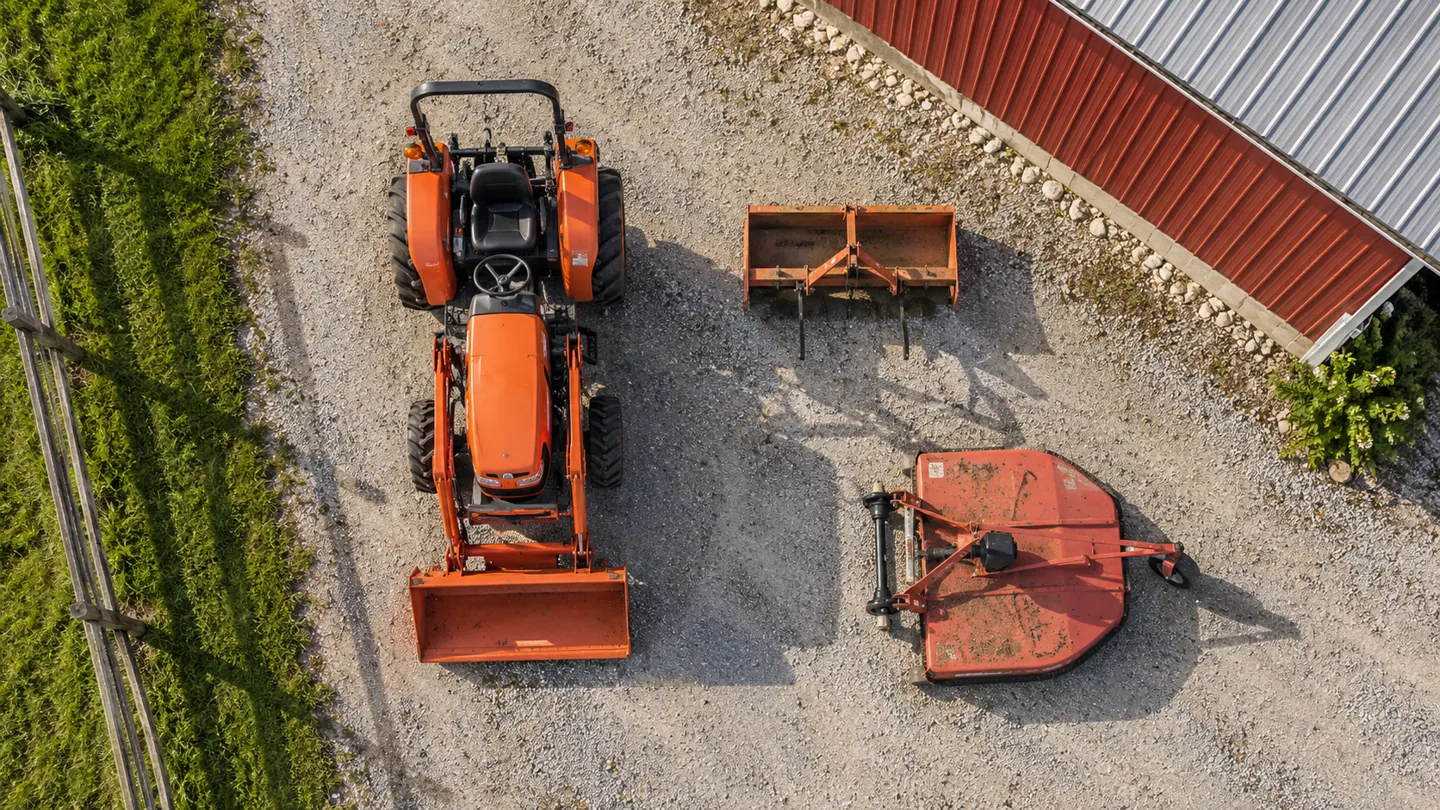
A new sub compact tractor starts at $12,798 on Kubota’s price list, checked October 15, 2026. That is only the first answer to how much does a tractor cost. Add a box blade, rotary cutter and pallet forks and you are near $18,000, before the loader.
The tractor is the starting price. The working package is often $25,000 to $30,000.
Below are starting prices by class, what a loader and implements add, and the yearly cost after the sale. Every price carries a source and a date. Treat each figure as a snapshot from October 2026, not a quote.
The short version
- Kubota’s “as low as” prices run from $12,798 (BX1880) to $109,390 (M6-101), read October 15, 2026. Most other makers publish no US list price.
- Compact tractors for small acreage start at about $15,000 to $34,000 before a loader, freight and setup.
- A box blade, rotary cutter and pallet forks totaled $5,260 at one maker’s direct prices (October 15, 2026).
- Our worked estimate: a new $30,000 package costs about $3,900 a year to own and run. Bought 5 years old, about $2,100.
- Ask every dealer for an out the door price in writing. Freight, setup, prep, fees and tax go on separate lines.
How much does a tractor cost by class?
A new sub compact costs about $12,800 to $18,000. A compact runs about $15,000 to $34,000. A utility tractor starts near $29,000 and climbs well past $100,000.
Those ranges come from Kubota, the one maker whose full US line carries public starting prices. Each series page shows an “MSRP as low as” figure for every model. The table below is copied from those pages as read on October 15, 2026.
Horsepower is Kubota’s gross engine figure. It is higher than the PTO horsepower your implements get. Kubota’s B01 page conflicts with itself on horsepower, so the B01 row uses its model list.
| Kubota series | Models and gross hp | Starting MSRP (“as low as”) |
|---|---|---|
| BX (sub compact) | BX1880 16.6 hp; BX2380 21.6 hp; BX2680 23.3 hp | $12,798; $16,624; $17,632 |
| B01 | B2401 21.9 hp; B2301 20.9 hp; B2601 24.3 hp | $15,230; $18,874; $20,017 |
| Standard L | L2502 23.3 hp; L3302 33 hp; L3902 37.5 hp; L4802 48.4 hp | $17,449; $23,791; $26,181; $24,925 |
| LX | LX2620 23.3 hp; LX3520 34.9 hp; LX4020 39.8 hp | $20,337; $29,879; $32,084 |
| MX | MX4900 50.3 hp; MX5400 55.5 hp; MX6000 63.4 hp | $33,796; $29,170; $41,020 |
| M60 | M5660SU (hp not printed); M6060 66.4 hp; M7060 72.1 hp | $34,093; $43,018; $44,781 |
| M4 | M4 071 72.1 hp | $61,724 |
| M5 | M5 091 92.5 hp | $78,563 |
| M6 | M6-101 104.5 hp | $109,390 |
Source: Kubota USA equipment series pages, such as the BX series page, read October 15, 2026. Some larger models say “refer to dealer” and print no price. Rows appear as the pages print them, so a bigger model can list below a smaller one.
Read the table as floors, not promises. The “as low as” price is the least equipped version of each model. Cab, four wheel drive, hydrostatic transmission and tire choice all move the real number up.
Sub compact tractors
Sub compact tractors cost about $12,800 to $20,000 new. That covers Kubota’s BX line and the entry end of the B01 series. These are the tractors for a few acres of mowing, a gravel driveway, snow and light loader work.
Our tractor size guide maps acreage and jobs to horsepower. The cheapest tractor is the one that is big enough the first time.
Compact tractors
Compact tractors run $17,400 to $34,000 in Kubota’s L and LX lines (23 to 40 hp). This is the class most small farms shop. It handles pasture mowing, post holes, a box blade and a real loader.
The L2502 and LX2620 both list 23.3 hp, yet the LX2620 starts about $2,900 higher. Kubota describes the LX as four wheel drive with HST, ROPS and cab options. You pay for the frame and features, not the engine.
Utility tractors
Utility tractors start near $29,000 on Kubota’s list. The MX and M60 series run about $29,000 to $45,000. The M4, M5 and M6 lines run about $61,700 to $109,400.
Most hobby farms do not need this class. You pay for bigger frames, more hydraulic flow and heavier loaders. If your jobs include round bales or daily loader work, the size guide shows when it makes sense.
What do makers other than Kubota publish?
Most other makers publish no US list price. Deere’s US compact tractor pages show offers but no price. LS’s MT125 page showed promotions only in an archived capture from July 22, 2026.
Mahindra and Kioti block automated reads of their sites, so dealers fill the gap. One John Deere dealer in the Northeast, United Ag and Turf, publishes cash prices for loader packages. They are valid August 5 to October 30, 2026.
A 1023E with a 120R loader is $17,860. A 1025R with a 120R loader is $20,385, and a 2025R with the same loader is $22,525. A 3025E with a 300E loader is $24,005, and a 4044M with a 400E loader is $38,340.
Those are one dealer’s prices for six states, and the dealer says prices vary by location. They show where loader packages land. They are not a national price.
For lineups, warranties and weak spots, see our guides to Kubota tractors and John Deere compact tractors. The compact tractor brand ranking compares them with Kioti, Mahindra, LS, TYM and Yanmar. Pick a brand there, then get a written dealer quote for the price.
How much does a compact tractor cost with a loader and implements?
A compact tractor with loader and starter implements usually costs $5,000 to $9,000 over its starting price. That range is our estimate, not a published total. It comes from the implement prices below plus the loader gap in the dealer packages above.
Kubota prints no loader price on the series pages we read, but the dealer packages give a cue. A Deere 1025R with a loader lists at $20,385. A Kubota BX2380 without one lists at $16,624, and the loader is part of that $3,800 gap.
A starter implement set at a maker’s list prices
Everything Attachments sells its own implements direct and prints prices on its product pages. We read them on October 15, 2026. They are one brand’s prices, and other brands run higher or lower.
| Implement | Product and size | List price |
|---|---|---|
| Box blade | XTreme Duty compact box blade, 60 inch, 385 lb | $1,380 |
| Rotary cutter | XTreme 60 inch rotary brush cutter (5 ft) | $2,470 |
| Pallet forks | 42 inch compact tractor forks, 2,200 lb, Hardox tines | $1,410 ($1,200 sale price shown) |
| Set total | The three above | $5,260 ($5,050 at the sale price) |
Source: everythingattachments.com product and category pages, October 15, 2026. Fork mounts add $50 to $125.
Check fit before you buy: Kubota’s BX implement limits sheet caps box blades at 60 inches and 375 pounds. The 385 pound blade above is too heavy for a BX2380. The 48 inch version at 355 pounds and $1,300 fits.
Expect other line items too. A hydraulic top link, quick hitch, tire chains, grapple and rear ballast are not in the set above. Each runs from a few hundred to a few thousand dollars.
What a typical build adds up to
Take a Kubota L3302 at $23,791 as the starting price. Add the $5,260 implement set and you are at $29,051 before the loader, freight, setup and tax. That is why the worked estimates later in this guide use a round $30,000 package.
That $30,000 is our round number, not a quote. Your build may be $22,000 or $45,000 depending on the loader, the cab and the dealer.
What drives the price of a tractor?
Frame size, transmission, cab, four wheel drive, the loader and the brand set most of a tractor’s price. Emissions equipment adds cost on larger engines. Kubota’s own list and one dealer’s package prices show how much each matters.
Horsepower and frame size
More horsepower costs more, but the frame matters as much as the engine. A larger frame carries a stronger loader, a heavier rear axle and more hydraulic flow. That is why the L2502 ($17,449) and LX2620 ($20,337), both 23.3 hp, differ by about $2,900.
HST versus gear drive
Hydrostatic transmission (HST) costs more than gear drive. On Kubota’s B01 page, the gear drive B2401 (21.9 hp) starts at $15,230. The B2301HSD (20.9 hp) starts at $18,874, and the page says its DT models are gear drive.
HST is easier for loader work, because you change direction with a pedal and no clutch. Gear drive saves money up front. It suits mowing, tilling and plowing, where you set a speed and hold it.
Cab, ROPS and four wheel drive
A cab adds thousands: United Ag and Turf lists a 1025R with a loader at $20,385. With a cab and the same loader it is $27,920. That gap of $7,535 (August to October 2026) is one dealer’s example, not a rule.
Four wheel drive adds cost on models that offer both. Kubota’s “as low as” prices do not split out the premium, and no maker price pair we found does.
Kubota’s LX series lists four wheel drive as standard. That is part of why the LX2620 starts above the L2502.
If you plan to run a loader, treat four wheel drive as required. A loaded bucket lifts weight off the rear tires, and two wheel drive spins.
Loader and attachments
A front end loader is the biggest single add on, so buy it with the tractor if you can. The tractor needs the subframe, valve and hydraulics set up for it. Quick attach, a third function valve and a heavier bucket each add to the price.
Emissions equipment
Emissions equipment adds cost and complexity on bigger diesels. Kubota’s M60 series page describes common rail injection with EGR and a DPF muffler. Mahindra’s 1600, 2600 and 4500 pages describe tractors without a DPF.
A DPF has to burn off soot, which is why owners talk about regen. Engine size and model year decide whether you get one.
Brand and dealer network
Brand sets price through resale value, the dealer network and what the maker includes. Owners disagree on whether Kubota costs more or less than its rivals. Compare real quotes, not reputations.
Warranty is part of the price too. Kubota’s residential warranty on BX, B, LX and L tractors is 24 months or 1,500 hours basic. Powertrain coverage is 72 months or 2,000 hours, for units bought after January 1, 2026.
Deere publishes warranty documents, but applicability depends on the tractor and delivery date. Obtain the current statement with the quote. Do not confuse a missing link on a product page with an absence of published terms.
What do used tractors cost, and how do you read the prices?
Used tractors run from a few hundred dollars for an antique to near new money for a late model. The honest answer to how much does a tractor cost used comes from sold prices. Asking prices are what sellers hope for.
Reading auction results
Auction results give you a spread, not a single number. For our John Deere 4020 buyer’s guide, we pulled 47 sales (August 2024 to October 2026) from one auction page. The median was $6,250, and the middle half sold between $3,873 and $8,250.
That method works for any model. Use only recent sales, drop the extremes and read the middle half. A single spectacular sale tells you nothing about the next one.
Those pages list no hours, condition or attachments for most sales. A running tractor with a loader sells well above a parts tractor, so adjust for the one you are buying. The Ford 8N buyer’s guide applies the same method to a $1,200 tractor.
Hours versus age
Iowa State’s March 2026 planning table estimates residual values for agricultural tractors. Its 30 to 79 hp example gives 36 percent of list at 10 years and 200 hours per year. That is a planning input, not a valuation of every compact tractor at lower annual use.
Those are averages of auction values, not guarantees. Condition, local demand and the model decide the real number.
For hobby use, hours are usually low for the age, so inspect the machine, not just the meter. Hour meters fail. Owners report that pedal, seat and drawbar wear often tell a different story than the dash.
Used price rules of thumb
The big drop comes early. In the same Iowa State column, the tractor keeps about 65% of list after year 1. It keeps 48% after year 5 and 36% after year 10, then slides to about 29% at year 15.
That curve is the reason to look at a tractor 3 to 6 years old. The first owner paid for the steepest part of the drop. You still get a modern machine with most of its life left.
What does it cost to own a tractor each year?
Owning a compact tractor costs about 7% to 13% of its price each year in our worked estimate. That covers depreciation, interest, insurance, storage, fuel and repairs. It is not a published range, and your number will move with your hours and your loan.
The question of how much does a tractor cost does not end at the sale. Iowa State University Extension’s file A3-29, “Estimating Farm Machinery Costs,” sets out the method we used. Ownership costs come due whether you use the tractor or not, and operating costs grow with hours.
Ownership costs: depreciation and interest
Depreciation and interest are the largest costs, and Iowa State combines them in a capital recovery formula. It uses the purchase price, the expected resale value and a “real” interest rate. That rate is your borrowing rate minus inflation.
Its example uses 4% real interest and a 12 year life. It suggests a 15 year economic life for tractors unless you know you will trade sooner.
Insurance, taxes and storage
Insurance, property tax and housing are smaller; Iowa State lumps them at 1% of average value each year. It cites Iowa farm machinery insurance at $4 to $6 per $1,000 of value, plus 0.5% for housing. Property tax is added at 1% only in states that tax farm machinery.
On a $30,000 tractor worth $20,400 on average over its life, 1% is about $200 a year. Check your own policy. Many homeowner policies exclude a tractor, and the loader and implements need to be listed.
Fuel
Fuel is the largest operating cost for most owners. Iowa State estimates average diesel use at 0.044 gallons per hour for each maximum PTO horsepower. A 27 PTO hp tractor works out to about 1.2 gallons an hour.
The US Energy Information Administration reported on highway diesel at $6.179 a gallon (week of October 12, 2026). At 100 hours a year that is about $735 in fuel. Iowa State adds lubrication at about 15% of fuel cost, which is about $110 here.
Full throttle mowing burns more and loader puttering burns less. Off road diesel and local prices differ, so use your own.
Maintenance and repairs
Budget scheduled service separately from unexpected repairs. Include oil, filters, coolant, lubricants, dealer labor and transport where applicable. A low statistical repair allowance does not pay for all routine maintenance.
Use the schedule that applies to the tractor serial number and manual edition. Deere documents differ across editions and summaries. Our BX maintenance guide and Deere maintenance guide explain those document checks.
We could not verify current parts or dealer labor prices from a maker, so we print none. Ask your dealer for a service price list.
For repairs, Iowa State’s table (from ASABE data) covers two wheel drive tractors. It puts accumulated repairs at about 1% of list by 1,000 hours and 3% by 2,000 hours. That reflects farm averages, so expect more if a dealer does all your service.
A sample year of costs
This table is our worked estimate, not a published range. It assumes a $30,000 package, 100 hours a year, 10 years, 4% real interest and 27 PTO hp. Resale is 36% at year 10, from Iowa State’s 30 to 79 hp table at 200 hours a year.
| Cost item | New $30,000 package, per year | How we got it |
|---|---|---|
| Depreciation and interest | about $2,794 | Iowa State capital recovery: $19,200 lost value x 0.123 (10 year factor at 4%), plus 4% on $10,800 resale value |
| Taxes, insurance, housing | about $204 | 1% of average value, $20,400 |
| Fuel | about $734 | 0.044 gal x 27 PTO hp x 100 hours x $6.179 |
| Lubrication | about $110 | 15% of fuel cost |
| Repairs | about $30 | 1% of list over 1,000 hours, spread over 10 years |
| Total | about $3,872 a year | About 12.9% of the purchase price |
This total excludes a separately priced routine service budget. Add actual scheduled parts, labor and transport before treating it as an ownership budget. The agricultural repair factor is not a service quote for a compact tractor.
How do tractor financing and dealer promotions work?
Tractor financing is usually a 0% or low rate for a fixed term, or a cash discount, not both. John Deere’s US compact tractor page, read October 15, 2026, lays the structure out plainly. Its offers run through November 1, 2026.
On the 1025R, Deere offered 0% APR for 60 months plus $1,000 off. On the 1023E, it offered 0% for 60 months, or $1,000 off with a cash purchase.
On the 4066M, it offered 0% for 60 months plus $2,500 off, or $5,000 off for cash. So the 0% loan on that model costs $2,500 of discount. Deere also listed 1.9% APR for 84 months on sub compact and compact tractors.
The new 1E 23, 1M 25 and 1R 25 got 0% for 36 months. The Deere compact tractor page shows the current terms, which need approved credit and change often.
Other makers use the same shape. LS’s US site showed 0% for 60 months or $6,000 cash back on the MT4 (archived July 22, 2026). We could not read Kubota USA’s own offers page, so ask the dealer for Kubota’s current sheet.
When is 0% worth it?
Take 0% when the discount you give up is small next to the interest you would pay elsewhere. The size of that gap decides it. Here are two illustrations with our assumptions, not quotes.
A $40,000 tractor at 0% for 60 months costs $667 a month and $40,000 in total. Suppose the cash option is $2,500 off, as on Deere’s 4066M. You would borrow $37,500 from your bank.
That loan beats the 0% deal only below about 2.6% APR. At 5% it costs about $42,460 in total. The 0% offer wins by about $2,500.
Make the gap $6,000, as in LS’s MT4 offer, and the answer flips. Borrowing $34,000 at 5% for 60 months costs about $642 a month and about $38,500 in total. Cash wins by about $1,500.
The break even on a $6,000 gap is near 6.6% APR. Take the cash if your credit union is under that. Take the 0% deal if you can only borrow above it.
Two more cautions. Financing offers apply to specific models and need approved credit. Ask for the cash price and the financed price in writing, because they may differ.
What do taxes, freight, setup and dealer fees add?
Freight, setup, dealer prep, documentation fees and sales tax all add to the sticker price. We could not verify a standard amount for any of them.
The Deere dealer list above says taxes and fees could raise a payment. Its Long Island stores exclude the destination fee. Buyers on owner forums report the same pattern: some dealers fold freight and setup into the quoted price.
Others add them as separate lines at the end, sometimes with tire fill or a bundled prep charge. The amounts vary too much to print. The fix is to ask for every charge by name.
A fair quote lists the tractor, each implement, freight, setup, prep, documentation fee, any tire fill, and tax.
Sales tax and farm exemptions
Sales tax is set by your state and county, and many states exempt farm machinery for qualifying farm businesses. Texas is a clear example. Its Agricultural Sales and Use Tax Exemption Certificate (Form 01-924, revised June 2026) is for commercial agricultural producers.
Sales tax and agricultural exemptions depend on jurisdiction, purchaser and actual use. Check the state revenue department rules for your situation before claiming an exemption. A hobby or business label alone is insufficient.
Check your state revenue department before you sign. Ask whether your use qualifies, what certificate or registration number the dealer needs, and what records you must keep. Misusing an exemption can bring penalties.
Is buying a used tractor cheaper over 10 years?
In our estimate, a 5 year old tractor costs about half as much as a new one over 10 years. The first owner absorbed the steepest depreciation. This is Iowa State’s method with the assumptions below, not a market quote.
We compared two ways to hold the same $30,000 package for 10 years at 100 hours a year. Option A buys new and holds it to age 10. Option B buys the same package at 5 years old and holds it to age 15.
Assumptions: Iowa State’s 30 to 79 hp resale factors at 200 hours a year. We use 4% real interest, 27 PTO hp, diesel at $6.179 and the same fuel and lubrication in both. Implements are assumed to depreciate like the tractor, a simplification.
| Item | A: New, held to age 10 | B: Bought at age 5, held to age 15 |
|---|---|---|
| Purchase price | $30,000 | $14,400 (48% of list) |
| Resale at the end | $10,800 (36%) | $8,700 (29%) |
| Depreciation and interest per year | about $2,794 | about $1,049 |
| Taxes, insurance, housing per year | about $204 | about $116 |
| Fuel and lubrication per year | about $844 | about $844 |
| Repairs per year (our interpolation) | about $30 | about $60 |
| Total per year | about $3,872 | about $2,069 |
| Total over 10 years | about $38,700 | about $20,700 |
The used option is cheaper under these particular assumptions. Change repair, resale, service and financing inputs before applying the result. It is not evidence that every 5 year old tractor costs half as much to own.
The estimate leaves out risk, because a used tractor has no warranty and may have unknown history. A new Kubota BX, B, LX or L carries a 72 month powertrain warranty on 2026 purchases. That is real value for some buyers.
It also assumes you can find a 5 year old package at 48% of its original list. Real asking prices vary with condition and local demand, so use sold prices and a pre purchase inspection.
If you keep a tractor 20 years the gap narrows. If you sell after 3 or 4 years, a new tractor loses the most.
How do you get an out the door quote and negotiate?
Get an out the door quote from two dealers of the same brand, in writing, with every charge included. Then compare the totals, not the discounts. The method works across brands.
- Decide the exact build first. Write down the model, transmission, cab or no cab, tires, loader, bucket and each implement.
- Ask each dealer for the same build, with the same options, in writing.
- Request separate lines for the tractor, loader, each implement, freight, setup, prep, documentation fee, tire fill, tax and registration.
- Ask for the cash price and the price with each financing offer. Request both numbers.
- Ask whether a manufacturer rebate applies and whether it can be combined with 0% financing.
- Compare the out the door totals. Ignore “discount off list” claims, because the starting price differs.
- Get the warranty terms in writing, including hour limits and what voids coverage.
Your leverage is a competing written quote from the same brand, and owners commonly report that it works. Use the maker’s “as low as” price as a baseline. Ask what is in any gap beyond freight and setup.
Rebate periods change, so ask each dealer what offers end soon. Pay no deposit until the written quote matches what you agreed.
Mistakes that cost money
- Buying too small and trading up inside two years. The size guide exists to prevent this.
- Ignoring loader and implement weight limits for your tractor.
- Comparing a quote that includes freight to one that does not.
- Taking the 0% deal without pricing the cash discount you give up.
- Skipping a pre purchase inspection on a used tractor.
Stress test the example before you buy
Replace the repair allowance with a written service budget and a separate reserve for faults. An extra $500 a year adds $5,000 over 10 years. That arithmetic does not predict a repair bill, but it shows why omitted costs matter.
Change the assumed resale independently. A $3,000 change in the final sale price changes simple depreciation by $300 a year over 10 years, before financing effects. Use several realistic cases rather than one reassuring total.
Bottom line
The honest answer to how much does a tractor cost is a range with a date on it. On Kubota’s October 2026 list, a sub compact starts near $12,800 and a compact near $17,400. A utility tractor starts near $29,000.
Use the model to compare your own alternatives. A different purchase price, resale estimate, repair history or service bill can change the result substantially. The illustrative totals are not a market forecast.
Pick the size first, then the brand, then get two written quotes.
Frequently asked questions
How much does a tractor cost to buy new?
New tractors start at $12,798 for a Kubota BX1880 and reach $109,390 for an M6-101. That is Kubota’s list, read October 15, 2026. Most compacts for acreage fall between $17,000 and $34,000 before extras; other brands publish few US prices.
How much does a compact tractor cost with a loader?
One John Deere dealer listed a 1023E with a 120R loader at $17,860. The 1025R with the same loader was $20,385. Both were valid August 5 to October 30, 2026, in the Northeast, not national prices.
What are compact tractor prices for the common brands?
Kubota’s L and LX series start from $17,449 (L2502) to $32,084 (LX4020), as of October 15, 2026. We could not read a full set of US starting prices from Deere, LS, Kioti, Mahindra or TYM. Compare written dealer quotes for the same build.
Is it cheaper to buy a used tractor?
The used option is cheaper in the worked example. That depends on its assumed purchase price, repairs, resale and financing. Have the tractor inspected and replace the assumptions with your own figures.
How much does it cost to run a tractor each year?
Our estimate for a new $30,000 package used 100 hours a year is about $3,900. That includes depreciation, interest, insurance, storage, fuel and repairs. Fuel was about $735 of that, so replace the inputs with your own hours and fuel price.
Is 0% financing better than a cash rebate?
A $2,500 gap, as on Deere’s 4066M offer in October 2026, makes 0% the better deal. Only a loan under about 2.6% beats it. A $6,000 gap flips it, and cash wins if you can borrow under about 6.6%.
Do I pay sales tax on a tractor?
Sales tax and agricultural exemptions depend on jurisdiction, purchaser and actual use. Check the state revenue department rules for your situation before claiming an exemption. A hobby or business label alone is insufficient.