
Troubleshooting
Diesel Tractor Won’t Start: Step by Step Diagnosis
A diesel tractor that won't start usually has a weak battery, an open safety switch, no preheat, air in the fuel or a blocked intake. This guide checks them in order, with the numbers from Kubota and Deere manuals.
IN THIS GUIDE JUMP TO A SECTION +
As an Amazon Associate, TractorFolk earns from qualifying purchases. Links to products on this page may earn us a commission at no cost to you.
You turn the key on a cold morning and get a click, a slow groan, or nothing at all. When a diesel tractor won’t start, the way it fails tells you where to look. A fast crank with no fire points to preheat, fuel or air.
A slow crank points to the battery or cables. A click or silence points to the starting circuit or a safety switch.
Nearly every no start on a compact diesel traces to one of five things. Those are a weak battery, an open interlock, no preheat, bad fuel and a blocked intake. You can check all five with a multimeter, a few wrenches and your operator’s manual.
This guide walks the checks in the order that finds the fault fastest. It also shows where a dealer takes over.
The short version
- Sort the symptom first: fast crank with no fire, slow crank, one click, or nothing.
- A healthy rested 12 volt battery reads about 12.6 volts. Kubota’s chart calls 12.2 half charged and 11.8 empty.
- While cranking, the starter circuit should hold about 9.6 volts or better. A deep sag means a bad battery or a bad cable.
- Preheat by the book. A Kubota BX wants 2 to 10 seconds depending on temperature; a Deere 1025R wants 5 to 10 seconds with the key on.
- Bleed the fuel system after running dry, after a filter change and after long storage. Many newer tractors do it with the key on.
- Never use ether on an engine with glow plugs or an intake heater. Kubota and Deere manuals both say so.
Why your diesel tractor won’t start: triage by symptom
Decide which of four things your tractor does when you turn the key. Each one sends you to a different section. Do this before you pick up a wrench.
It cranks fast but never fires
The starter and battery are fine. The engine is missing heat, fuel or air. Check preheat first, then fuel, then the intake.
It cranks slowly or labors
Slow cranking is the classic weak battery or bad cable symptom. Thick oil in deep cold makes it worse.
A diesel has to spin fast enough to heat the air in the cylinder. A slow engine can turn all day and never light.
It clicks once, or clicks rapidly
One solid click usually means a bad cable end, a weak battery or a stuck solenoid. A fast machine gun click means the battery cannot hold the solenoid in. Both send you to the battery and cable section.
Nothing happens at all
If the dash lights come on but nothing cranks, work through the safety switches and fuses. If the dash is dead too, suspect a loose terminal, a bad ground or the main fuse.
Safety interlocks: how to rule them out
An open safety switch is the most common reason a compact tractor won’t start at all, and the checks cost nothing. Compact diesels run the starter through switches on the PTO, the drive or clutch pedal, and the range lever. Some models add the seat or parking brake to the circuit.
A Kubota BX will not start unless the speed control pedal is in neutral and the PTO lever is off. The L3301 and L3901 add a rule for gear models: clutch pedal fully down.
A Deere 1025R needs the range lever in neutral, feet off both travel pedals and the parking brake set. Your model may differ, so read the starting section of your own manual. Good examples are Kubota’s BX operator’s manual or Deere’s 1025R operator’s manual.
The five minute interlock check
- Set the parking brake. Sit in the seat with your weight fully on it.
- Push the PTO lever or switch fully to off, even if it already looks off.
- Press the clutch pedal to the floor on a gear tractor. Move the range and gear levers firmly through neutral.
- On a hydrostatic (HST) tractor, lift your foot. Watch the drive pedal return all the way to center.
- Try the key again.
Owners report two repeat offenders. The range lever can feel like neutral when it sits just off the gate.
The HST pedal can hang a hair off center when the return linkage is dirty. That leaves the neutral switch open.
Seat switches are a model by model question. On the Deere 1025R the seat switch shuts a running engine down if you rise with the PTO engaged. The manual’s no crank list does not mention it.
Kubota L series owners do report seat switches knocked out of place or acting up in the cold. Check your wiring diagram before you blame one.
Testing a switch the way the manuals do
Both manuals include a self test that proves the circuit works. The BX test is to press the speed control pedal and turn the key to start. The engine must not crank.
The 1025R test is to sit down with the PTO off and the range lever in high or low. Then turn the key. Again, the engine must not start.
If it does crank in either test, the switch has failed. Both manuals send you to a dealer.
Never leave a safety switch bypassed. Kubota warns that a bypassed start switch can let the tractor start in gear and move. A jumper is a diagnostic step only, and it comes out before you start the engine for real.
Battery and cables: what the numbers should be
A weak battery or a bad connection causes more no starts than any other single fault. Cold weather makes it worse. Test before you replace anything.
A Deere 1025R ships with a 500 cold cranking amp battery. That number shows how much current a small diesel pulls.
Resting voltage
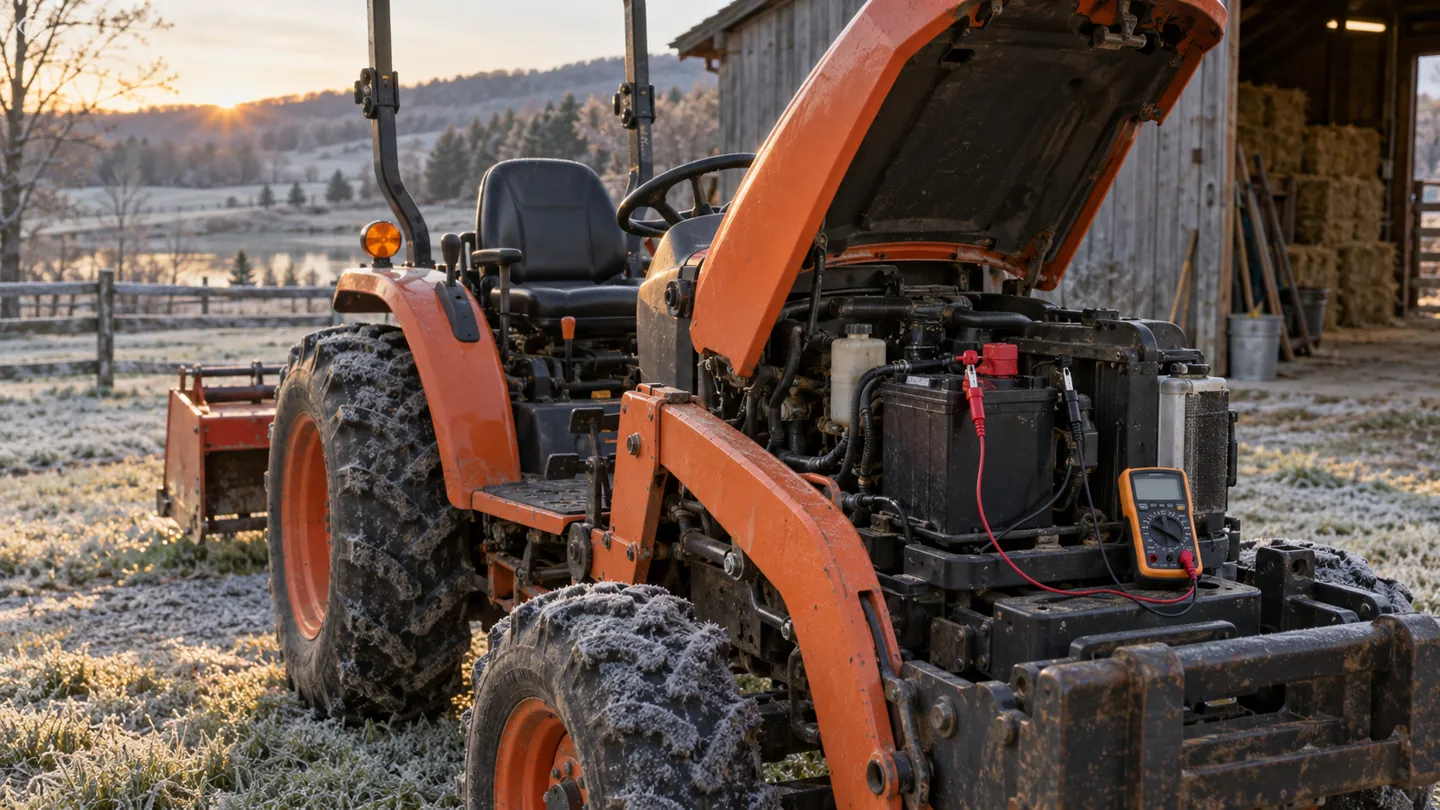
Let the tractor sit a few hours with the key off. Read across the posts with a multimeter set to DC volts. The Kubota BX manual gives this chart.
| Resting voltage | State of charge (Kubota chart) | What to do |
|---|---|---|
| 12.6 volts | 100 percent | Battery is charged. Move on to the cranking test and cables. |
| 12.4 volts | 75 percent | Usable, and the minimum for a fair cranking test. |
| 12.2 volts | 50 percent | Charge it now. It may not crank a cold engine. |
| 12.0 volts | 25 percent | Charge, then load test. |
| 11.8 volts | 0 percent | Fully discharged, possibly damaged. |
A good resting reading does not prove a good battery. A tired battery can show 12.6 volts and collapse the moment the starter pulls on it.
The AstroAI true RMS auto ranging multimeter covers this test and the resistance checks later in the guide. Any meter that reads DC volts and ohms will do.
Voltage while cranking
Have a helper crank while you watch the meter. Bosch’s starting system test, the one starter shops follow, wants at least 9.6 volts at the solenoid while cranking. It defers to the engine maker’s figure if the manual lists one.
The same test wants the battery at 12.4 volts or better before you trust the result.
Kubota and Deere operator manuals give no cranking figure, so treat 9.6 as the floor rather than a target. A healthy compact diesel usually holds well above it. If the reading dives below it, charge the battery fully and test again.
If it still collapses, the battery needs a load test. A hand held tester like the TOPDON BT100 battery tester does that in the shed and reads cranking voltage too. Skip it if a parts store will load test for free.
Loose or corroded grounds and cables
If the battery passes but the engine still cranks slowly or clicks, look at the path to the starter. Owners repeatedly find a bad ground between the battery and the engine block. A corroded clamp that looks fine from above is the other usual find.
The 1025R troubleshooting chart agrees. It lists loose or corroded connections ahead of a low battery for a slow starter and for a dead one.
- Disconnect the negative cable first, then the positive.
- Clean both posts and both clamps to bright metal with a wire brush.
- Follow the negative cable to its bolt on the frame or engine. Clean that contact too.
- Check that the starter feed cable and the small solenoid wire are tight.
- Reconnect the positive first, then the negative, and try again.
Bosch adds a quick confirmation. Put the meter between the starter case and the battery negative post while cranking. More than 0.1 volt means the ground cable or its connection is the problem.
Replace a corroded cable end with a whole new cable. A clamp on end is a temporary fix at best.
The starter solenoid
Strong battery, clean cables and still one click? Suspect the solenoid or the starter, and do not keep cranking against it. The BX limit is 30 seconds continuous, the L3301 limit is 10 seconds in cold, and the 1025R limit is 20 seconds with a two minute rest.
Past those limits you are cooking the starter.
For a tractor that sits between jobs, a maintainer is cheaper than a battery. The 1025R storage procedure is to remove the battery, store it cool and dry, and recharge it every 90 days.
The NOCO GENIUS5 battery maintainer does that on its own. It also handles the 6 volt batteries in many vintage tractors.
Glow plugs and intake heaters: how long to hold, how to test
Glow plugs or an intake air heater warm the cylinder or the intake air so cold diesel will ignite. When they fail, the engine cranks normally but will not fire in the cold.
Kubota compacts use glow plugs. The Deere 1025R has glow plugs plus an optional air heater, and its manual says they also run during cranking.
How long to hold the key
Times differ by model and temperature, so follow your manual. A Kubota BX wants the key at preheat for 2 to 3 seconds above 32 degrees F. It wants about 5 seconds from 23 to 32, and about 10 seconds from 5 to 23.
On the L3301 and L3901 the glow plug light comes on when the coolant is cold. It goes out by itself when preheat ends. Below 23 degrees F, the manual says to hold the glow position for 10 seconds.
The 1025R is simpler: turn the key to on for 5 to 10 seconds to activate the glow plugs. The glow plug icon lights while they heat. Below 0 degrees F the manual recommends the optional block heater.
If the engine does not catch within the starter limit, turn the key off for 30 seconds. Then run the preheat again. Owners commonly cycle the plugs two or three times in deep cold, and nothing in either manual forbids that.
Symptoms of a failed glow plug or heater
- It starts fine when warm but cranks and cranks when cold.
- It fires, then runs rough and clouds white smoke for a minute or two.
- The glow plug light never comes on in the cold, or never goes off.
- The preheat fuse or slow blow fuse is open.
One bad plug out of three may still let the tractor start on a mild day. Two bad plugs usually will not.
The L3301 manual lists a preheat fault as a cause of hard starting. Its fix is to check the slow blow fuse first.
How to test glow plugs
- Check the preheat fuse or slow blow fuse and replace it if it is blown.
- With the key at preheat, read voltage at the glow plug bus bar. You should see close to battery voltage.
- Turn the key off and disconnect the bus bar from the plugs.
- Set the meter to ohms. Touch one probe to a plug terminal and the other to bare engine metal.
- A very low reading means the plug is intact. An open circuit means it has failed.
The exact resistance is a workshop manual number, and the operator’s manuals do not print it. Owners quote everything from about 1.5 ohms to under 10 depending on the engine. Compare plugs to each other and to your workshop manual, not to a forum figure.
A plug that reads open is bad. So is one that reads far higher than its neighbors.
Fuel problems: empty tank, air, clogged filter, water and gel
If the engine cranks fast and preheat works, fuel is next. Air in the system is the usual cause on a tractor that sat or ran dry. Check the tank, the shutoff, the filter, then bleed.
Empty tank, shutoff valve or solenoid
Look in the tank, not just at the gauge. A low fuel light gives little warning on some models. A tank that ran empty must be bled before the engine will start.
Many tractors have a manual fuel shutoff valve. The L series and the 1025R manuals both list opening it as the first step of starting. Others use an electric shutoff solenoid that clicks when you turn the key on.
Listen for that click. No click can mean a solenoid or fuse problem rather than a battery problem.
Air in the fuel system and how to bleed it
Kubota lists four reasons to bleed: removed filter or lines, a dry tank, a drained separator, or long storage. Procedures differ, so use the one in your manual. You will meet one of three patterns.
Electric lift pump, no bleeder. On the BX, fill the tank and turn the key on for about 30 seconds. Then start and run it for 30 seconds.
The 1025R system is self bleeding too. Its manual says to hold the key on for 10 to 15 seconds after a filter change.
Bleeder plug on the filter. On the L3301 and L3901, open the shutoff valve. Loosen the air vent plug on the filter about 2 turns.
Turn the key on for about a minute. Tighten the plug, set the throttle to minimum and crank.
Keep each crank to 10 seconds or less with 30 seconds between. Once it fires, raise the rpm to clear the last air.
Common rail Tier 4 engines. Owners warn not to loosen injector lines at the pump on these. Use the bleeder on the filter housing and let the lift pump do the work.
The bleed itself tells you two things. If fuel only trickles from the bleeder, something is restricting flow between tank and pump. A clogged filter or a weak lift pump is the usual cause.
If you keep finding air, you have a leak. The classic sign is a tractor that starts, runs half a minute and dies after sitting a day. The leak is usually a loose fitting on the suction side.
Snug every fitting between tank and pump. For the filter change itself, see the fuel section of our Kubota BX maintenance guide.
Clogged filter and water in the fuel
A clogged filter or water in the tank can starve the engine with a full tank. The manuals list no fuel flow, air and water as the top causes of a hard start. The fix is the same each time: drain the water separator, replace the filter, tighten the couplers and bleed.
If your tractor has a clear separator bowl, look at it. Water sits at the bottom. Purdue’s winter advice to keep at least half a tank also limits condensation.
Gelled diesel
Untreated diesel turns waxy in the cold and plugs the filter. The tractor cranks without firing, or starts and dies. Blends and gel points vary, so treat any hard cold snap as a risk.
Purdue recommends winter grade number 1 diesel, an additive and spare filters on hand. If you suspect gel, warm the tractor and the fuel in a heated shed and replace the filter.
Anti gel only works when it is in the fuel before the cold arrives. Power Service Diesel Fuel Supplement with Cetane Boost is the white bottle most owners keep on the shelf for this.
Kubota also warns that biodiesel blends clog filters in cold weather. Ask if your supplier sells B20.
Cold weather: block heater, anti gel and the ether question
In deep cold a diesel tractor needs a block heater, winter fuel and a strong battery. It never needs ether. Cold thickens the oil, cuts the battery’s output and makes diesel harder to light, all at once.
Block heaters
A plug in block heater warms the engine overnight and is the most reliable cold start aid you can add. Purdue’s winter tractor guidance calls it critical, with plug in time depending on age, make and model. The optional L series heater is meant for below minus 4 degrees F; the 1025R heater is recommended below 0 degrees F.
If your tractor has no factory heater, a magnetic pan heater is the simple option.
The Zerostart 200W magnetic block and pan heater sticks to a flat steel surface and plugs into a standard outlet. Check for a flat spot on your oil pan first. Skip it if you already have a coolant heater.
A heater warms the engine, not the fuel. It does nothing for diesel that has already gelled in the tank.
Why ether is risky on glow plug and intake heater engines
Ether can ignite from the heat of a glow plug or an intake heater and damage the engine. Deere’s 1025R manual says engine damage occurs if ether or starter fluid is used. The reason is that the plugs and heater are live during cranking.
Kubota’s BX and L manuals simply say not to use starting fluid or ether. Some engines do have an ether port, and the 1025R manual mentions one as an option. It still carries the same warning: never on an engine with glow plugs or an air intake heater.
If you are not sure what your engine has, treat it as if it has both.
What to do instead: charge the battery, run the preheat cycle twice, plug in the heater and crank in bursts. Then let the engine and hydraulics warm before you load them.
Air intake blockage and rodent nests
A blocked air intake keeps a diesel from firing even though it cranks fine. After storage, the blockage is almost always a nest. Owners report nests beside the battery, in the engine bay and inside the air cleaner housing.
Pull the air cleaner cover and the element. Shine a flashlight into the housing and the hose behind it. Look for shredded material, seeds and droppings.
Never run the engine without the element, so reinstall a clean one before you start. Check the wiring while you are in there. Chewed insulation near the battery, starter or harness can cause a no crank that is not a battery problem.
Some owners store with the hood raised to make the engine bay less inviting.
Tier 4 tractors: DPF, sensor and ECU faults
On a Tier 4 tractor an ECU or sensor fault can block starting or cut power. Those faults need a dealer scan tool.
The diesel particulate filter (DPF) sits in the exhaust and burns off soot in a cycle called regeneration. Most hard starting on these tractors is still battery or fuel trouble, so do those checks first.
Kubota’s L3301 and L3901 manual describes four PM warning levels. At level 3 a buzzer sounds, output drops to 50 percent and you stop work for a parked regeneration.
At level 4 the engine warning stays on. The manual says to park, shut down and call a dealer.
Running on at level 4 damages the DPF and the engine. The same manual’s error code table lists faults where the engine cannot start at all. Those include certain ECU and meter compatibility problems, plus starter relay and engine shutoff relay faults.
All of them are dealer jobs. Owners who have been through a DPF lockout say the same thing: only the dealer’s tool could force a regeneration or reset the ECU. Write down any code, photograph the display and call.
Do not try to defeat the emissions system.
After running out of fuel, and after sitting for months
A tractor that ran dry needs a bleed and clean fuel. A tractor that sat for months also needs a battery, intake and oil check. Treat the two cases separately.
After running out of fuel
- Fill the tank with clean diesel.
- Bleed the system using the procedure in your manual. Hold the key on if your tractor self bleeds.
- Replace the fuel filter if the tractor was already starving before it quit.
- Crank in short bursts with rest between them.
Owners report that some models are stubborn after running dry. The only real cure is never letting them run out.
Do not pour fuel into the filter housing to prefill it. That bypasses the filter and can carry dirt to the pump.
After sitting for months
- Charge the battery and test it, resting and cranking.
- Check the oil level and look for water in the oil.
- Inspect the air intake and wiring for rodent damage.
- Drain the water separator and replace the fuel filter if it is due.
- Bleed the fuel system, since Kubota lists long storage as a reason.
- Preheat and crank as the manual says.
If the fuel looks cloudy or has water at the bottom of the tank, drain it. Do not hope the filter copes. The 1025R return from storage list is the same idea, ending with 5 minutes of running with nothing engaged.
A maintainer, a treated full tank and a raised hood prevent most of this next winter.
Symptom to cause to check table
This table maps what you see to the most likely cause and the first thing to check.
| Symptom | Likely cause | First check |
|---|---|---|
| Cranks fast, no fire, cold morning | Weak or failed glow plugs or intake heater | Preheat light, preheat fuse, plug resistance |
| Cranks fast, no fire, warm weather | Air or no fuel | Tank level, shutoff valve, bleed the system |
| Cranks slowly | Weak battery, dirty cables, thick oil | Resting voltage, then voltage while cranking |
| One loud click | Bad cable end, bad ground, stuck solenoid | Clean and tighten every battery cable |
| Rapid clicking | Battery too low to hold the solenoid | Charge and load test the battery |
| No click, dash lights on | Safety switch open, solenoid wire off, fuse | PTO, pedal, clutch, range lever, starting fuse |
| No click, no dash lights | Dead battery, loose terminal, main fuse | Terminals, ground cable, main fuse |
| Starts, runs briefly, dies | Air leak, clogged filter, gelled fuel | Fuel fittings, filter, water separator |
| Long crank after sitting | Fuel drained back or air | Bleed the system, check fittings |
| Cranks, no fire, old fuel | Gelled or contaminated fuel | Replace filter, drain water, treat fuel |
| Cranks, no fire after storage | Rodent nest in the intake | Air cleaner housing and hose |
| Tier 4 warning light or error code | DPF, sensor or ECU fault | Note the code and call the dealer |
When to stop and call the dealer
Call a dealer when the basics check out, or when the tractor shows a fault you cannot test yourself. Stopping early saves money. Repeated cranking can cook a starter or wash fuel into the cylinders.
- The battery passes both tests, the cables are clean and the starter still only clicks.
- The engine cranks well, preheat works and bleeding does not get it to fire.
- A steady engine warning light, buzzer or error code shows on a Tier 4 tractor.
- A safety switch fails its test, or the engine cranks when it should not.
- You smell fuel or see a leak you cannot find.
- The engine makes a metallic knock, or stops dead mid crank.
Have your model, serial number, hours and exact symptom ready, and say what you already checked. The maintenance and troubleshooting section and the troubleshooting category cover the next steps once it runs.
Keep a jump starter in the shed for the mornings when the battery is simply flat. The NOCO Boost GB70 has the output for a compact diesel. A jump only helps when the battery is the problem.
Purdue warns against repeated jump starts in cold weather. A frozen or gassing battery can explode.
Bottom line
When a diesel tractor won’t start, sort the symptom first. Then check the safety switches, battery, preheat, fuel and air intake in that order. Most fixes cost a few dollars and an hour.
Leave ether in the can and bleed after any fuel disruption. Call the dealer for Tier 4 warnings or a dead starter circuit. The brand pages for Kubota, John Deere and Kioti lead to more model specific guides.
Frequently asked questions
Why does my tractor click but not crank?
A single click usually points to a bad cable or ground, a weak battery, or a stuck starter solenoid. Rapid clicking means the battery is too low to hold the solenoid in. Charge the battery, clean every cable end and ground, and test again.
How long should I hold the glow plugs on a tractor?
It depends on the model and the temperature, so follow your manual. A Kubota BX wants 2 to 3 seconds above freezing and up to 10 seconds in the single digits.
A Deere 1025R wants the key on for 5 to 10 seconds. Many tractors turn the glow light off when preheat is done.
Can I use starting fluid on a diesel tractor?
Not on a tractor with glow plugs or an intake heater, which covers nearly every modern compact. Kubota’s manuals say not to use it at all, and Deere’s says engine damage occurs if you do. Use a block heater, a charged battery and a second preheat cycle instead.
Do I need to bleed the fuel system after changing the filter?
Yes, in most cases. Kubota lists a removed filter or fuel lines as a reason to bleed, along with an empty tank and long storage. On tractors with an electric lift pump, such as the BX and the 1025R, bleeding is just holding the key on briefly.
Why won’t my tractor start after sitting all winter?
When a diesel tractor won’t start after sitting, suspect a discharged battery, stale fuel or air, and a rodent nest in the intake. Charge and test the battery, check the intake and wiring, and replace the filter if it is due. Then bleed, preheat and crank as the manual says.
Can a bad safety switch stop my tractor from starting?
Yes. A PTO, drive pedal, clutch or range lever switch can hold the starter circuit open, and on some models the seat switch does too. Check each lever and pedal position first, then run the switch test from your manual.
Will a Tier 4 tractor start if the DPF is clogged?
Often it starts but runs with reduced power and a warning. Kubota’s manual says to shut down and call a dealer at its highest warning level. Some ECU and sensor faults do prevent starting, and those are dealer repairs.